SKYJO rules lab
SKYJO House Rules: Fun and Crazy Variants That Actually Work
The best SKYJO house rules solve a table problem without erasing the tension that makes Classic work. Here are precise, testable variants for faster matches, longer duels, new clearing patterns and team play—plus the combinations we would reject.
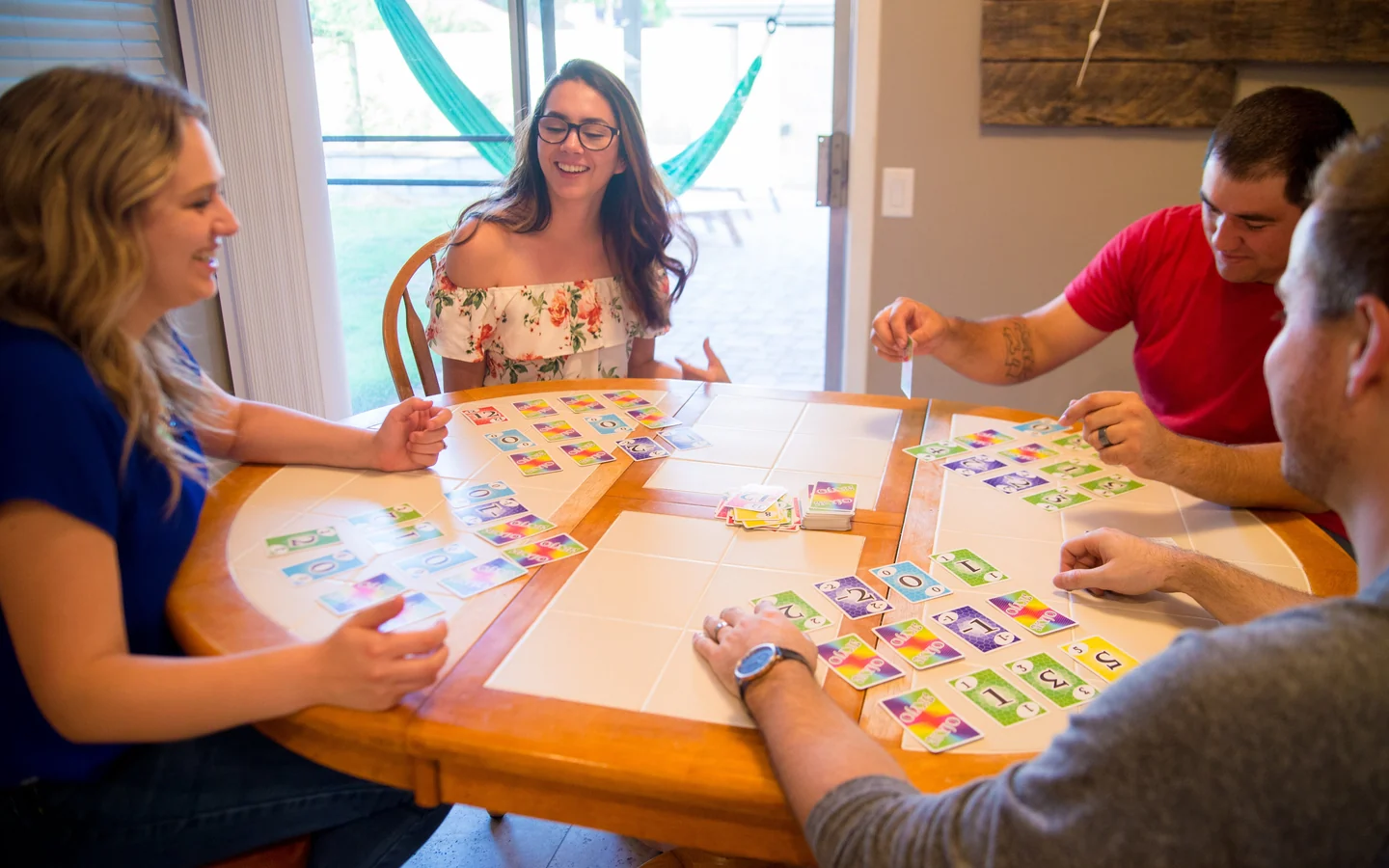
First, Separate Official SKYJO from House Rules and SKYJO Action
A house rule is an agreement your table adds to or substitutes for the published game. It can be clever, chaotic or terrible; it is never retroactively “the official rule.” That distinction matters in SKYJO because players also encounter SKYJO Action, a separate Magilano game with physical Star cards and Action cards. Saying “rows count in SKYJO” without naming the version creates exactly the kind of argument a fun variant is supposed to prevent.
| Rules layer | What it means | What belongs there | How to label it |
|---|---|---|---|
| Classic SKYJO | Published baseline for the original number-card game | 12-card 4×3 grid, vertical identical triples, finisher test, 100-point match | Official Classic |
| House rule | A voluntary change agreed by your group | Different target, extra clear pattern, team score, altered penalty | Unofficial variant |
| SKYJO Action | A separate commercial edition | Its own Star cards, Action cards and edition-specific interactions | Action only |
The Classic baseline is your control group. Players each manage twelve cards in four columns and three rows; official clearing is a vertical column of three identical revealed values. The first fully revealed grid triggers the round end sequence, and the finisher risks doubling a positive round score if another player finishes lower or equal. Scores accumulate until a completed round puts somebody at 100 or more, then the lowest total wins. If you change any of those pressure points, you are running a variant.
That is not a criticism. Great house rules solve a real table problem: two-player matches feel short, eight-player nights drag, children dislike a brutal double, or veterans want another spatial puzzle. The problem begins when a group changes three systems and still compares its scores with a standard game. A horizontal-clear rule, a 50-point target and no finisher penalty all push the pace in the same direction; together they can turn a measured round into a sprint.
Write one sentence before the deal
“Tonight we use Classic SKYJO, except identical horizontal rows may clear once per player per round.” That sentence names the base game, the changed rule and its limiter. Put it at the top of the score sheet so nobody discovers the experiment after building a grid under different assumptions.
If what your group really wants is printed powers, stealing, wild cards and high interaction, use the SKYJO Action guide and play the designed edition. This article instead treats the Classic deck as a laboratory: every proposal that follows is explicitly unofficial, reversible and judged by what it does to turns, scores and player decisions.
How to Test a House Rule Without Breaking the Game
Treat a house rule like a small playtest, not a family constitution. Begin with a problem you can recognize: “our six-player match runs past an hour,” “the children stop enjoying the round after a double,” or “experienced players want another pattern to watch.” Then change one lever. If you lower the target, add horizontal clears and remove the finisher penalty at the same time, a faster game tells you nothing about which change worked.
1 · Problem
Describe the table problem in one sentence and include player count.
2 · One change
Alter one target, pattern, penalty or social rule—not the whole system.
3 · Trial
Play two or three matches at the same player count before drawing a conclusion.
4 · Record
Track minutes, rounds, doubles, final spread and one sentence of feedback.
5 · Verdict
Keep, revise or retire the rule. “Crazy but funny once” is a valid verdict.
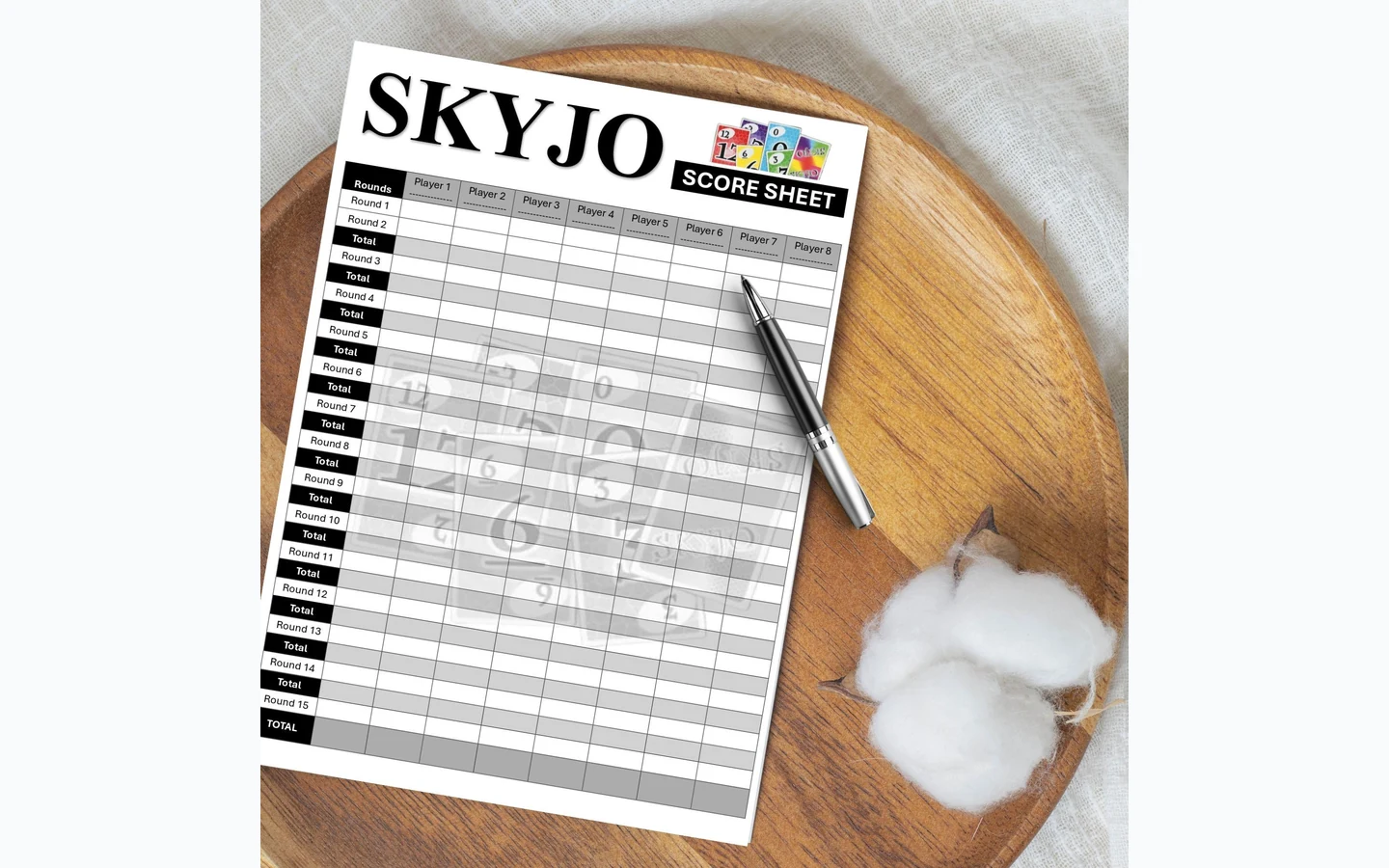
Five numbers worth keeping
Write the total match time, number of rounds, number of finisher doubles, winner-to-last-place score gap and number of special clears created by the variant. These are not laboratory statistics; they are useful table signals. If a 75-point match takes four rounds instead of six and everybody still gets meaningful endgame decisions, the speed rule probably solved the problem. If two of three tests end immediately after one player’s first doubled score, the target is too brittle for that group.
Pair the numbers with one short question: “What decision became more interesting?” A horizontal-run rule may create satisfying planning, but if everybody merely grabs any public card that completes a new clear, it has increased spectacle while reducing judgment. A no-penalty rule may feel kinder, but if players flip aggressively with no need to estimate opponents’ boards, it has removed one of Classic SKYJO’s sharpest risk decisions.
Retire the rule when it fails repeatedly
Stop after the third test if the same failure keeps appearing: one player snowballs beyond recovery, most rounds end before grids develop, the variant needs repeated explanation, or the result feels decided by the opening deal. A house rule does not earn permanence merely because someone invented it.
Use the official Classic SKYJO rules as the control between experiments. Play one standard match occasionally. Without that reset, groups forget the original tension and begin balancing the latest house rule against the previous house rule instead of against the game they meant to improve.
Pace Variants: Speed, Marathon, and Fixed-Round SKYJO
Changing the match end is the cleanest house-rule experiment because every turn inside a round stays familiar. Official Classic SKYJO checks for 100 or more after a completed round. A lower target gives a large table an earlier exit; a higher target lets a duel develop across more deals; a fixed-round format gives an organizer predictable structure. The tradeoff is that every target changes the weight of one lucky grid or painful double.
| Variant | Exact change | Best fit | What changes | Failure warning |
|---|---|---|---|---|
| Speed 75 | Trigger at 75+ | 5–8 players | Shorter match with some comeback room | Still volatile after a large double |
| Extreme 50 | Trigger at 50+ | One-off lunch game | Every opening round matters enormously | A single 26 doubled to 52 can end it |
| Marathon 150 | Trigger at 150+ | 2–3 experienced players | More recovery and long-game adaptation | Drags badly with a full table |
| Five rounds | Ignore target; stop after round 5 | Scheduled events | Predictable number of deals | Known final round changes risk timing |
Why 75 usually beats 50 for a short game
Fifty sounds neat because it halves the official target, but SKYJO scoring is not a smooth meter. Suppose the finisher’s raw grid is 26 and another player scores 20. The finisher records 52 and can trigger the whole match in the first round. That is funny once; it is a poor default if your group still wants the later score-management phase. A 75-point line keeps the time box tighter while leaving at least some room for a bad opening to be answered.
Marathon is a duel tool, not a party cure
At two players, turns return quickly and visible information is easier to track. Raising the target to 150 gives both players more chances to adjust how aggressively they finish. At seven players, the same extra rounds multiply downtime, shuffling and scoring. A rule can be balanced numerically and still fail socially because the people between turns stop watching.
Fixed-round SKYJO solves a different problem: scheduling. Everyone knows there will be exactly five completed deals. That helps a club or family rotation, but it creates a declared final round. A leader can play conservatively while a trailing player hunts a risky column because no future round exists to repair the result. That endgame is not worse—just different from the uncertain official threshold.
Do not stack speed levers on trial one
Keep the normal finisher penalty and normal vertical-clear rule while testing a lower target. Combining 50 points, horizontal clears and no doubling attacks duration three times and almost guarantees a sprint. If Speed 75 is still too long after several matches, adjust one further lever later.
For a duel-specific look at opening information and grid-size experiments, continue with the two-player SKYJO guide. For this pace test, keep everything except the stopping condition official so the result stays readable.
Pattern Variants: Rows, Runs, and Extra Clears
Pattern rules feel like the most natural way to make Classic SKYJO “crazier” because the 4×3 grid already invites visual puzzles. The official Classic clear remains narrow: three identical revealed cards in one vertical column. A horizontal pattern is therefore an unofficial Classic house rule, even though SKYJO Action has its own published row system. Borrowing the word “row” does not import Action’s complete design or components.
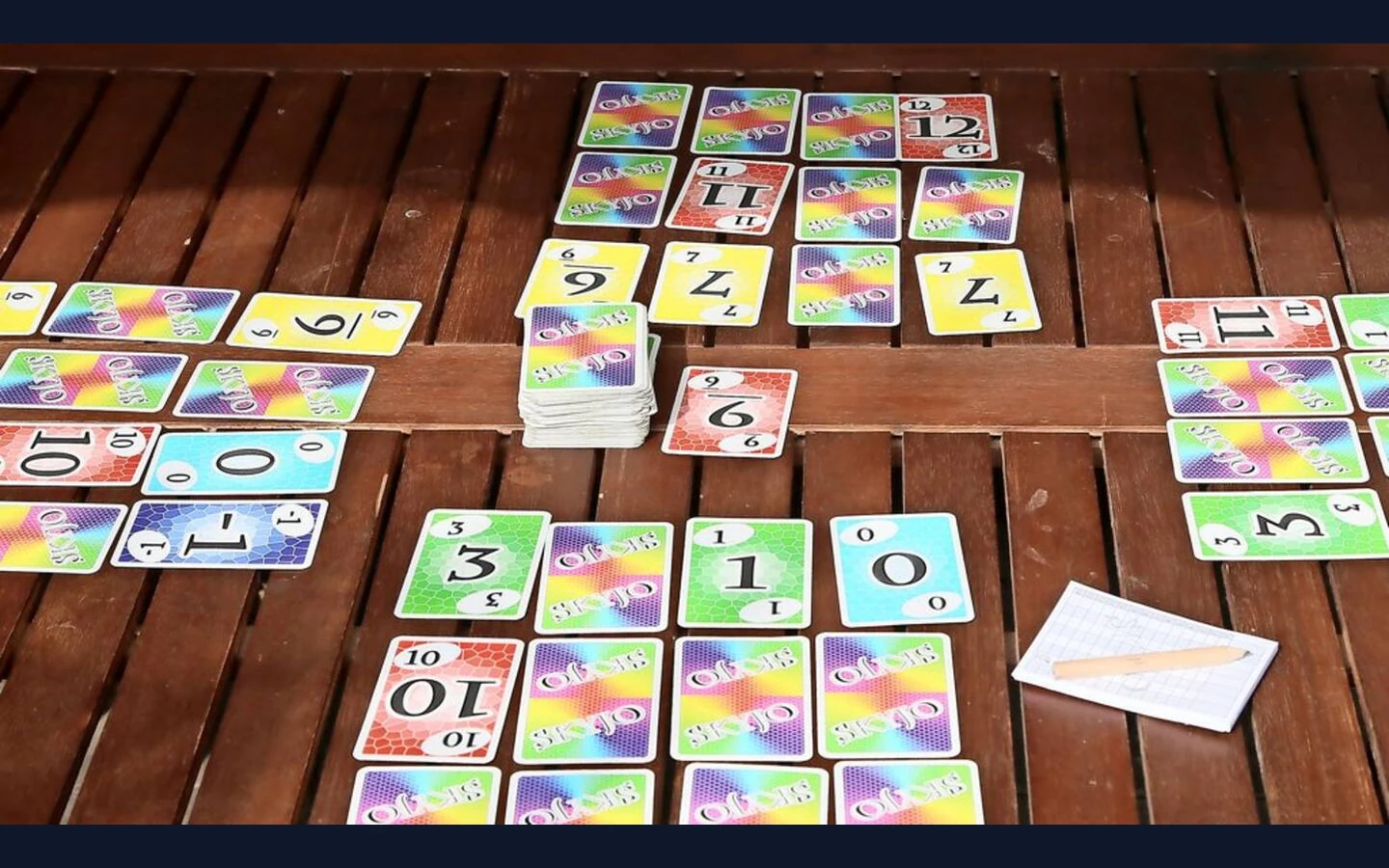
Variant A · Identical full row
Clear four identical revealed cards
A horizontal row qualifies only when all four original positions remain and all four show the same value. Four 9s remove 36 points. Because that swing can rival or exceed an official column clear, limit each player to one extra row clear per round during early tests.
Variant B · Color-band run
Clear 1–4, 5–8, or 9–12
A full row containing every value in one four-number band may clear in any order. This adapts a run idea discussed by players, but the exact full-row version here is an editorial house rule. It rewards planning across different values rather than collecting four copies.
The score swing is not equal
The low band 1+2+3+4 removes 10 points; the high band 9+10+11+12 removes 42. That asymmetry is interesting because a dangerous row can become a high-reward project, but it also means one completed red run may decide a short match. Watch whether players stop replacing visible 11s and 12s because the new jackpot is too attractive. A rule designed to add choice has failed if the optimal plan becomes “always keep the high run.”
Do not let gaps create bargain clears. If an official column has already been removed, a horizontal line may contain only three physical cards. Under this variant, that shortened line does not qualify. Requiring all four original row positions prevents a player from shrinking the grid and then claiming easier two- or three-card patterns. It also gives everybody a visual test that can be resolved immediately.
Use one pattern and one limiter
Choose identical rows or color-band runs for the first session, never both. Keep official vertical triples active, and allow at most one house-rule row clear per player per round. This matters most with six to eight players: more simultaneous grids create more total opportunities for someone to hit the new pattern, and every extra clear removes cards that would otherwise extend the round.
Likely imbalance signal
If most players finish with fewer than six cards still in their grids, or the house-rule clear appears multiple times every round, the pattern is too generous. Keep the full-row requirement, reduce the variant to once per match, or retire it. Do not solve excessive clearing by inventing a second scoring bonus.
The Classic 3-in-a-row guide covers official timing and negative-card edge cases. Use it as the unchanged column reference while the horizontal experiment gets its own clearly written line.
Finisher and Penalty Variants: Soften the Double Without Removing the Drama
The official Classic rule creates the sharpest decision in SKYJO. After you reveal your last card, everyone else gets one final turn. If your round score is not strictly lower than every opponent’s score, your positive total doubles. A tie fails the test. A raw 26 becomes 52, while zero or a negative score is not doubled. That positive-only boundary is official; every alternative below is an unofficial house rule.
| Rule | Exact scoring | What it changes | Verdict |
|---|---|---|---|
| Official Classic | Double a failed finisher’s positive raw score. | High information risk; ending is never automatic. | Best baseline |
| No penalty | Everyone records the cards left in the grid. | Faster rounds, more early finishes, less bluffing. | Teaching only |
| Capped extra penalty | Raw score + the smaller of raw score or 20. | Preserves danger but limits one-round blowouts. | Recommended test |
| Successful-finish bonus | Subtract 5 only if the finisher is strictly lowest. | Rewards racing and shortens cautious endgames. | High energy |
| Double a negative | For example, change −6 to −12 after a successful finish. | Compounds an already excellent round. | Reject |
The cap is the cleanest compromise
Under this guide’s capped formula, a failed finisher at 12 still records 24, because the normal double adds only 12. At 28, the player records 48 rather than 56: the extra punishment stops at 20. The decision to finish remains dangerous, but one unlucky reveal is less likely to erase an entire evening. It is especially useful with six to eight players, where several opponents receive a last chance to undercut the finisher.
No penalty is gentler but strategically expensive. In a two-player game, the finisher survives only one opponent’s final turn, so removing the downside can make both players race to uncover the grid. Use it for a first teaching round, then restore the official rule. Never combine no penalty with a −5 finish bonus: that deletes the downside and adds upside to the same action.
Why we would not double negative scores
Players do propose this idea, and at least one third-party scorekeeper lets groups configure it. That does not make it a Magilano rule. Turning −6 into −12 rewards the player who already assembled the round’s strongest grid and makes a comeback harder. In a 50- or 75-point match, the swing is even more influential. If your group wants a louder finish, a fixed −5 bonus is visible and bounded; negative doubling is not.
Editor’s pick
Keep official scoring for two to five experienced players. Test the capped-extra-20 formula with six to eight or with mixed-skill families. Write the formula on the score sheet before the deal, because “we cap the double” is too vague when the round ends.
Team and Social Variants for 4–8 Players
Classic SKYJO officially gives every player a separate grid and an individual score; it has no printed partnership mode. Teams are therefore an unofficial house-rule layer. The useful question is not merely “Can we add teams?” but whether teams reduce downtime or just let the loudest player make twice as many decisions.
Mode A · Score-only pairs
Keep one grid per person
- 1. Make fixed pairs and seat partners apart so allied turns do not occur back to back.
- 2. Everybody plays a normal 4×3 grid. Resolve the official finisher test against all individual players.
- 3. Add partners’ scores after each round. After exactly four rounds, the lowest team total wins.
This preserves personal control and the full discard-pile puzzle. It does not solve waiting time: six or eight grids still mean six or eight turns around the table.
Mode B · Silent relay
Share one grid per pair
- 1. Two teammates share one ordinary 4×3 grid and one cumulative score.
- 2. Partners alternate as active pilot each time their team’s turn returns.
- 3. The inactive partner stays silent from the draw through the completed discard. Play to the ordinary 100-point ending.
Four, six or eight people become two, three or four active grids. The round moves more like a small-table game, while each handoff creates a fun “what was my partner planning?” puzzle.
Which mode fits your player count?
| People | Best test | Reason | Main risk |
|---|---|---|---|
| 4 | Either mode | Downtime is already manageable. | Teams may overpower individual grudges and table talk. |
| 6 | Silent relay | Three grids retain discard interaction with shorter loops. | Partners can feel disconnected from every other turn. |
| 8 | Silent relay | Four grids behave closer to a normal four-player table. | Strong players may start coaching constantly. |
Control quarterbacking with one visible token
If complete silence feels flat, give each team one coach token per round. Before the active player draws, the team may spend it for one short suggestion based only on public information. The token makes advice a scarce choice rather than a running commentary. Do not use it when an expert adult is already directing younger players; silent relay gives every participant more genuine agency.
Do not mix two-person and three-person teams. Extra partners receive fewer turns per person and create different communication resources, so neither combined totals nor a shared grid stays comparable. With an odd number, individual Classic is cleaner than inventing compensation points. The site’s SKYJO player-count guide explains why the official 3–5-player range usually gives the best balance of interaction and waiting.
Stop the experiment if…
one partner makes the draw, replacement and finishing calls even when it is not their turn, or players cannot remember who pilots next. Team SKYJO should distribute decisions. If it concentrates them, return to individual grids and compare scores socially without declaring a team winner.
Is There a “SKYJO App Crazy Rules” Mode?
Short answer: we could not verify an official Magilano feature with that name.
Current search results for “SKYJO app crazy rules” blend third-party scorekeepers, unofficial playable versions and SKYJO Action. A mode called “Perks” in one unofficial implementation is that developer’s feature; it is not a universal app setting, not Classic SKYJO, and not the separate physical SKYJO Action game.
Third-party tools do offer useful switches. Current store listings include examples with custom point targets, fixed-round games, doubling on/off, editable scores and even a “land exactly on the limit” option. ScoreCrew documents a selectable negative-doubling setting. Those controls show how differently developers interpret optional play. They do not turn the options into official rules, and an update can change them after this article is published.
Check the scorer before your first deal
- Identity: Who developed it, and does the listing claim only scorekeeping or full gameplay?
- Endpoint: Can you choose 75, 100 or 150 points, or a fixed number of rounds?
- Penalty: Can automatic finisher doubling be disabled or can the final score be edited?
- Recovery: Can you correct a mistaken round without restarting the match?
- Capacity: Does it accept your number of players or teams?
- Freshness: Recheck platform, version, privacy and price on the day you install.
Let the app total scores, not define your table
For a capped penalty, calculate the adjusted result first and enter that number manually. For row clears, relay teams or a coach token, write the rule on paper because a scorer cannot police table behavior. If automation forces an unwanted penalty, disable it or use an editable round; if neither is possible, a paper score sheet is better than changing the agreed variant to please the software.
Our SKYJO app and mobile guide separates scorekeepers from playable copies, while the online multiplayer guide covers remote-play tradeoffs. Neither a search-result label nor one community post should override the rule sheet your group agreed to use.
Three Balanced SKYJO Variant Packs to Try Tonight
These are editorial starting configurations, not official Magilano modes and not mathematically certified formats. “Balanced” means each pack has a clear purpose, a bounded change and a rollback condition. Play every individual ingredient alone before combining it; Tactical Duel is the only preset below that deliberately pairs two previously tested changes.
Quick Lunch
3–5 playersRule card: end the match after a round in which anyone reaches 75 cumulative points. Keep the official 4×3 grid, vertical clear, final turns and finisher penalty unchanged.
PaceUsually fewer rounds; each turn still feels like Classic.
Risk and scoreA bad double consumes more of the 75-point budget, so reckless finishing hurts more.
RollbackIf round one uses most of your time, score it and stop. Do not pile on no-penalty scoring to force another round.
Tactical Duel
2 experienced playersRule card: play to 150 points. Once per player per match, a complete horizontal row of four identical revealed values may clear; official vertical columns remain active. Test 150 and the row rule separately before using this pack.
PaceThe match gains comeback rounds, while the rare extra clear can shorten one round.
Risk and scoreFour 9s remove 36, but holding a visible high card while hunting copies can punish the project.
RollbackIf either player keeps 10–12 for more than two turns because the jackpot dominates, retire row clearing and finish to 150 under Classic rules.
Party Relay
4, 6 or 8 playersRule card: form equal pairs, give each pair one grid, and alternate its active pilot. Stay silent from draw through discard. Use the official scoring and 100-point endpoint, with no coach token.
PaceTwo to four grids make the turn loop shorter than six or eight individual grids.
Risk and scoreThe score is familiar; the new risk is inheriting a partner’s unfinished plan.
RollbackIf pilot order is missed twice in a round or one partner coaches constantly, return to individual Classic for the next round.
Run a two-minute debrief
Ask four questions before packing up: Did the rule solve the original problem? Could someone exploit it repeatedly? Did the final scores spread farther apart? Did choices become more varied or more automatic? Mark the result keep, change or retire and write the next version before the next deal. A memorable house rule earns its place by creating decisions, not merely noise.

Loading comments...