How Many Players Can Play SKYJO?
The complete guide to SKYJO player counts. Learn the official player range, discover which player counts work best, explore 2-player strategies, large group dynamics, solo variants, and house rules for 9+ players.
Quick Answer
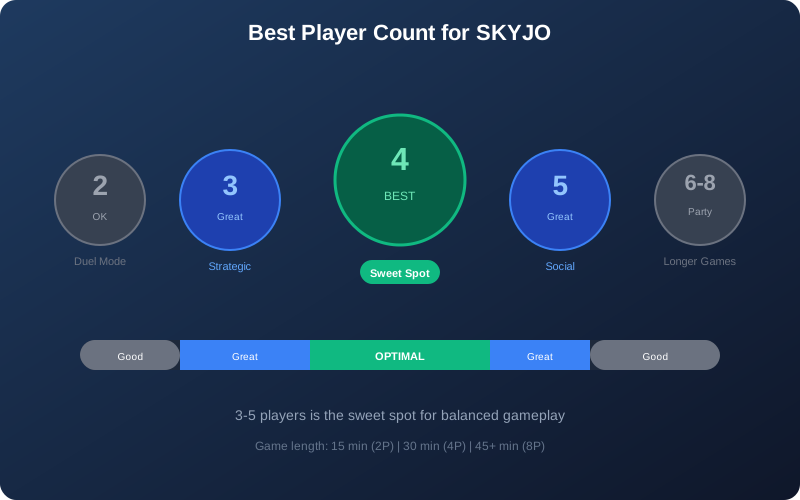
SKYJO officially supports 2 to 8 players. The game plays best with 3-5 players, offering the ideal balance of interaction, downtime, and strategic depth. Two-player games work well but feel more tactical, while 6-8 player games create a party atmosphere with longer wait times between turns.
SKYJO Player Count at a Glance
| Feature | Details |
|---|---|
| Official Player Range | 2-8 players |
| Recommended Player Count | 3-5 players (sweet spot) |
| Minimum Players | 2 players (works well, more tactical) |
| Maximum Players | 8 players (party game feel) |
| Solo Variant | Unofficial variants available |
| 9+ Players | Possible with house rules or two decks |
| Game Duration (per player) | Adds ~3-5 minutes per additional player |
| Deck Size | 150 cards (enough for 8 players) |
Table of Contents
Official Player Count: 2-8 Players
According to Magilano, the publisher of SKYJO, the game officially supports 2 to 8 players. This range is printed on the box and represents the player counts that have been playtested and balanced by the game designers.
The 150-card deck provides enough cards to accommodate up to 8 players comfortably. Here is how the math works:
Card Distribution Breakdown
- Each player receives: 12 cards (arranged in a 4x3 grid)
- Draw pile: Remaining cards after dealing
- Discard pile: Starts with 1 card
- For 8 players: 96 cards dealt + 54 cards remaining = 150 total
The deck size is the primary limiting factor. While you could theoretically play with 9 players (108 cards dealt), you would have only 42 cards left in the draw pile, which might not be enough to complete a full round comfortably.
SKYJO's design scales remarkably well across its entire player range. Unlike many games that feel stretched at their maximum player count, SKYJO maintains its core gameplay loop regardless of whether you have 2 or 8 players at the table.
What Is the Best Player Count for SKYJO?
While SKYJO works at all player counts from 2-8, the sweet spot is 3-5 players. This range offers the best balance of several key factors:
Minimal Downtime
With 3-5 players, turns move quickly enough that you stay engaged. You are never waiting more than 1-2 minutes for your next turn, keeping the game flowing smoothly.
Strategic Interaction
Enough players to create meaningful competition and unpredictability in the discard pile, but not so many that you lose track of what others are doing.
Ideal Game Length
Games typically last 20-30 minutes with 3-5 players, which is perfect for a quick, satisfying experience without overstaying its welcome.
Balanced Competition
With 3-5 players, the game maintains tension throughout. The discard pile changes frequently enough to matter, but not so chaotically that strategy becomes impossible.
Community consensus on BoardGameGeek and Reddit strongly favors 4 players as the optimal count. At 4 players, SKYJO hits its stride: turns are quick, everyone stays engaged, and the strategic depth shines through without analysis paralysis.
Playing SKYJO with 2 Players
SKYJO works surprisingly well as a 2-player game, though the experience differs significantly from larger player counts. If you are looking for a quick, tactical card game for two, SKYJO delivers.
Advantages of 2-Player SKYJO
- ✓ Zero downtime: Turns alternate rapidly, keeping both players constantly engaged
- ✓ More tactical: You can track your opponent's visible cards and make informed decisions
- ✓ Faster games: Rounds typically finish in 10-15 minutes
- ✓ Discard pile control: You have more influence over what cards appear in the discard pile
- ✓ Easy to teach: Perfect for introducing new players without overwhelming them
Disadvantages of 2-Player SKYJO
- ✗ Less chaos: The game feels more predictable and less exciting
- ✗ Reduced social interaction: Missing the party game atmosphere of larger groups
- ✗ More pressure: Every decision matters more when there is only one opponent
- ✗ Less variety: The discard pile changes less frequently
2-Player Strategy Tips
Watch the discard pile closely. With only two players, you can predict when your opponent might take a discarded card. If you discard a low card, expect them to grab it.
Memorize your opponent's visible cards. Since there are only 12 cards to track, you can remember which high cards they have face-up and adjust your strategy accordingly.
End rounds strategically. In 2-player games, you have more control over when to flip your last card. Time it to maximize your advantage.
Play more conservatively. With fewer players, the game is less forgiving. Avoid risky plays that might backfire.
Verdict: SKYJO at 2 players is a solid experience, especially for couples or when you want a quick filler game. It is not the definitive way to play SKYJO, but it is far from broken. If you primarily play games with just one other person, SKYJO will serve you well.
The Sweet Spot: 3-5 Players
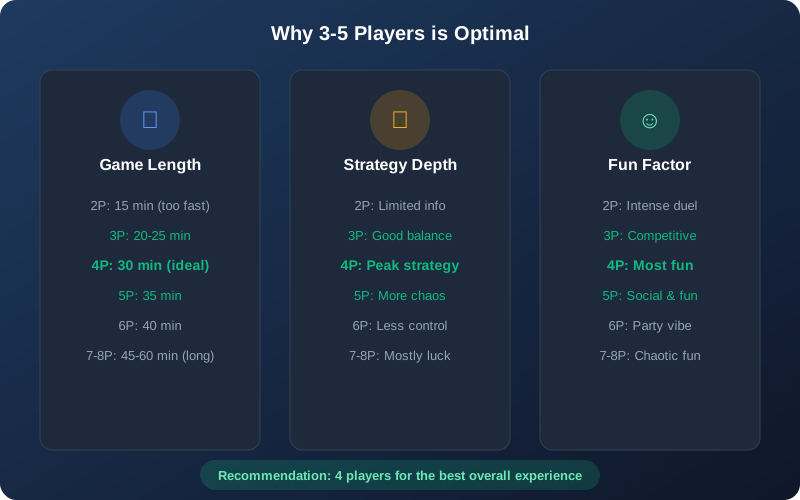
This is where SKYJO truly shines. With 3-5 players, the game achieves perfect harmony between strategy, chaos, pacing, and social interaction.
Why 3-5 Players Is Ideal
1 Perfect Pacing
Turns cycle quickly enough to maintain engagement, but not so fast that you cannot think strategically. You typically wait 30-60 seconds between turns, which is the sweet spot for maintaining focus without boredom.
2 Dynamic Discard Pile
With 3-5 players, the discard pile becomes genuinely interesting. Cards you want might appear, but they might also get snatched by someone else before your turn. This creates tension and forces you to adapt your strategy on the fly.
3 Balanced Competition
You can track what other players are doing without overwhelming yourself. You notice when someone is close to ending the round, but you cannot predict everything, which keeps the game exciting.
4 Social Interaction
Enough players for banter, reactions, and table talk, but not so many that conversations become fragmented. The game facilitates natural social interaction without forcing it.
5 Optimal Game Length
A full game (multiple rounds to 100 points) takes 20-30 minutes with 3-5 players. This is perfect for a quick game night opener or a casual lunch break game.
Player Count Breakdown
3 Players
Slightly more tactical than 4-5 players. You can track opponents more easily, but the game still has enough unpredictability to stay interesting. Great for a focused, strategic experience.
4 Players (The Gold Standard)
The most recommended player count by the community. Perfect balance of everything. If you can only play SKYJO at one player count, make it 4.
5 Players
Still excellent, though turns take slightly longer. The discard pile becomes more chaotic, which some players love and others find frustrating. Adds more party game energy.
Bottom line: If you are buying SKYJO and want to know if it will work for your group, ask yourself if you typically have 3-5 players. If yes, SKYJO is an excellent choice. This is the player count range where the game consistently delivers its best experience.
Large Groups: 6-8 Players
SKYJO can accommodate up to 8 players, and while the game still functions at this player count, the experience shifts significantly. At 6-8 players, SKYJO transforms from a strategic card game into more of a casual party game.
What Works at 6-8 Players
- + Party atmosphere: More players means more laughter, reactions, and social energy
- + Inclusive: Nobody gets left out when you have a large group
- + Unpredictable: The discard pile becomes wildly chaotic, which can be fun
- + Easy to teach: Simple rules mean you can onboard 8 people quickly
Challenges at 6-8 Players
- − Significant downtime: You might wait 3-5 minutes between turns
- − Longer games: Rounds can stretch to 15-20 minutes, full games to 45+ minutes
- − Less strategic: Too many players to track, so strategy becomes less important
- − Discard pile chaos: Cards you want rarely survive until your turn
- − Table space: Requires a large table to fit 8 player grids comfortably
Tips for Playing SKYJO with 6-8 Players
- Keep turns moving: Encourage players to make decisions quickly. Analysis paralysis kills the pacing at high player counts.
- Use a large table: Make sure everyone has enough space for their 4x3 grid plus room for the draw and discard piles.
- Play fewer rounds: Instead of playing to 100 points, consider ending at 50 or 75 to keep the game from dragging.
- Embrace the chaos: Do not try to play strategically at 8 players. Just enjoy the ride and the social experience.
- Consider splitting into two games: If you have 8 players, two simultaneous 4-player games might be more enjoyable than one 8-player game.
When to play at 6-8 players: Choose this player count when your priority is including everyone at the table rather than optimal gameplay. It works well for family gatherings, casual game nights, or when you want a light, social experience. Just know that you are sacrificing some of SKYJO's strategic depth for inclusivity.
6 vs 7 vs 8 players: There is not much difference between 6, 7, and 8 players in terms of gameplay experience. All three feel similar, with slightly longer wait times as you add more players. If you are already committing to a large group game, the jump from 6 to 8 players is not significant.
Solo SKYJO: Can You Play Alone?
SKYJO does not include official solo rules in the box. The game is designed as a multiplayer experience, and the core mechanics rely on competition and the shared discard pile. However, the SKYJO community has developed several unofficial solo variants for players who want to enjoy the game alone.
Popular Solo Variant: Beat Your Best Score
Setup: Deal yourself a standard 4x3 grid of 12 cards. Flip two cards face-up to start. Create a draw pile and discard pile as normal.
Gameplay: Play exactly as you would in a multiplayer game, but you are racing against yourself. Your goal is to minimize your score by the time you flip your last card.
Scoring: Track your score for each round and try to beat your personal best. Here is a rough scoring guide:
- Expert: 0-10 points
- Great: 11-20 points
- Good: 21-30 points
- Average: 31-40 points
- Needs improvement: 41+ points
Challenge mode: Set a target score (like 15 points) and see how many rounds it takes you to achieve it. Or play 10 rounds and calculate your average score.
Alternative Solo Variant: Dummy Opponent
Setup: Create two 4x3 grids — one for you and one for a "dummy" opponent. Flip two cards in each grid.
Your turns: Play normally, making strategic decisions to minimize your score.
Dummy's turns: The dummy opponent follows simple rules:
- Always draw from the draw pile (never take from discard)
- If the drawn card is 5 or lower, swap it with a random face-down card
- If the drawn card is 6 or higher, discard it and flip a random face-down card
- When all cards are face-up, the dummy ends the round
Goal: Beat the dummy opponent's score. This variant adds more unpredictability and competition to solo play.
Speed Solo Variant: Time Attack
Setup: Standard 4x3 grid with two cards flipped.
Challenge: Set a timer for 5 minutes. Your goal is to complete as many rounds as possible within the time limit while keeping your average score below 25 points.
Scoring: Count how many rounds you completed and calculate your average score. Try to beat your record for most rounds completed with a low average score.
Is solo SKYJO worth it? Honestly, SKYJO is not designed for solo play, and it shows. The solo variants work as a puzzle-solving exercise, but they lack the tension, unpredictability, and social interaction that make SKYJO great. If you are looking for a solo card game, there are better options designed specifically for single-player experiences.
That said, if you love SKYJO and want to practice your decision-making or kill time alone, the solo variants provide a decent way to engage with the game's core mechanics. Just do not expect the same level of enjoyment as playing with others.
9+ Players: House Rules and Modifications
While SKYJO officially supports up to 8 players, some groups want to include even more people. Playing with 9 or more players is technically possible, but it requires modifications to the standard rules and comes with significant tradeoffs.
Important Warning
Playing SKYJO with 9+ players is not recommended. The game was not designed for this player count, and the experience suffers considerably. Downtime becomes excessive, strategy disappears, and games drag on far too long. Only attempt this if you have no other option and your priority is pure inclusivity over gameplay quality.
Method 1: Two Decks
The most straightforward way to accommodate 9+ players is to combine two SKYJO decks.
Setup with Two Decks
- Combine two complete SKYJO decks (300 cards total)
- Deal 12 cards to each player as normal
- With 9 players: 108 cards dealt, 192 cards remaining
- With 10 players: 120 cards dealt, 180 cards remaining
- With 12 players: 144 cards dealt, 156 cards remaining
Pros: Plenty of cards, no rule changes needed, works up to 12 players.
Cons: Requires buying a second copy of SKYJO, games take 60+ minutes, extreme downtime between turns.
Method 2: Smaller Grids
Another approach is to reduce the grid size so one deck can support more players.
Modified Grid Setup
- Each player gets a 3x3 grid (9 cards) instead of 4x3 (12 cards)
- Flip one card face-up to start (instead of two)
- Column elimination requires matching all 3 cards in a column
- With 9 players: 81 cards dealt, 69 cards remaining
- With 10 players: 90 cards dealt, 60 cards remaining
Pros: Works with one deck, faster rounds due to fewer cards per player.
Cons: Changes the game balance significantly, less strategic depth, still has downtime issues.
Method 3: Team Play
Instead of individual play, divide players into teams.
Team Play Rules
- Divide 9-12 players into 4-6 teams of 2-3 players each
- Each team shares one 4x3 grid
- Team members take turns making decisions for their shared grid
- Teams can discuss strategy openly or play silently (your choice)
- Lowest team score wins
Pros: Keeps player count manageable, adds cooperative element, works with one deck.
Cons: Changes the game significantly, some players may feel less involved.
Method 4: Multiple Simultaneous Games
The best solution for 9+ players is often to split into multiple games.
Why This Works Best
For 9 players: Run two games simultaneously (5 players and 4 players). Both games finish around the same time.
For 10 players: Two 5-player games. Perfect balance.
For 12 players: Three 4-player games or two 6-player games.
Benefits: Everyone gets the optimal SKYJO experience, games finish faster, more strategic gameplay, less downtime. After the first round, you can reshuffle players between games to mix up the competition.
Final recommendation: If you have 9+ players and want to play SKYJO, strongly consider running multiple simultaneous games instead of trying to cram everyone into one game. You will need multiple decks, but the gameplay experience will be infinitely better. If you must play with 9+ in a single game, use the two-deck method and embrace the chaos.
Player Count Comparison Chart
Here is a comprehensive comparison of how SKYJO performs at each player count, rated across multiple factors.
| Player Count | Overall Rating | Strategy | Downtime | Social | Game Length |
|---|---|---|---|---|---|
| 2 Players | ⭐⭐⭐⭐☆ | High | None | Low | 10-15 min |
| 3 Players | ⭐⭐⭐⭐⭐ | High | Minimal | Good | 15-20 min |
| 4 Players ⭐ | ⭐⭐⭐⭐⭐ | High | Minimal | Great | 20-25 min |
| 5 Players | ⭐⭐⭐⭐⭐ | Medium-High | Low | Great | 25-30 min |
| 6 Players | ⭐⭐⭐⭐☆ | Medium | Moderate | Great | 30-35 min |
| 7 Players | ⭐⭐⭐☆☆ | Low-Medium | High | Great | 35-40 min |
| 8 Players | ⭐⭐⭐☆☆ | Low | Very High | Excellent | 40-45 min |
Note: ⭐ indicates the community-recommended optimal player count. Game length shown is for a single round; full games to 100 points take approximately 2-3x longer.
Frequently Asked Questions
SKYJO requires a minimum of 2 players. The game works well with just two people, though the experience is more tactical and less chaotic than with larger groups.
SKYJO officially supports up to 8 players with one deck. You can play with more players using house rules (like combining two decks or using smaller grids), but the experience degrades significantly beyond 8 players.
Yes, SKYJO works well with 2 players. The game becomes more tactical and strategic since you can track your opponent's cards more easily. Games are faster (10-15 minutes per round) and there is zero downtime. However, you lose some of the social energy and unpredictability that makes SKYJO shine at higher player counts.
The best player count for SKYJO is 4 players. This is the sweet spot where the game balances strategy, social interaction, pacing, and downtime perfectly. The community consensus on BoardGameGeek and Reddit strongly favors 4 players, though 3-5 players all provide excellent experiences.
SKYJO does not include official solo rules, but the community has created several solo variants. The most popular involves playing against yourself to achieve the lowest score possible. While these variants work as puzzle-solving exercises, SKYJO is not designed for solo play and lacks the tension and excitement of multiplayer games.
SKYJO can accommodate large groups (6-8 players), but the experience changes significantly. At higher player counts, the game becomes more of a casual party game with longer wait times between turns and less strategic depth. It works well for family gatherings or casual game nights where inclusivity is more important than optimal gameplay.
Game length increases with player count. A single round takes approximately: 2 players (10-15 min), 3-4 players (15-25 min), 5-6 players (25-35 min), 7-8 players (35-45 min). A full game to 100 points typically takes 2-3 times longer than a single round.
Playing with 9+ players is possible but not recommended. You will need to either combine two SKYJO decks, use smaller grids (3x3 instead of 4x3), or split into teams. However, the best solution for 9+ players is to run multiple simultaneous games (e.g., two 5-player games) rather than cramming everyone into one game.
Yes, SKYJO Action also supports 2-8 players, just like the original SKYJO. The optimal player count remains 3-5 players, though SKYJO Action adds more strategic depth with action cards, which can make larger player counts slightly more engaging than in the original game.
SKYJO's simple, simultaneous gameplay scales well because each player manages their own grid independently. Unlike games where players directly interact every turn, SKYJO's main interaction point is the shared discard pile, which works at any player count. The game's elegant design means adding more players does not break the core mechanics, though it does affect pacing and strategy.
Final Recommendations: Choosing the Right Player Count
After analyzing every player count from 2 to 8+ players, here are our final recommendations for getting the most out of SKYJO:
Best For Strategy
Player Count: 2-4 players
If you want to play SKYJO as a strategic card game where every decision matters, stick to 2-4 players. You can track opponents, plan ahead, and execute meaningful strategies.
Best For Balance
Player Count: 4 players
The gold standard. Four players offers the perfect balance of strategy, social interaction, pacing, and game length. This is the player count we recommend most.
Best For Parties
Player Count: 6-8 players
When you want a light, social experience and need to include everyone at the table, go for 6-8 players. Just accept that strategy takes a backseat to fun and chaos.
Best For Quick Games
Player Count: 2-3 players
Need a fast filler game? Two or three players keeps rounds short (10-20 minutes) while maintaining strategic depth and minimal downtime.
The Bottom Line
If you typically play with 3-5 people, SKYJO is an excellent choice. This is where the game performs at its peak.
If you primarily play with 2 players, SKYJO works well but consider whether you want a more tactical experience or something with more chaos.
If you often have 6-8 players, SKYJO is a solid option for casual game nights, but be prepared for longer games and less strategic depth.
If you regularly have 9+ players, plan to run multiple simultaneous games rather than trying to fit everyone into one game.
SKYJO's flexibility across player counts is one of its greatest strengths. While the game has a clear sweet spot at 3-5 players, it remains functional and enjoyable from 2 to 8 players. Few games can claim such versatility without significant rule modifications.
The key is understanding what you are getting at each player count and setting your expectations accordingly. A 2-player game of SKYJO is a different experience than an 8-player game, but both can be enjoyable if you approach them with the right mindset.
Ultimately, the best player count for SKYJO is the one that matches your group size and gaming preferences. Whether you are playing a quick tactical duel with one opponent or hosting a chaotic 8-player party game, SKYJO adapts to deliver an entertaining experience.
Related Articles
Complete SKYJO Rules Guide
Learn how to play SKYJO with our comprehensive step-by-step rules guide.
SKYJO Strategy Guide
Master SKYJO with advanced strategies and tips from experienced players.
SKYJO vs SKYJO Action
Compare the original SKYJO with SKYJO Action to decide which version is right for you.
Conclusion
SKYJO's official player range of 2-8 players is not just a number on the box — it represents genuine versatility. The game functions across this entire spectrum, though it clearly performs best at 3-5 players where strategy, pacing, and social interaction reach optimal balance.
Whether you are playing an intense 2-player tactical duel, enjoying the perfect 4-player experience, or hosting a chaotic 8-player party game, SKYJO adapts to your group size. The key is understanding what each player count offers and choosing accordingly.
For most players, we recommend experiencing SKYJO at 4 players first. This gives you the definitive SKYJO experience and helps you understand why the game has become such a beloved modern classic. From there, you can experiment with other player counts to find what works best for your gaming group.
Now that you know how many players can play SKYJO and which player counts work best, gather your friends, deal out those cards, and start flipping. Whether you have 2 players or 8, SKYJO delivers fast-paced, accessible fun that keeps everyone coming back for one more round.

Loading comments...