Your next card game
Games Like SKYJO: Choose Your Next Low-Score Card Game
The best starting point for finding games like SKYJO is deciding which decision you want more of. Play Nine and traditional Golf keep the personal layout close. Cabo puts more weight on remembering and changing concealed information. No Thanks! and 6 nimmt! preserve low-score tension while moving the contest into shared choices.
This guide compares those five options by their rules, information and practical fit. It begins with printed Classic SKYJO as the baseline and identifies editions where they matter. Use it to shortlist a game for your actual group, whether that means keeping a familiar replacement turn or trying a different reason to hesitate over a card.
Decide which part of SKYJO you want to keep
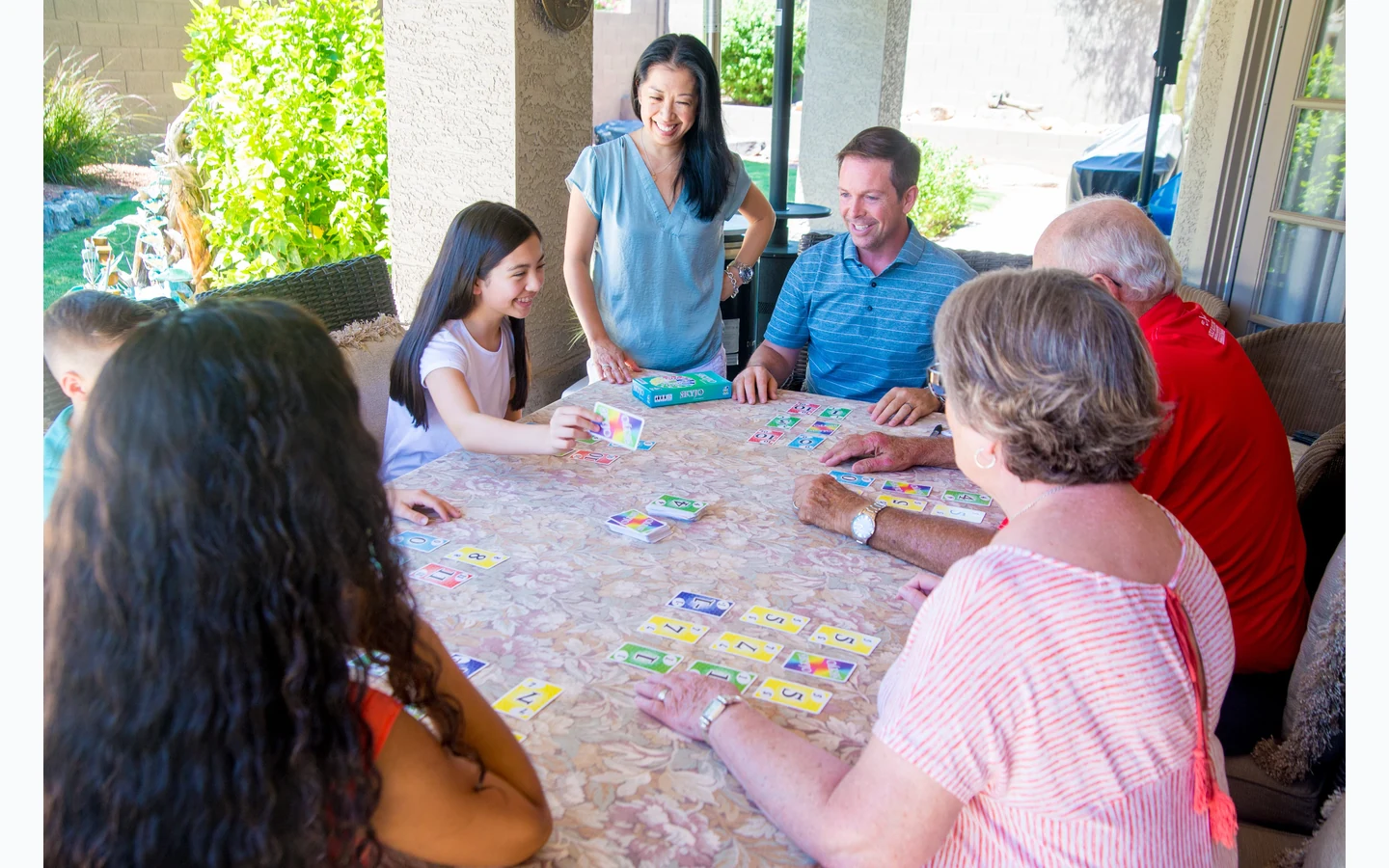
A useful alternative keeps something you enjoy while changing something you are ready to leave behind. In Classic SKYJO, that enjoyment might be watching a high card disappear, completing a vertical triple, choosing between a known discard and an unknown draw, or deciding whether your layout is safe enough to finish. A low final score is the shared destination, but each of those moments suggests a different next game.
Start by separating information from memory. Classic SKYJO begins with twelve hidden cards and two initial reveals. As play exposes cards, much of your position becomes visible to everyone; you do not normally turn known cards back down and test your memory of them. If you want a game in which remembering a briefly seen card is more central, seek that change deliberately. Buying another number-grid game does not automatically supply it.
| What you want to keep | What to look for next | What may change |
|---|---|---|
| Improving your own small layout | A nearby Golf-family game | Matching patterns and scoring exceptions |
| Tension around unseen values | A stronger memory-and-information game | When you can look and what opponents can change |
| Choosing the least painful low-score outcome | A shared-card or passing contest | Your private grid may disappear entirely |
Also name what you do not want. Someone tired of waiting through other people's turns needs a different recommendation from someone who likes chatting between quick replacements. Someone who dislikes attacks on their position may not welcome an interaction-heavy game even if its card count looks invitingly small. Decide this before a colourful box or an enthusiastic recommendation makes the choice for you.
The shortlist below uses Classic SKYJO as its baseline. Keep the Classic rules separate from Action powers and house rules when comparing. The goal is not to find one objectively superior replacement. It is to identify the particular new decisions your table will enjoy making.
Keep the grid with Play Nine or traditional Golf
If rearranging your prospects through replacement is the appeal, begin close to home. A nearby grid game lets players reuse the familiar idea of improving a personal position. It will provide a smaller change than moving to auctions, trick-taking or a shared row of cards. That can be exactly right for a group that wants a different flavour without learning an entirely different kind of turn.
Play Nine when completing pairs is the attraction
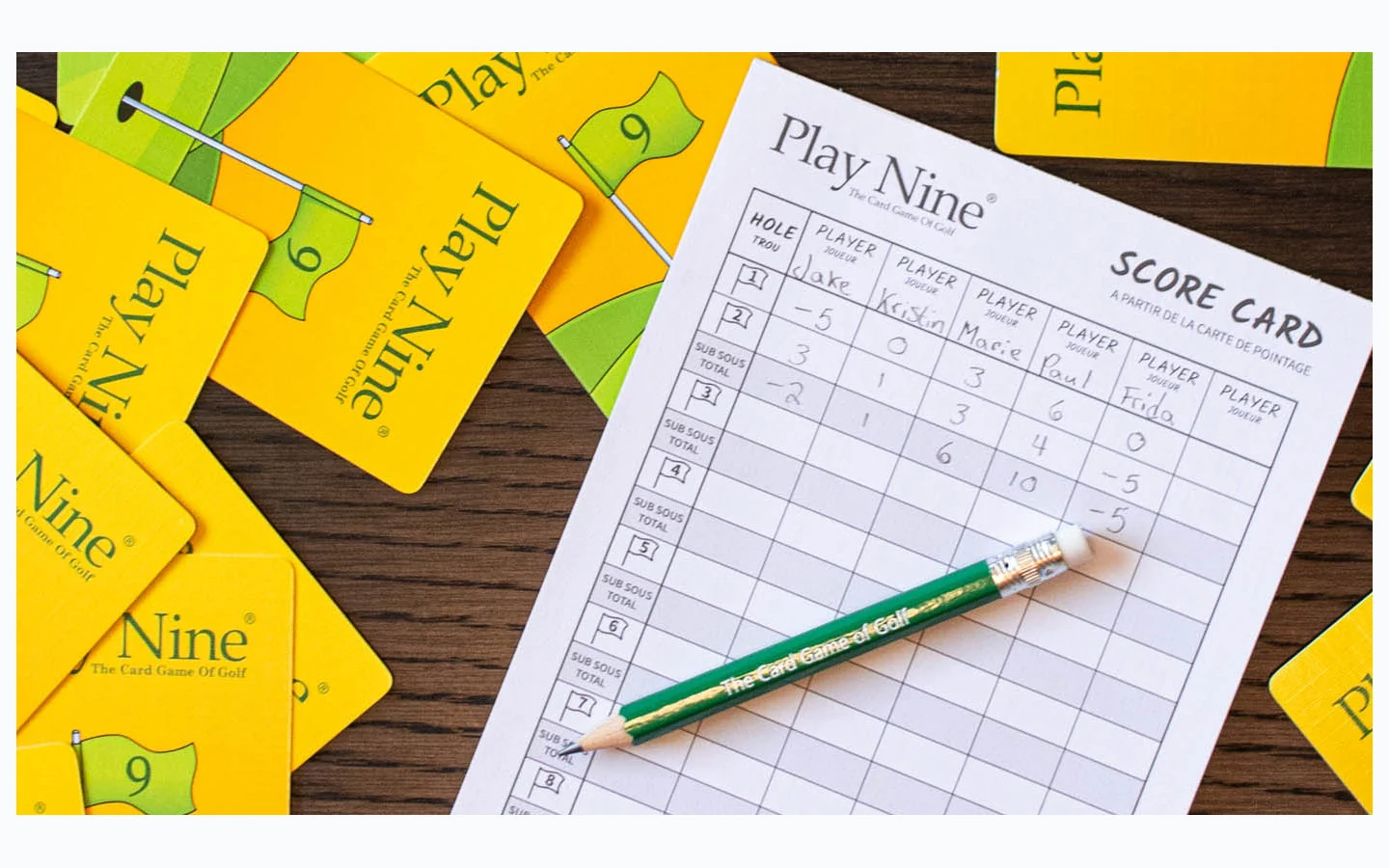
Play Nine gives each player eight cards in two rows of four. A matching vertical pair ordinarily cancels its column to zero, and further same-rank matching configurations can earn bonuses. This gives a familiar drawing-and-replacing decision a different positional target. Two sevens in one Play Nine column complete a pair; two sevens in a three-card Classic SKYJO column still leave a job unfinished.
The recommendation fits someone who enjoys making a visible plan and checking how its pieces combine. It fits less well if the household wants to escape personal grids altogether. Do not assume eight cards make the whole session shorter: the standard Play Nine contest runs through nine holes, while SKYJO uses a cumulative score threshold. Our SKYJO versus Play Nine comparison works through the accounting and closing decisions in detail.
Try asking whether your table would enjoy protecting an established pair. A small number drawn late may be worth less than the matching relationship it would break. That is an attractive question for players who like building a position, but another layer to explain for people who only want to replace high numbers and add what remains. A different scoring pattern is a reason to choose the game, not an incidental exception to skip during the teach.
Traditional Golf when you want to use an existing deck
Traditional Golf is a family of card-game variants rather than one universally fixed boxed rule set. Pagat documents multiple layouts and conventions, including a six-card game with vertical pairs. An ordinary deck can make this an appealing experiment when you already own playing cards. It does not make every family's remembered Golf rules interchangeable.
Agree on layout, card values, matching, the ending trigger and the number of deals before starting. The smallest missing agreement can matter: does a pair have to be vertical, and what happens to a pair of negative-valued cards? Record the version once so that a player does not discover a decisive local exception after making a reasonable move.
Use our regular-playing-card adaptation guide if that is the route you want. Treat the result as an adaptation or a particular Golf variant, rather than claiming a standard pack recreates SKYJO's dedicated deck exactly. Choose this option for flexibility and experimentation; choose a boxed game when a shared printed reference is more valuable to your group.
Choose Cabo when remembering hidden information is the point
Cabo is a useful direction when you like low totals but want knowledge about cards to matter differently. The 2019 Bézier second edition starts with four cards in front of each player and lets you look at two initially. Its card powers include looking at one of your own hidden cards, seeing an opponent's card, and swapping cards between players. A smaller personal layout therefore does not simply mean a smaller version of SKYJO.
Knowing a card changes how you value a swap
Imagine that you remember one hidden position contains a large value. A smaller drawn card offers a clear improvement there, even though the table cannot see the number you are removing. If a later swap changes that position, the old certainty no longer applies. Tracking what changed matters as much as remembering what you first saw. That is a different demand from watching a Classic SKYJO tableau gradually become public.
This is the attraction for someone who wants information tools and direct changes to another player's position. It is also a reason to skip Cabo if forgetting a card would feel irritating rather than entertaining. More memory is not inherently more skillful fun for every group, and a correct memory does not control a random draw. Choose it because the uncertainty invites the decisions your players want.
The call to end the round changes the rhythm too. In the Bézier second edition, calling Cabo ends your turn, after which the other players get one more turn. You are judging the likely totals rather than waiting for a twelve-card tableau to become fully exposed. A player who enjoys making a timed claim about an imperfectly known position may find that distinction more interesting than any difference in artwork.
Keep Cabo's edition rules separate
Cabo exists in different editions, so the details above identify the 2019 Bézier second-edition rules. In that version, a card taken from the visible discard remains faceup in the player's area. Do not confuse the publisher's optional all-facedown expert variant with the standard rules, or assume that every card stays hidden forever. Read the rules included with the particular copy you plan to use.
A familiar SKYJO penalty is another trap. In the identified Cabo edition, a caller who has the lowest total or ties for it scores zero for the round; an unsuccessful call adds ten to the caller's remaining-card total. That is not Classic SKYJO's positive-score doubling test. Our SKYJO versus Cabo guide provides a fuller comparison. For this shortlist, the reason to consider Cabo is the shift toward remembered information and powers, with edition checks as part of the choice.
Keep low-score tension but move to a shared card contest
If you want the anxiety of avoiding points without another private rectangle of cards, consider a game whose interesting position is shared. No Thanks! and 6 nimmt! keep the desire for a low total but make other people's choices more immediate. They are adjacent recommendations, not claims that either recreates a SKYJO turn.
No Thanks! makes passing a visible resource decision
In the base game of No Thanks!, you either take the offered card with any tokens on it, or spend a token to refuse it. Passing therefore changes the offer for the next person. When the card comes around again, it may carry enough compensation to become attractive. A player who has no token available cannot keep paying to avoid the decision.
Consecutive cards change the accounting: only the lowest card of a continuous run contributes its number. Suppose you already hold 21 and 22 is offered with three tokens. Taking 22 extends your run, so its card contribution stays 21 rather than becoming 21 + 22, and you gain those tokens. Their value is not only an eventual point offset; they also let you refuse later offers. That is a useful reason to reconsider an offer another player dislikes.
The uncertainty remains because nine number cards are removed unseen before the base game. A plan that depends on finding one missing connection may fail. Choose No Thanks! if you want a clear shared offer, a finite resource for saying no, and quick debates with yourself about compensation. Skip it if the satisfying part of SKYJO is building your own board. Some current No Thanks! packages include additional special cards; begin with the base rules when comparing these mechanisms.
6 nimmt! makes placement depend on everybody's choice
In standard 6 nimmt!, each player secretly chooses a card, then everyone reveals together. Cards resolve from lowest to highest into four shared rows. The placement follows the closest lower row ending; players cannot simply choose whichever row looks harmless. Whoever must place the sixth card takes the previous five, then starts the row with the card just played.
Imagine row endings of 10, 30, 50 and 80, with four cards in the row ending 50. You choose 53 expecting it to become the fifth card. An opponent reveals 51, which resolves first and fills that row to five. Your 53 now becomes the sixth and collects it. The trap was not a worse hidden replacement; it was a shared board that changed between your decision and its resolution.
The printed numbers decide placement, while bullhead symbols on collected cards determine penalty points. Taking a 53 is not automatically a 53-point penalty. Learn that distinction and the too-low-card rule from the publisher's base rules. Choose 6 nimmt! for simultaneous-choice tension and a table that enjoys seeing plans collide. It is a different experience from gradually improving a private tableau, and that difference is its reason to join this shortlist.
Check player count, table space, and attention before buying
Start with the people who actually come to your table. A recommendation that suits seven friends can be useless for a couple. These are the standard printed ranges for the identified games, rather than an invitation to stretch them with an online house rule.
| Game or ruleset | Players | First practical check |
|---|---|---|
| Classic SKYJO | 2–8 | Room for each personal grid. |
| Play Nine, one standard set | 2–6 | Personal layouts and a scorekeeper. |
| Cabo, second-edition family discussed here | 2–4 | Comfort with remembered information. |
| No Thanks!, base game | 3–7 | At least three players under the published rules. |
| 6 nimmt!, standard game | 2–10 | Space to extend four shared rows. |
| Traditional Golf | Variant dependent | Choose a complete ruleset before dealing. |
The published No Thanks! rules are especially useful for eliminating a mismatch: its standard range starts at three. For a regular two-person evening, begin with the eligible candidates rather than buying it in the expectation that a fan adaptation will preserve the same contest. Likewise, a four-person Cabo box does not automatically accommodate the full group that plays your eight-person SKYJO night.
Look beyond the size of the carton. A compact deck can still occupy a substantial part of a pub table. Private grids need separate spaces that players can reach without mixing cards. Shared rows need enough horizontal room to see their order and endings. Try laying out the required number of ordinary cards on your intended table before ordering; that answers a practical question that a box photograph cannot.
Attention matters as much as space. Ask whether your group likes remembering concealed information or wants most of the relevant state visible. Cabo's memory decisions may be exactly the attraction, but interruptions can undermine that attraction. In 6 nimmt!, everyone needs to follow how the revealed cards alter the shared rows. That does not establish a universal difficulty ranking; it identifies what people will be doing between decisions.
Finally, separate a game's advertised duration from the evening you have available. Teaching, counting, conversation and the agreed ending all affect the session. Agree on the published match structure, or announce a shorter house format before starting and label it clearly. Avoid choosing a winner simply because an unfamiliar game's first teaching round took longer than a familiar SKYJO round.
Build a small rotation with a reason for every box
You do not need every game on this list. Give the next one a clear job. If a group keeps asking for SKYJO because it enjoys turning an untidy personal layout into something better, Play Nine is a focused next candidate. Its matching pairs offer another way to pursue that satisfaction. Traditional Golf is also worth considering when the immediate aim is to explore the draw-and-replace family with cards you already own, provided everyone agrees on the specific variant.
If the complaint is that players want more reason to track concealed information and interfere with it, look at the identified Cabo rules. If the complaint is that everyone spends too much attention on their own layout, choose a more substantial change: No Thanks! puts one offer and the cost of refusing it at the center, while 6 nimmt! connects everyone's chosen card through the same rows. Those two alternatives deserve consideration because of the decisions they change, even though neither replicates SKYJO's tableau.
Change one part of the experience at a time
Before the first round, name what you are testing as a group: “Do we like paying to avoid a bad offer?” is more useful than “Is this the next SKYJO?” Teach the printed base game, make its scoring target clear, and give people a chance to see why an apparently unattractive card might become desirable. Save optional expansions and mixed house conventions for a later, deliberate decision. Otherwise, you cannot tell whether the new mechanism or an improvised rule caused the reaction.
Afterward, ask about the actual choice people enjoyed or disliked. Did remembering a changed card feel satisfying or distracting? Did a shared row create welcome anticipation or take away the sense of control people liked in their private grid? Did the token supply make refusing an offer interesting? These answers guide the next selection more reliably than the winner's enthusiasm after one fortunate draw. A single result also cannot establish that one game is more skillful or balanced.
Keep a familiar option available while exploring. A small rotation can serve different evenings: a personal layout when the group wants gradual improvement, a memory game when attention is available, or a shared contest when everyone wants their choices to meet. Use the SKYJO comparison hub for closer edition comparisons, then choose one candidate whose central decision sounds appealing. The useful next game is the one that gives your particular table a reason to ask for another round.

Loading comments...