Classic SKYJO comparison
SKYJO vs Play Nine: Rules, Scoring, and Which Game to Buy
SKYJO and Play Nine can look almost interchangeable from the next table: rows of hidden cards, a shared draw pile, and players trying to finish with fewer points. Their important differences emerge when a useful match appears, a score is calculated, or someone considers revealing the final hidden card.
This comparison follows Classic SKYJO and standard printed Play Nine. It explains what those rule differences ask you to notice, with constructed scoring examples and practical choices for two players or a family group. Choose by the decisions you want to make rather than by an unsupported promise that one box is always luckier, faster, or more strategic.
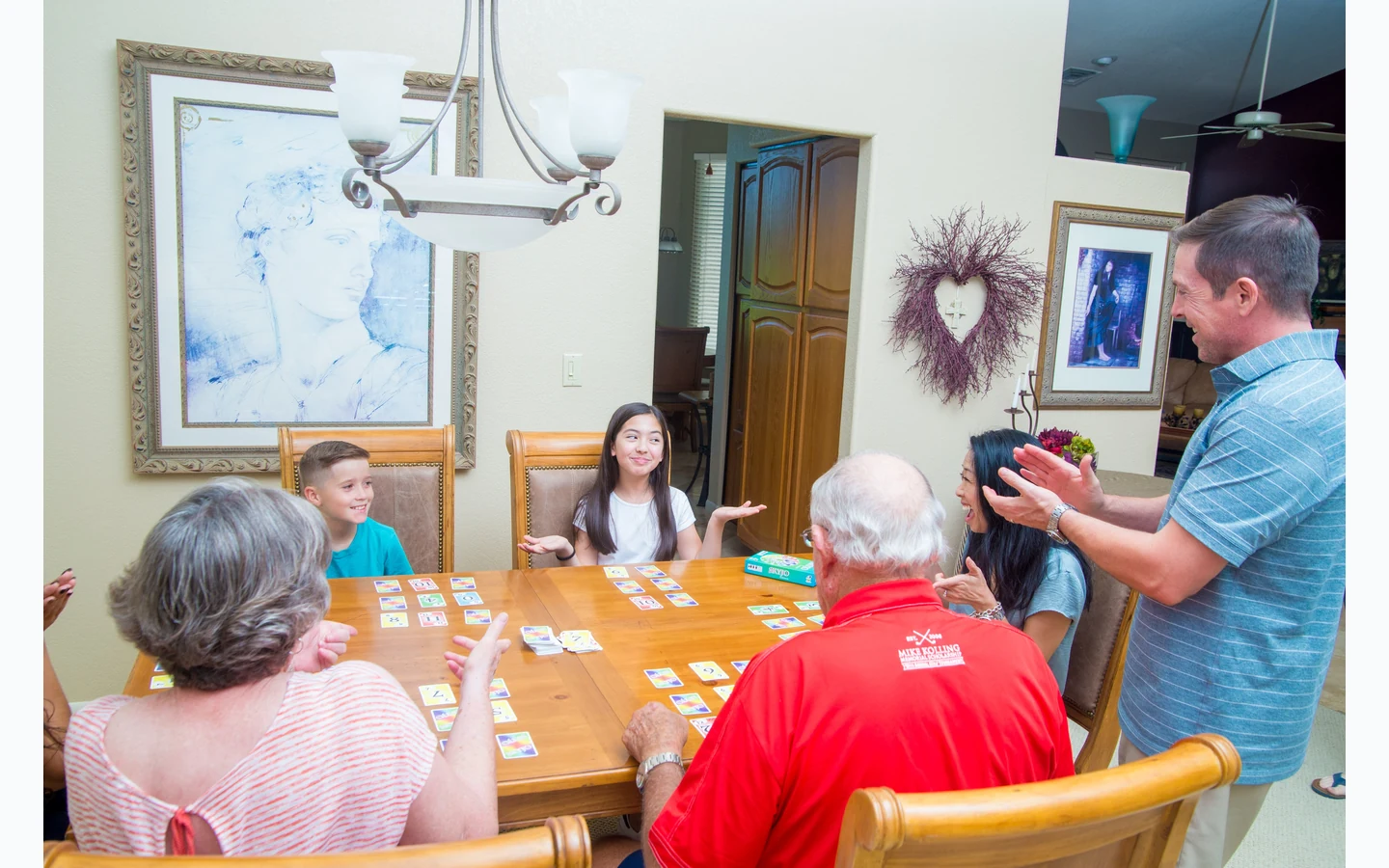
Choose the game by the kind of low score you enjoy
Choose Classic SKYJO if you want a larger personal layout that can shrink as you clear matching columns, with an important risk attached to finishing a round. Choose Play Nine if you like completing pairs, working toward scoring bonuses, and following a golf-themed scorecard through nine holes. Both ask you to keep your total low. The difference is what you are trying to build while you do it.
That is more useful than asking which game has “more strategy.” A player who enjoys assembling a promising position may prefer Play Nine's scoring possibilities. Someone who wants the satisfying moment of removing a complete column may prefer SKYJO. Either can produce an unlucky reveal or a fortunate draw; neither box can promise that the most careful player wins every session.
| Decision | Classic SKYJO | Play Nine |
|---|---|---|
| Standard player range | 2–8 | 2–6 |
| Starting personal layout | 12 cards, three rows of four | 8 cards, two rows of four |
| Matching reward | Remove a vertical triple | Cancel a vertical pair; further matching bonuses can apply |
| Standard full-game endpoint | A cumulative score reaches 100 or more | Nine holes |
For a regular group of seven or eight, SKYJO is the straightforward choice between the standard boxes. With two to six, choose the scoring experience rather than the number of cards on the table. The following examples compare the printed games; they do not transfer SKYJO Action powers, app settings, or your family's Golf conventions into either rule set. If you need the full Classic turn sequence first, keep the SKYJO rules guide beside this comparison.
Different layouts change the value of a replacement
At a glance, both games show a rectangle of mostly hidden cards. You draw, replace, reveal, and hope to improve it. That resemblance makes either game approachable after learning the other. It can also cause errors: a card that completes something useful in one layout may only start a longer project in the other.
Eight cards versus twelve
Play Nine starts each player with eight cards arranged in two rows of four. Classic SKYJO starts with twelve, in three rows of four. You initially reveal two in both games, leaving a different amount of your own position unresolved. This is a difference in information and space, not proof that one game is always faster or harder.
Consider a visible 11 and an available 2. If no matching condition changes, exchanging them reduces that card's contribution by nine points. You can describe that gain before taking the card. Replacing a hidden card with the same 2 is less certain: you may remove a larger number, but you may also give up something lower. The unknown card has an opportunity cost even when the replacement looks reassuringly small.
This shared decision is why players can transfer a useful habit between the games: name the benefit of a replacement. Are you reducing a known liability, resolving an unknown position, or building a match? Those are different reasons. If your group understands that distinction, it has learned something more durable than “always keep the smallest card.”
Matching a pair is not the same as clearing a column
In Play Nine, two equal cards in a vertical column ordinarily cancel that column's score. Two visible 8s therefore have a completed role. In Classic SKYJO, two 8s stacked above a third card are an unfinished possibility. You need the third matching 8 to remove the column. The SKYJO column rule concerns a vertical triple, not three matching cards scattered anywhere across your layout.
That extra requirement changes what patience costs. Keeping two high 8s in SKYJO may become valuable if you finish the column, but they remain points while the project is incomplete. If another player is nearly finished, there may be little time to find the third card. A lower replacement can be sensible even when it abandons an attractive-looking set. In Play Nine, a completed pair has already changed the accounting, so replacing one member needs a reason beyond improving its printed face value.
Scoring rewards different plans
The important difference appears when you turn a layout into a number. In Classic SKYJO, remove qualifying equal vertical triples and add the cards left behind. Play Nine asks you to inspect pair positions and possible matching bonuses before totalling the hole. Reading the numbers without reading the arrangement can produce a very wrong answer.
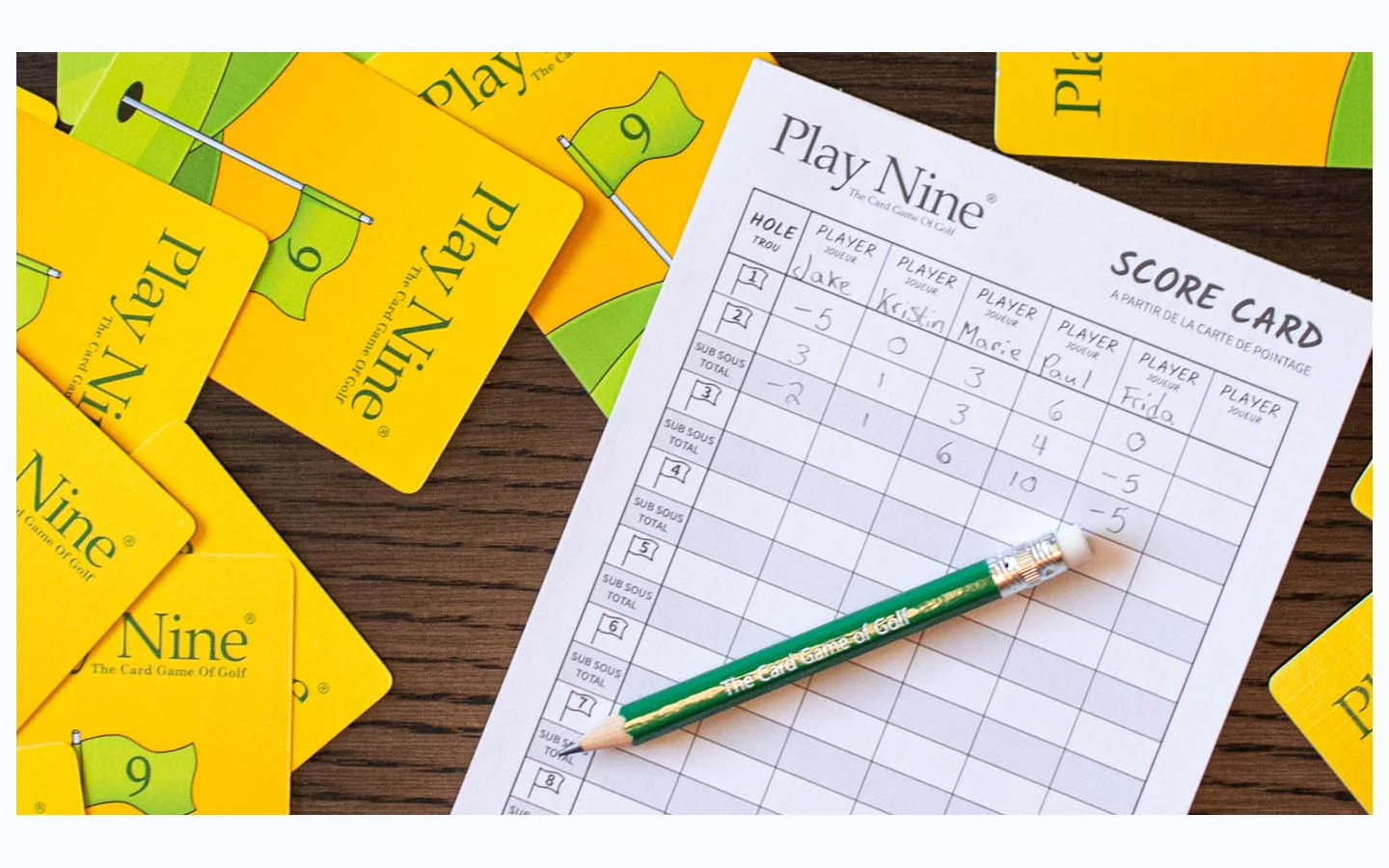
Start with the cards that still count
In Play Nine, an ordinary matched vertical pair contributes zero. Additional bonuses reward four, six, or eight equal cards arranged as matching vertical pairs: respectively minus ten, minus fifteen, or minus twenty strokes. The repeated rank matters. A column of paired 4s beside a column of paired 9s is not the same configuration as two columns made entirely of 7s.
Classic SKYJO has no equivalent bonus ladder. Three equal cards in one vertical column must be discarded, and that column no longer contributes points. This applies to negative cards as well. Three minus-one cards would contribute minus three before removal; removing them changes their contribution to zero. Matching is compulsory when the condition occurs, so deliberately assembling that negative column is not automatically an improvement. The card-values guide explains why a lower number and a desirable matching plan are separate questions.
Work through one small scoring example
Here is a constructed Play Nine position, with each column written top card/bottom card. It is an arithmetic example, not the position pictured above.
| Column | Cards | Contribution |
|---|---|---|
| First | 7 / 7 | 0 |
| Second | 7 / 7 | 0 |
| Third | 2 / 4 | 6 |
| Fourth | 0 / 3 | 3 |
| Four matching 7s bonus | Two aligned pairs | −10 |
The hole scores 0 + 0 + 6 + 3 − 10 = −1. Simply adding the printed numbers would give 37. The gap is not a hidden piece of luck; it is the value of the arrangement. That makes breaking one of the paired columns expensive unless the replacement creates a better complete position. A tempting small card can cost a bonus that was worth more.
Keep each game's exceptions in its own rulebook
Play Nine's Hole-in-One cards have a separate exception: a matched pair of minus-five cards keeps its negative value, scoring minus ten rather than cancelling to zero. Four arranged as two vertical pairs score minus thirty after the extra bonus. Those details belong to Play Nine's printed scoring examples; they are not rules for SKYJO's negative cards.
A useful table habit is to settle matching conditions first, identify exceptions second, and add the remaining contributions last. Let another player check the arrangement before writing the score. This is especially helpful when switching games during the same evening: familiar-looking columns can tempt an experienced player to apply the wrong exception confidently.
Ending a round changes the risk you are taking
Finishing your own layout does not instantly freeze everyone else's score. Both games give the other players one final turn before the hole or round is scored. A promising lead must survive those turns and the revelation of remaining hidden cards. That is a reason to examine the whole table, not merely count how few unknown cards you have left.
Classic SKYJO adds a specific consequence for the player who ends the round. If that player's final round score is positive and another player finishes with an equal or lower score, the finisher's round points double. A positive tie is not safe. Zero and negative round scores are exempt. Play Nine does not add that SKYJO-style penalty to a player simply for finishing without the lowest hole score.
Compare visible totals before choosing to finish
Suppose your final Classic SKYJO total will be eight. If an opponent ultimately scores eight as well, you record sixteen while that opponent records eight. If the opponent instead scores five, you still record sixteen. But looking across the table and seeing five in exposed cards does not establish their final total: hidden cards, a final exchange, and a completed removable column can change it. The decision requires a range of possible outcomes, not a claim that the current exposed subtotal is the answer.
Play Nine offers another pacing distinction in its printed instructions. With exactly one facedown card left, you may draw and discard without replacing a card or exposing that final hidden card. You can repeat that choice on later turns while the condition remains. You might use it to wait for a useful replacement rather than reveal into an unattractive position. Someone else can still finish first, so waiting does not buy unlimited opportunity.
Do not bring that option into Classic SKYJO by familiarity. A rejected blind draw in Classic is followed by revealing one of your hidden cards. Switching between the games therefore calls for a brief reminder about the final card, even if everyone already knows how to draw and replace. A rule that changes when you must reveal changes the risks of rejecting an unhelpful draw.
Finally, separate the end of a hole from the end of the whole contest. Standard Play Nine totals nine holes; Classic SKYJO ends after a round brings someone's cumulative total to at least one hundred. The lowest cumulative total wins SKYJO, not the player who first crosses that threshold. Read the SKYJO tie guide before borrowing a familiar tie convention from another game. In either box, a reasonable decision near the beginning may be too cautious when the final overall score is at stake.
Player count and pacing are practical buying criteria
Count your usual players before comparing scoring elegance. Classic SKYJO supports two to eight in its standard rules. A standard Play Nine game lists two to six. Play Nine's publisher does describe an expanded eight-person setup using 162 cards, but that requires more cards than the standard 108-card game. It is an additional arrangement, not a reason to label the ordinary box an eight-player equivalent.
At larger tables, the practical question is how much attention people can give between their own turns. More players place more turns between your decisions. They also create more layouts to inspect when you are deciding whether to finish. A group that enjoys reacting to other people's draws may welcome that shared spectacle. A group waiting silently for its own next card may experience the same interval as dead time. That is a group preference, not something a printed player range settles.
The publishers give different planning estimates: approximately thirty minutes for Classic SKYJO, and thirty to ninety minutes on Play Nine's family page. Treat these as estimates for the games they describe, not a timed head-to-head result. Nine holes tell you how many rounds remain; they do not guarantee that your thoughtful six-person table finishes at a particular minute. Conversely, a hundred-point finish can arrive after a variable number of SKYJO rounds.
If you want a shorter Play Nine session, agree on fewer holes before dealing; the publisher explicitly permits adjusting the length by agreement. A mid-game decision to stop immediately can favour whoever happens to lead. In either game, leave a little space for teaching, recording scores and one disputed calculation. Twelve card positions per SKYJO player also call for more personal layout space than eight per Play Nine player, although the actual footprint depends on spacing and the edition's cards. Check the table you use, not only the box that fits in a cupboard.
Match the game to the people who will play it
The best comparison is a description of your next game night. Who is coming, what do they enjoy noticing, and what kind of reminder will they tolerate? Both games offer straightforward actions, but straightforward actions do not make every scoring habit equally intuitive. A household can like one and feel that the other repeats the wrong parts.
For a regular two-player table
With two players, the same opponent receives the discard you leave and responds before you act again. Their visible matching needs become a useful part of your decision. A card you no longer want may be exactly what they need, so your improvement should be weighed against the opportunity you hand over. This is a consequence of the turn order, not a promise that you can control the next draw.
Choose Play Nine if both players enjoy working toward paired configurations and comparing the chance of improving them against the opportunity to finish. Choose SKYJO if the risk of a positive-score finish and a larger unresolved layout is the interesting part. Neither choice removes luck. A player can make a defensible decision and still reveal a poor hidden card. If arguments about unlucky finishes spoil an evening, discuss whether the group actually enjoys that uncertainty rather than inventing a rule change after losing.
For a couple learning SKYJO, the two-player rules and tactics guide is a useful follow-up. Use it to learn the shared game first; treat a custom score target or altered penalty as a later agreement. You will get a clearer comparison if both games have an opportunity to work as written.
For a mixed-experience family group
Teach one real turn, one correct match, one score, and one ending before listing every clever tactic. For Play Nine, show where a pair must sit and why minus-five cards are exceptional. For Classic SKYJO, show that only the complete vertical triple disappears and explain the positive-score finishing penalty before someone is caught by it. These examples make the next choice understandable without taking the choice away from the learner.
Do not let an experienced player “help” by freely rearranging Play Nine cards after the starting reveal. Its publisher specifies that the positions are fixed: improvement comes through permitted replacement or revelation, not moving cards across the table. A family used to a different Golf variant should agree on that boundary openly. Quietly importing a familiar rule changes the comparison everyone thinks they are making.
Play Nine's golf terms can give the scorecard a friendly theme, but nobody needs to know golf to compare numbers. SKYJO's number-first presentation may be easier for a group that wants fewer thematic terms. The age guidance on a box is a starting point, not a verdict about an individual child or adult. Choose the explanation and accounting your own players can comfortably follow.
Buy one first, and add the other for a specific reason
If neither game is already in your cupboard, buy the one that fits your usual group and learn it thoroughly before treating the second as an automatic upgrade. Choose Classic SKYJO for its removable triples, larger tableau and standard support for up to eight. Choose Play Nine for pair-based scoring, its bonus configurations and the structure of a golf scorecard. The overlap is real enough that buying both immediately may provide less variety than your shopping list suggests.
Owning both makes more sense when you can name the difference you want. Perhaps two regular players enjoy Play Nine's scoring construction but want SKYJO's positive-score closing pressure on another evening. Perhaps a household already plays SKYJO with eight and wants a separate smaller-group game built around pairs. Those are specific reasons. “The cards look different” is a weaker reason if everyone expects the same decisions to feel entirely new.
Before ordering, read the actual product title, contents and language information. Play Nine appears in different packaging presentations; compare the included instructions rather than relying only on an old photograph. Likewise, SKYJO Action is a different game from Classic SKYJO, with additional card mechanisms. The Classic versus Action comparison is the appropriate guide if that is the box you are considering. For Classic purchase channels and edition checks, use the SKYJO buying guide.
Keep the decks separate and teach the version on the table. Similarity does not make a combined deck an official way to play either game, and an online title does not establish which printed rules an app implements. Your useful final question is simple: would this group rather complete rewarding pairs through a fixed scorecard, or manage a shrinking twelve-card layout and judge the risk of ending? Answer that together, and the choice between the boxes becomes much clearer.

Loading comments...