Edition comparison · Rules · Review
SKYJO Voyage vs SKYJO: Rules, Cards, Differences & Honest Review
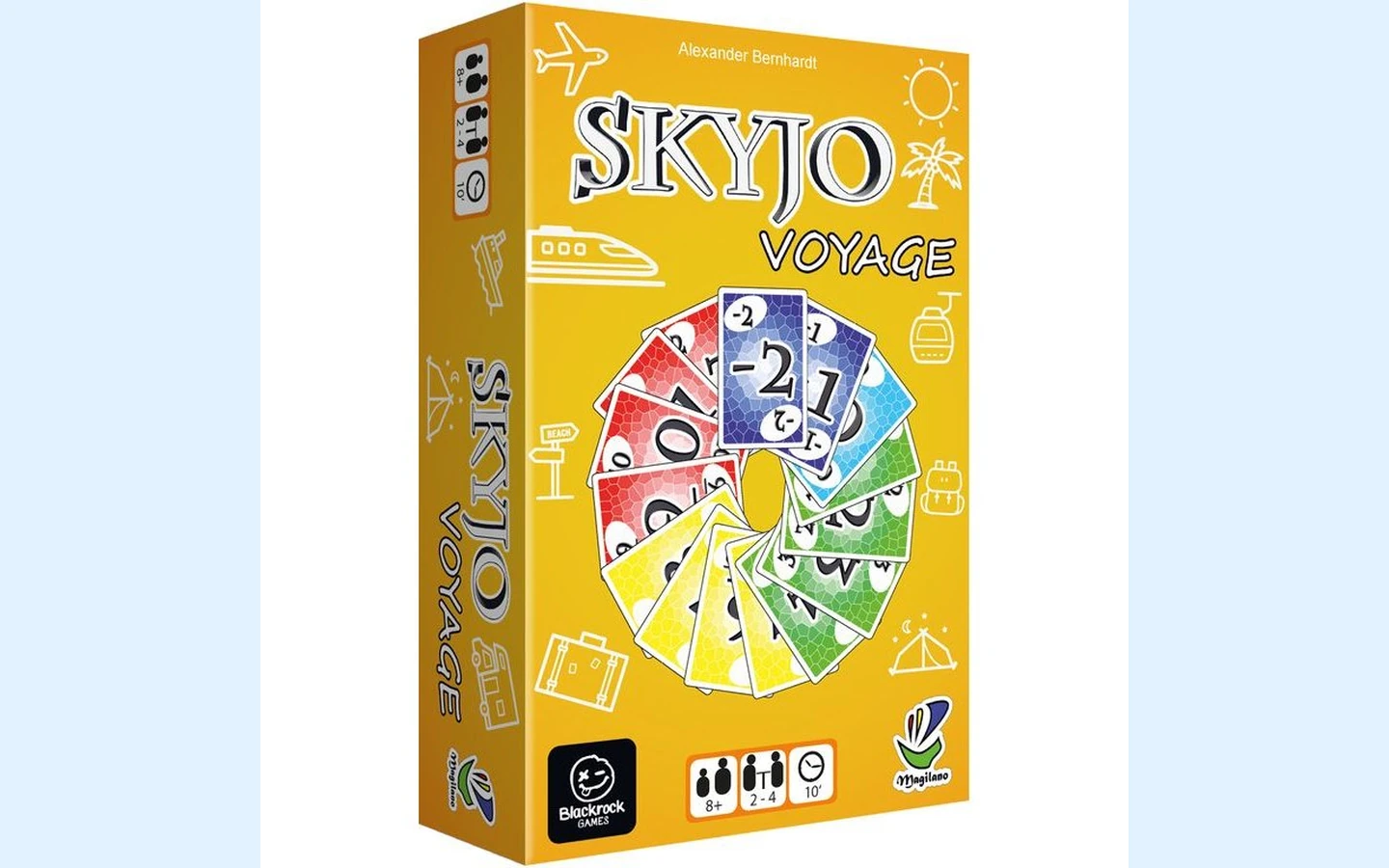
SKYJO Voyage preserves the Classic low-score game in a smaller physical format. Its official 2–4-player scope makes it a smart companion for couples and small travel groups—but not an automatic replacement for the more flexible Classic box.
The quick verdict
Buy Voyage if you regularly play with two to four people and the standard box is genuinely too bulky for your bag or table. Buy Classic if this is your first SKYJO, five or more players may join, or larger cards make the game more comfortable. The gameplay choice is familiar; the physical use case is what changes.
SKYJO Voyage vs Classic at a Glance
The short answer is refreshingly simple: SKYJO Voyage keeps the central Classic game but packages it for a smaller group and a smaller bag. You still try to finish with the lowest score, manage a twelve-card grid, replace bad values, and remove matching vertical columns. You are not buying new powers, a campaign, or an expansion for another box.
The important difference is capacity. The publisher-attributed 2025 Voyage rules specify two to four players, age eight and up. Classic is the more flexible household box when five, six, seven, or eight people may join. That single difference should decide the purchase before price or packaging does: a travel edition that excludes half your regular table is not more convenient in practice.
| Decision point | SKYJO Voyage | Classic SKYJO |
|---|---|---|
| Core objective | Lowest cumulative score | Lowest cumulative score |
| Grid | 12 cards, four columns of three | 12 cards, four columns of three |
| Official player range | 2–4 in the 2025 Voyage rulebook | 2–8 |
| Physical priority | Compact cards and package | More comfortable standard format and group flexibility |
| Best fit | Couples, small families, light luggage | Home play, gifts, changing group sizes |
Specification note
Current listings disagree on some details: the official booklet's component table totals 105 cards, while one retailer publishes 108; dimensions and duration also vary in presentation. Treat the booklet as the baseline for rules and contents, then check the GTIN and printed specifications on the exact box you are ordering.
Our verdict at this stage: Voyage is the stronger second box for people who already enjoy SKYJO and repeatedly travel with two to four players. Classic remains the safer first purchase. If you need the entire rules foundation before comparing boxes, use the site's complete SKYJO rules guide; the rest of this review concentrates on what the smaller edition changes at the table.
SKYJO Voyage Rules: What Stays the Same?
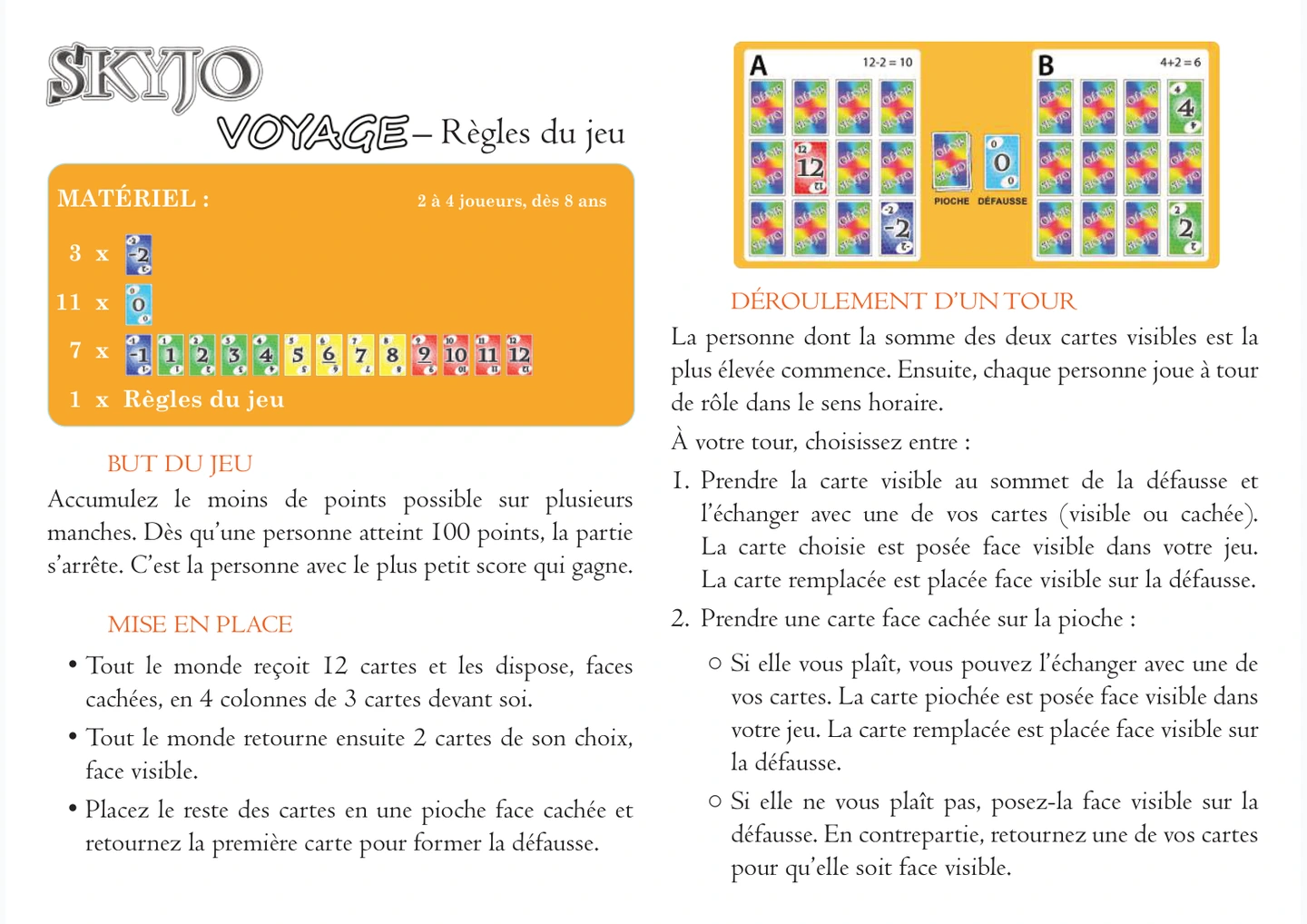
Voyage is easy to teach if anyone at the table already knows Classic. Shuffle, deal twelve face-down cards to each player, and arrange them as four vertical columns of three. Everyone reveals any two cards. The remaining deck becomes the face-down draw pile, with one card turned face up beside it to start the discard pile. Your aim over several rounds is to collect fewer points than everybody else.
Take the visible discard
You must exchange it for one card in your layout. The incoming card is placed face up, whether the replaced card was visible or hidden.
Draw from the hidden pile
Keep the draw by exchanging it face up, or reject it to the discard pile and reveal one of your own hidden cards instead.
That choice is the whole engine: certainty from the discard versus information and possible improvement from a blind draw. When three equal cards are all face up in the same vertical column, remove the column immediately. A column of three 7s therefore deletes 21 possible points, but three equal cards spread across a row do nothing under the documented Voyage rules.
Ending and scoring a round
When one player has no hidden cards left, every other player takes one final turn. Then all remaining hidden cards are revealed, any newly completed matching columns are removed, and each player adds the cards still in the layout. Negative cards reduce the total; removed columns contribute nothing.
The player who triggered the end accepts a real risk: if that player does not have the strictly lowest positive round score, the score doubles. A tie is not good enough. If Maya ends on 8 and Theo also scores 8, Maya records 16. The 2025 Voyage booklet says the doubling penalty does not apply when the ender's score is negative.
Why the “strictly lowest” wording matters
Revealing your last card is not an automatic achievement. It is a wager that your final total beats every opponent after their last turn. If another grid has several hidden cards, ending on a merely decent score can turn a small lead into a damaging double.
Keep a running total across rounds. Once any player reaches 100 points or more, finish the accounting and declare the player with the lowest cumulative score the winner. These are Classic mechanics in a compact edition—not Action-card effects and not Junior scoring. For unusual cases beyond this comparison, consult the site's dedicated SKYJO rules hub.
Cards, Box, and Table Footprint
Voyage saves space by reducing both the deck and the physical format. The 2025 booklet's component table adds up to 105 cards: three -2 cards, eleven zeroes, and seven copies of each of the other thirteen values (-1 and 1 through 12). That reduced distribution supports up to four players rather than Classic's larger table.
For one currently listed French product reference, the cards are 4.4 × 6.9 cm and the box is about 3 × 8.2 × 12.8 cm. Another retailer lists a nearly identical box footprint. These numbers explain why Voyage slips into a daypack or a crowded suitcase more easily, but they should not be treated as a promise for every printing. Retail pages even disagree on card count, so match the item code or GTIN and read the photographed packaging before ordering.
| Physical question | Voyage advantage | Trade-off |
|---|---|---|
| In your luggage | A slimmer, lighter package is easier to justify | The box only solves packing, not where you deploy the grid |
| On the table | Smaller cards compress each player's layout | Every player still needs 12 card positions |
| In the hand | Cards are quick to move between grid and discard | Small cards can be fiddlier for large hands or limited dexterity |
| Across the table | Colors and values retain the familiar visual language | Smaller numerals may be harder to scan from another seat |
Smaller does not mean hand-held
A complete two-player setup contains twenty-four personal card positions, then a draw pile, discard pile, and enough clearance to exchange cards without disturbing neighboring columns. Four players need forty-eight positions. Voyage reduces the width and height of those positions, but it does not change the 4-by-3 architecture. A narrow train tray may hold one grid, not two opposing grids and the common piles.
Pack a small score pad or use a scorekeeper, and consider a zip pouch if the retail carton may be crushed. Sleeves add bulk and can undo part of the footprint advantage, so test a few before sleeving the entire deck. At home, Classic's larger cards are often nicer to read and manipulate. On the road, Voyage's physical compromise makes sense when saving bag volume and table width matters more than maximum handling comfort.
How Voyage Feels on a Trip
“Travel game” can mean two very different things. Voyage is unquestionably easier to carry; its small carton is less likely to be the item you remove when a bag is full. Playing during the journey is more conditional. The cards still lie loose in a wide grid, so motion, wind, drink spills, and narrow trays matter more than the logo on the box suggests.
One train traveler reported sliding the cards into a pocket page made for trading cards so they would not move with the carriage. Another owner praised the luggage size but noted that each player still needs room for twelve cards. These are individual customer experiences, not official product promises, yet together they identify the real constraint: Voyage reduces area; it does not anchor the layout.
| Travel setting | Fit | Practical call |
|---|---|---|
| Hotel or holiday rental | Excellent | Stable table, easy scoring, little reason to carry Classic |
| Café or airport table | Good | Keep drinks away and confirm two grids fit before dealing |
| Train table | Conditional | Movement and narrow surfaces may require a grippy mat or pocket-page solution |
| Airplane tray | Awkward | A full opposing setup usually needs more width than two trays comfortably provide |
| Windy picnic or beach | Poor | Loose cards and sand defeat the benefit unless you bring clips, sleeves, or a covered surface |
A 30-second setup check
Before dealing, place four cards across and three down for each player without gaps, then reserve a central space for two piles. Shake or nudge the surface gently. If the cards drift or an elbow crosses another grid, wait for a better table. This quick dry run is faster than rebuilding forty-eight positions halfway through a four-player round.
For a couple, Voyage is particularly convincing: the two-to-four-player range matches the traveling party, turns stay predictable, and the package earns little bag space. For a family of five, it creates an exclusion problem that Classic avoids. Backpackers get the strongest packing benefit, but only if the planned stop provides a dry, flat surface. A deck that reaches the mountaintop easily is still a deck of loose cards once the box opens.
SKYJO Voyage Strategy: Same Decisions, Tighter Context
Voyage does not introduce a new strategy system, but its documented deck deserves its own baseline. From the component table, the 105 cards have a combined value of 533, so a card from a freshly shuffled, completely unseen deck averages about 5.08 points. That is not a prediction for every hidden card. The average changes as soon as cards are dealt, revealed, discarded, or removed.
At the opening shuffle, 49 of 105 cards are worth 4 or less (about 46.7%), while 56 are worth 5 or less (about 53.3%). Twenty-one cards—exactly 20%—are 10, 11, or 12. Those figures explain why replacing a visible 10–12 is usually sound even when the incoming card is merely middling. A guaranteed cut from 12 to 5 saves seven points; refusing it to chase a perfect zero leaves seven points exposed to an early ending.
Take certainty
Use a low visible discard to replace an exposed high card. You know the immediate score reduction and deny the next player that low value.
Chase a column selectively
Two matching 8s create a possible 24-point removal, but two matching 1s promise only three points. The payoff must justify leaving other high cards alive.
Respect the clock
When a rival has one hidden card, optimize the score you can guarantee now. A beautiful future column has no value if the round ends first.
Two players versus four
At two, discard control is unusually direct: anything you place on top is immediately available to your only opponent. If they show two 6s in a column, throwing away a 6 may hand them an 18-point removal. Sometimes you should use a mediocre draw in your own grid simply to avoid donating that exact card. This is a tactical denial, not a universal rule; taking extra points to block three low 1s would cost more than the threatened removal saves.
At four, the discard's next recipient is still predictable, but a particular distant rival may never see it. More important, triggering the round gives three opponents a final improvement turn. Your ending margin needs to survive more attempts. Smaller player count makes information easier to track; larger Voyage tables make timing less controllable even though the rules are identical.
Worked ending decision
You can end with 9 points. An opponent shows 7 and has one hidden card. If you trigger, that opponent receives a final turn and may preserve or improve the 7. You would not be strictly lowest, so your positive 9 becomes 18. Unless another player is about to end anyway, take another turn to reduce your total or learn more.
The best Voyage strategy is therefore conservative about unsupported precision: count what has actually appeared, compare visible totals, and price a column by the points it would remove. Use the fresh-deck average only when you have no better information. For a fuller discussion of replacement thresholds and tempo, continue with the site's SKYJO strategy guide or the dedicated two-player guide.
Honest Review: Strengths, Drawbacks, and Who Will Enjoy It
Voyage succeeds at the job named on the box. It makes a familiar family card game easier to pack and somewhat easier to deploy, while preserving the quick teach and the nervous decision about when to end. A recent newspaper review praised that combination of compactness, memory, risk, and timing. An independent board-game reviewer scored it 7.5/10, describing SKYJO as light and luck-driven but still capable of creating a satisfying race.
That praise needs context. Voyage does not make SKYJO deeper. The initial deal and blind draws can create large swings, direct player interaction remains limited, and many turns present an obvious choice when a very low card can replace a 10 or 12. If your complaint about Classic is “too random” or “not enough ways to affect opponents,” a smaller deck does not answer it. Compare the SKYJO editions before assuming Voyage fills the role of Action.
What Voyage does well
- ✓Fits bags that make the standard box feel wasteful.
- ✓Teaches almost instantly to anyone who knows Classic.
- ✓Matches couples and small-family travel particularly well.
- ✓Keeps the column-clearing payoff and dangerous ending decision.
What may disappoint
- —Small cards can be harder to shuffle, grip, or read.
- —The grid still asks for more surface than the box implies.
- —Four players is a firm ceiling in the documented edition.
- —Existing owners pay again for packaging, not new gameplay.
Our editorial verdict
Voyage is an 8/10 travel adaptation and a 5/10 reason to duplicate a game you already own. The first rating reflects how cleanly it preserves the experience in a lighter format. The second reflects the absence of new mechanics. If Classic already fits your luggage, there is little to discover here.
Customer feedback reinforces the trade-off rather than producing a universal answer. Several buyers praise how easily the box travels and how naturally it works at two. One prefers regular SKYJO for home because the small cards are harder to shuffle; another misses a score sheet. Those are personal experiences, but they are exactly the practical details a “travel” label can hide.
Buy Voyage if you regularly leave Classic behind because of volume, play mostly with two to four people, and accept smaller components. Skip it if five people often join, large print and easy shuffling matter, or you want a more confrontational game. In those cases, Classic or Action solves the actual problem more directly.
Which SKYJO Should You Buy?
For most first-time buyers, Classic remains the safest answer. It offers the same foundational game, more comfortable components, and room for a group to grow beyond four. Voyage becomes the better first box when your real table is almost always two to four people and storage or luggage space repeatedly decides whether a game comes with you.
| Your situation | Best choice | Why |
|---|---|---|
| First SKYJO; group size changes | Classic | The wider player range is worth more than marginal packing savings |
| Couple or family of four traveling often | Voyage | Its player range matches the group and the smaller package will be used |
| Own Classic, travel once a year | Keep Classic | A second copy adds almost no gameplay value |
| Want attacks, powers, and more interaction | Action | Voyage deliberately does not add those systems |
| Buying for a preschool-age child | Junior | Junior changes the objective and presentation for younger players |
Check the listing, not just the word SKYJO
The documented French Voyage product uses EAN/GTIN 4260470080124, but identifiers, language packs, and packaging can differ by market. Before paying, confirm the full title says Voyage, the printed range says two to four players, the rulebook language suits the recipient, and the pictured contents match the compact number-card edition. Do not use an Action or Junior photo as a substitute; both are separate games with different rules.
Retail prices and stock can change faster than an evergreen comparison. Instead of chasing a single “normal” price, compare the delivered cost of the exact edition across reputable sellers and inspect return terms if the listing is vague. The site's SKYJO buying hub and where-to-buy guide can help with retailer and authenticity checks.
Final recommendation
Buy Voyage when compactness changes whether you play; buy Classic when it merely changes how neatly the box fits. That test avoids paying twice for identical decisions or buying a four-player ceiling that your household will quickly outgrow.

Loading comments...