Classic SKYJO · Printable scorekeeping guide
Free Printable SKYJO Score Sheet PDF & Score Card
Use the printable 2–8 player score card in this guide, save it as a PDF from your browser, and record every round without losing the finisher penalty, negative cards or the 100-point endgame in the arithmetic.
A blank grid is easy to draw; a trustworthy SKYJO record is harder. The scorekeeper must know which card subtotal to enter, when the round-ending player doubles, how a tie affects that decision, and when a cumulative total actually ends the game. This guide solves those problems before giving you a master table you can print directly or save through the browser’s PDF destination.
The scoring rules here are for Classic SKYJO. You will get an eight-seat layout that works just as well for two players, clear asterisk notation for the finisher, print settings for A4 and US Letter, and a complete final-round example. No separate download is required for the article to be useful: the full score card appears on the page.
What a Useful SKYJO Score Sheet Must Track
A useful SKYJO score sheet does more than provide a row of empty boxes. It preserves enough of each round to explain the number that entered the running total. Write the player names across the top, put one completed round on each row, and reserve a visible marker for the player who ended that round. That last detail matters because the finisher may have a positive score doubled. If everybody gathers the cards first and asks who finished second, the sheet has already failed.
| Field | What to record | Why it earns space |
|---|---|---|
| Player name | One name per active column | Classic SKYJO supports 2–8 players, so unused columns can simply stay blank. |
| Round score | The adjusted score added for that round | This is the number used in the cumulative total. |
| Ender mark | Add an asterisk beside the finisher | It makes a doubled score auditable later. |
| Running total | Previous total plus the current round | The end condition is checked only after the round is scored. |
| Notes | Corrections such as “17 → 34” | A visible correction is safer than erasing the evidence. |
The number written in a player’s main cell should be the number that actually counts. If Mia’s raw card subtotal is 17 but the finisher penalty applies, write 34* in her round cell and note “17 × 2” in the margin. That is much clearer than writing 17, doubling it mentally, and hoping the next person understands the total. For a casual table, the asterisk is enough; for a league night or a family that debates every point, add a narrow raw-score column beside each player.
Editor’s table rule
Choose one scorekeeper, but make every player read their subtotal aloud before it is entered. The scorekeeper then names the ender and reads back the adjusted row. This ten-second ritual catches more errors than an elaborate app because the cards are still visible when the arithmetic is checked.
The same master sheet can serve a duel or a full eight-player table. If you are deciding how many seats to set up, the SKYJO player-count guide explains how the pace changes. The score-card principle does not: one player per column, one round per row, and one verified cumulative total after every round.
Calculate Every Round Before You Write the Total
Do not start writing while players are still resolving the end of the round. In Classic SKYJO, the clean scoring order is reveal, remove, add, record. After the finisher exposes the last face-down card, every other player receives the required final turn. Any cards still face down are then revealed. Only after every mandatory vertical match has been removed should anybody begin adding the cards that remain.
- Step 1
Keep each 4×3 grid untouched while final turns and the final reveal are completed.
- Step 2
Remove every vertical column containing three identical face-up values. Rows and diagonals do not qualify.
- Step 3
Add only the cards still in front of the player. Preserve the minus signs on −2 and −1 cards.
- Step 4
Say the raw subtotal aloud. Apply the finisher test in the next section, then write the adjusted score.
Worked subtotal: one removed column
Suppose one of your four columns has already been discarded. The nine remaining values are −2, 0 and 1 in the first row; 3, 4 and 5 in the second; and −1, 2 and 6 in the third. Grouping by row makes the check easy:
(−2 + 0 + 1) + (3 + 4 + 5) + (−1 + 2 + 6)
= −1 + 12 + 7
Raw round subtotal = 18
The removed column contributes zero because those cards are gone, not because you should copy three zeros onto the score sheet. That distinction prevents a common recounting error: somebody sees discarded cards beside the pile and adds them a second time. It also catches the uncomfortable but official outcome of matching three negative cards. A vertical trio of −2 cards must be removed too, so you lose a helpful −6 from your grid. Mandatory removal can make a pretty column strategically expensive.
Fast audit
Count the physical positions still on the table, sweep left to right, and subtotal each row. If your group needs to settle whether a match qualifies, pause before writing and consult the Classic SKYJO 3-in-a-row guide. Never repair the score after the cards have been shuffled into the deck.
Record the Round-Ender Doubling Penalty Correctly
The finisher’s score is the one result that should never be entered on autopilot. First compare everyone’s raw score for the current round. The player who ended the round must be uniquely lowest. If another player has a lower score or the same score, the finisher’s positive subtotal doubles. Previous-round totals do not enter this test, and nobody else is penalized.
| Finisher raw score | Best opponent score | Score to record | Reason |
|---|---|---|---|
| 14 | 13 | 28* | An opponent is lower. |
| 14 | 14 | 28* | A tie is not uniquely lowest. |
| 13 | 14 | 13 | The finisher is strictly lowest. |
| 0 | −1 | 0 | Zero is outside the positive-score penalty. |
| −3 | −4 | −3 | A negative score is not doubled. |
The tie boundary people misremember
The official English rules give a clean example: the finisher scores 10, one opponent scores 24, and another also scores 10. The finisher records 20. Matching the best opponent is not enough; the ender needed to be alone at the bottom. This is different from a tie in the final cumulative standings, so avoid saying merely “ties are allowed” at the table. Ask the precise question: “Did the person who ended this round have the only lowest raw score?”
Double the round, never the running total
If Noor entered the round on 61 points, ended with a raw 18, and lost the round-score comparison, the arithmetic is 18 × 2 = 36. Her new running total becomes 61 + 36 = 97. Do not double 79, the temporary sum of old total plus raw score. That wrong method would create 158 and can end a close game two rounds too early.
Best notation for a compact score card
Write the adjusted result in the main cell, add an asterisk, and preserve the calculation in the notes margin: 18 → 36*. At the bottom of the sheet, define the mark once: “* round ender; positive raw score doubled.” That notation keeps the running-total column honest while leaving enough space for eight players.
Zero and negative totals are the final edge. The official rule limits the penalty to positive points. If the finisher has −3 while another player has −4, record −3, not −6. Doubling a negative number would reward the risky finish, which is why “double everything” is a particularly disruptive house-rule accident. For a deeper separation of round ties and game ties, use the SKYJO tie guide; for this sheet, the essential test is uniquely lowest, positive, and current round only.
Running Totals and the 100-Point Endgame
A SKYJO score sheet tracks an accumulation, not a race to land exactly on 100. After the adjusted scores for a completed round are settled, add every player’s new entry to their previous total. Then—and only then—check whether anyone has reached 100 points or more. If the threshold has been crossed, the game ends and the player with the lowest cumulative total wins.
Finish the row before declaring a winner
The order in which the scorekeeper updates columns has no rules meaning. Consider this four-player final round. Ben is the first column calculated above 100, but stopping at Ben would leave two valid round results unrecorded and could name the wrong winner.
| Player | Previous total | Adjusted round | New total | Result |
|---|---|---|---|---|
| Ava | 77 | +19 | 96 | In contention |
| Ben | 92 | +14 | 106 | Triggers end |
| Cleo | 64 | +12 | 76 | Winner |
| Diego | 88 | +26 | 114 | Also 100+ |
Cleo wins on 76. It does not matter that Ben’s column was updated first, that Ben crossed the line, or that Diego also finished above it. The 100-point mark is simply the trigger that tells the table to compare the completed cumulative totals. It is not a finishing post that awards victory to the first person who reaches it—in a low-score game, reaching it is usually bad news.
Use two arithmetic checks
At the end of each round, calculate left to right: previous total plus adjusted round score. At the end of the game, perform a second check vertically by adding every round entry in each player’s column from scratch. Those two routes should agree. If they do not, keep the cards packed away and repair the score sheet before ranking players. A single early addition error can survive for four rounds because every later running total may be internally consistent but still wrong.
Three marks make the endgame readable
- Circle every new total of 100 or more.
- Underline the lowest verified cumulative total.
- Write “FINAL” across the completed row so nobody starts another deal by habit.
For the complete turn sequence around the final reveal, use the site’s Classic SKYJO rules reference. The scorekeeper’s job begins after that sequence: enter every adjusted score, finish every cumulative total, test the threshold once, and identify the lowest result.
The Printable Master Score Card for 2–8 Players
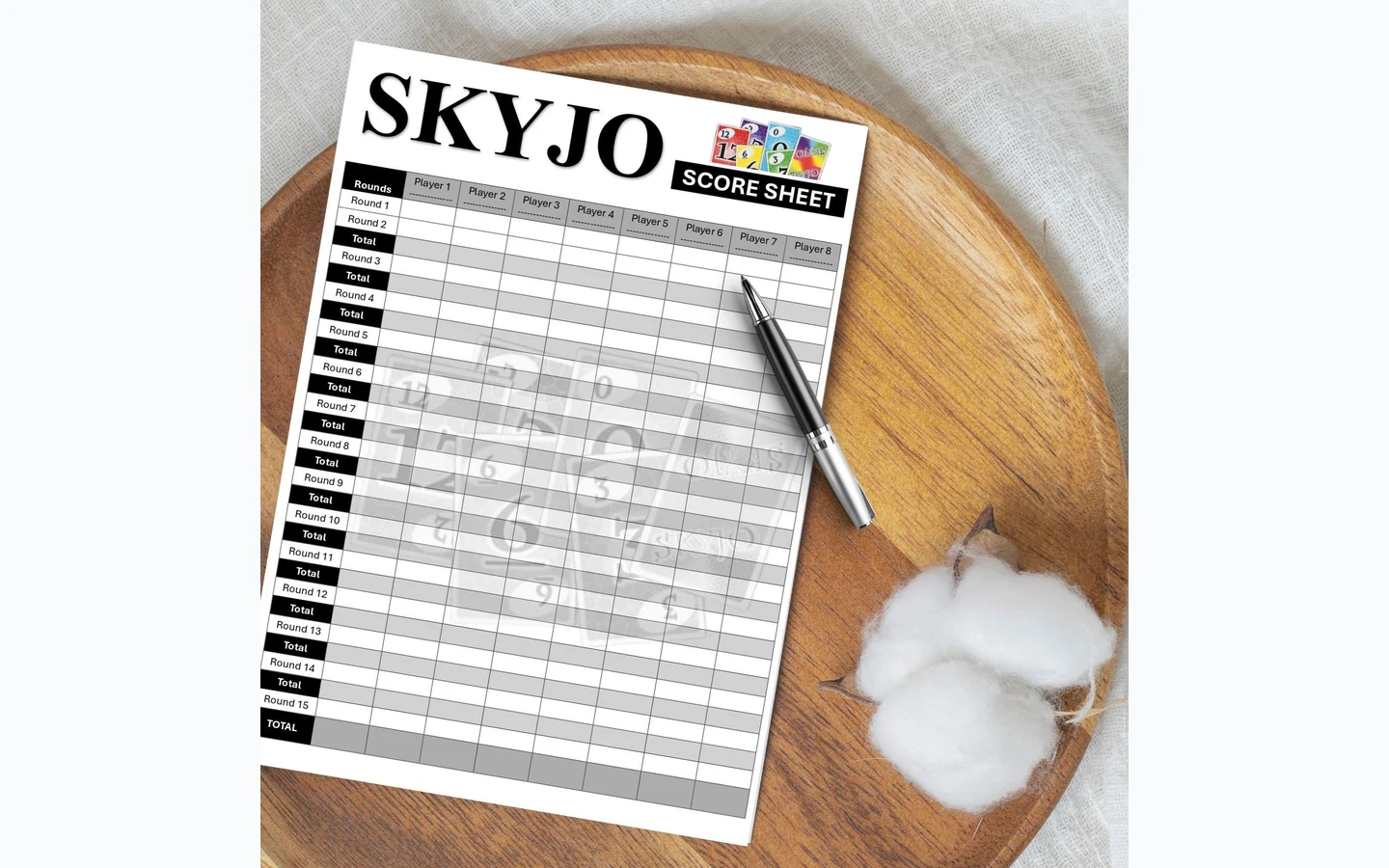
The score card below is the practical center of this guide. It has room for all eight officially supported Classic SKYJO players, twelve rounds, a total row and the two reminders most likely to prevent a scoring dispute. Twelve is a printing choice, not an official game length. The game stops when the completed cumulative totals trigger the 100-point rule; if an unusually low-scoring session reaches round 13, continue on a second copy.
SKYJO SCORE CARD
Classic · 2–8 players · lowest total wins
Date: ____________________
| Round | P1: ______ | P2: ______ | P3: ______ | P4: ______ | P5: ______ | P6: ______ | P7: ______ | P8: ______ |
|---|---|---|---|---|---|---|---|---|
| 1 | ||||||||
| 2 | ||||||||
| 3 | ||||||||
| 4 | ||||||||
| 5 | ||||||||
| 6 | ||||||||
| 7 | ||||||||
| 8 | ||||||||
| 9 | ||||||||
| 10 | ||||||||
| 11 | ||||||||
| 12 | ||||||||
| FINAL TOTAL |
Notation: write the adjusted round score; add * beside the player who ended the round.
End check: complete the row, then stop if any cumulative total is 100+; lowest total wins.
Notes / corrections: __________________________________________________________________________________
For two to four players, use the leftmost columns and leave the rest blank. For five to eight, switch the printer to landscape so names and two-digit entries do not collide. A blank column is not wasted space: it keeps one master layout reusable for every legal table size. If you want a compact duel-only sheet, print the active left side through your browser’s selected-area option or fold the paper after printing.
Enter the adjusted round result—not the raw subtotal—inside each cell. Put the asterisk beside the ender immediately, and use the notes line for a calculation such as “P4: 16 → 32*.” This table is designed to print directly from the page or through the browser’s Save as PDF command. It is not presented as a separate downloadable file, so what you see is the complete score card rather than a promise hidden behind a missing button.
Print, Save as PDF, and Reuse the Sheet
You do not need a special download button to turn the master score card into a PDF. Open your browser’s print dialog with Ctrl+P on Windows or Linux, or Cmd+P on macOS. Choose “Save as PDF” to keep a local file, or select your printer for an immediate paper copy. The print preview is the important checkpoint: confirm that the rightmost active player column and the FINAL TOTAL row are both visible.
For 2–4 players
- Use portrait orientation if the active columns remain comfortably wide.
- Write names only over P1–P4 and leave the unused columns blank.
- Keep scale near 100% so round entries stay easy to read.
For 5–8 players
- Choose landscape orientation before changing the scale.
- Use Fit to printable area only if the eighth column is clipped.
- Check that player names do not wrap into the first score row.
A reliable one-page print routine
- 1Open print preview and select A4 or US Letter to match the paper actually loaded.
- 2Choose portrait for a small table or landscape for a wide table; do not shrink first and investigate later.
- 3Turn off browser headers and footers if the URL, date or page number intrudes on the score card.
- 4Save one PDF and inspect it at normal zoom before printing a stack for game night.
Grayscale is perfectly usable because the table relies on labels, borders and an asterisk rather than color alone. If you keep the pale color bands, enable background graphics in the print dialog. A heavier sheet of paper is pleasant for repeated handling, but ordinary copy paper works better when you plan to archive finished score cards in a binder.
Turn one print into a reusable score board
For a regular group, slide the printed sheet into a clear document sleeve or place it behind a clear acrylic frame. Use a fine dry-erase marker so two-digit numbers fit cleanly. Before wiping the board, photograph the finished totals if your group tracks a season or settles bragging rights later. Reusability has a tradeoff: it saves paper, but an erased correction history cannot be recovered. Competitive groups are better served by paper; casual families may prefer the quick reset.
The site’s printable SKYJO rules reference makes a useful companion sheet. Print the rules once for the middle of the table and give the scorekeeper the score card; that keeps rule disputes away from the arithmetic column.
A Full Scoring Example and Table-Side Audit
Here is a complete final round traced from raw card subtotals to a winner. Lila begins the round on 83, Omar on 91, Priya on 70 and Theo on 84. Lila exposes her final card first, so the scorekeeper marks her as the ender before anyone touches the layouts. After the other three players take their final turns, every hidden card is revealed and all qualifying Classic vertical triples are removed.
From raw cards to adjusted row
The verified raw subtotals are Lila 16, Omar 11, Priya 16 and Theo 24. Lila does not have the uniquely lowest score: Omar is lower, and Priya also equals Lila. Because Lila’s raw score is positive, it doubles from 16 to 32. The other three scores stay unchanged.
| Player | Previous | Raw round | Adjustment | Write in row | New total |
|---|---|---|---|---|---|
| Lila — ender | 83 | 16 | ×2 | 32* | 115 |
| Omar | 91 | 11 | None | 11 | 102 |
| Priya | 70 | 16 | None | 16 | 86 — winner |
| Theo | 84 | 24 | None | 24 | 108 |
The scorekeeper writes 32* under Lila and notes “16 × 2” in the margin. The finished totals are 115, 102, 86 and 108. The game ends because at least one player reached 100 or more; Priya wins with 86, the lowest cumulative total. Notice how the three checks answer different questions: Omar’s 11 causes the penalty, Lila’s 32 is the number added to her history, and Priya’s 86 determines the winner.
The 30-second audit before the next deal
1. Ender
Is the asterisk beside the correct player?
2. Board resolved
Were final turns, reveals and mandatory vertical removals completed?
3. Raw subtotals
Did every player hear and accept the number, including minus signs?
4. Finisher test
Was the ender strictly lowest, and was any applied penalty positive-score only?
5. Running totals
Does previous total plus adjusted entry equal the new total?
6. End condition
Was the whole row finished before checking 100+ and ranking the lowest total?
If somebody spots a mistake, draw one line through the wrong number and write the correction beside it. Erasing or scribbling out the entry destroys the audit trail and invites a second argument later. Ask one non-scorekeeper to read the adjusted row and new totals back to the table. That verbal approval is the paper equivalent of pressing “confirm round” in a scoring app.
Do not gather the cards too early
Arithmetic can be corrected from a clear score sheet. A forgotten −2, an invalid row match or a vertical triple mixed into the discard pile cannot be reconstructed reliably after the deck is shuffled. Accept the row first; collect the cards second.

Loading comments...