Disneyland Paris exclusive · Buyer and rules guide
SKYJO Disneyland Paris Edition: Cards, Rules, and Buying Guide
Disneyland Paris announced an exclusive SKYJO box in February 2026. Here is what the official reveal and photographed packaging actually establish, where the 154-card wording gets confusing, how far Classic rules can guide your first game, and what to verify before buying a copy.
What Disneyland Paris actually announced
Disneyland Paris really did announce its own edition of SKYJO. In a February 18, 2026 Instagram post, the resort introduced an “exclusive Disneyland Paris edition” and said it was available in many of its stores, subject to availability. That is the strongest direct evidence for the product's existence and its original sales channel. A February 22 report also covered the reveal. The dated announcement matters because a listing found months later is not proof that a particular park shop has a copy on the shelf today.
The wording is narrower than many search snippets make it sound. “Available in many stores” does not name every store, promise permanent stock, or establish a global retail release. “Subject to availability” is a practical warning: even a shop that carried the game when the post appeared might sell out or change its assortment. The resort did not give a reliable live-stock feed, a fixed ongoing price, or a complete account of the special card's effect in that announcement. Treat those missing details as questions to verify, not as blanks to fill with guesses.
This is also a different claim from a reseller saying that it can source a copy. Third-party product pages can be useful for seeing a photographed box and finding potential sellers, but they speak for those sellers, not for Disneyland Paris. A fan's store sighting is even more time-sensitive. If the edition is the reason for a trip, ask the resort or the individual store about current stock shortly before visiting. If you are ordering from elsewhere, check the seller's current listing and terms instead of relying on the February launch post.
What makes the announcement interesting to SKYJO players is the combination of a familiar card game with park-specific character art and a box that calls out an exclusive card. The front and back of a physical package provide firmer details about those features than the social post alone. They also reveal an important card-count ambiguity in some retailer descriptions. Looking at that package is the next step before deciding whether this is a playing copy, a souvenir, or both.
What the physical box confirms
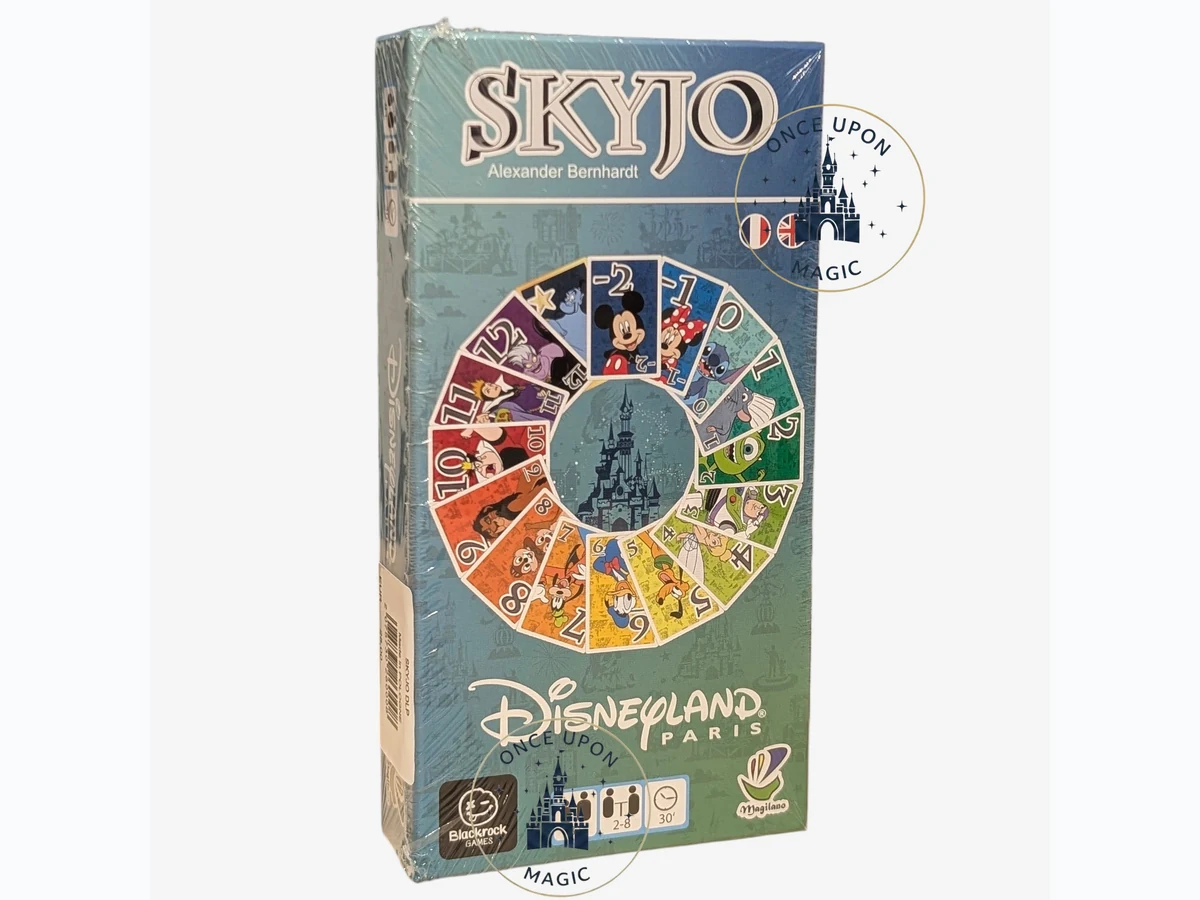
A photographed package is more useful than an enthusiastic product description because it lets you separate what is printed from what a seller has inferred. The front and back photographs in this retailer listing show a sealed Disneyland Paris SKYJO box. Its front carries Disneyland Paris, SKYJO, Magilano and Blackrock marks. Icons indicate two to eight players and an approximate 30-minute game, while French and UK flags suggest bilingual packaging. Those are observations about this photographed box; they do not verify that every online offer uses the same printing or includes the same insert.
Disney characters and card design
The visible card samples pair familiar SKYJO-style numbers with Disney character illustrations. That changes the look of the table immediately: the artwork gives players another detail to notice as they flip and replace cards. The package also presents the game as a Disneyland Paris exclusive, making it a souvenir as well as a playable box. Whether that visual difference is worth a search or a reseller premium is a personal choice, not a rules fact.
Look carefully at what the picture does not establish. A small group of displayed card faces does not prove the frequency of every value in the deck. It does not show the full rulebook, tell you whether card stock feels the same as Classic, or establish the language of every page inside. The flags on the front are a helpful clue; the sealed box alone is not a substitute for seeing the actual rules insert. If language matters to your group, request a photo of that insert before buying.
The 154-card count and the exclusive card
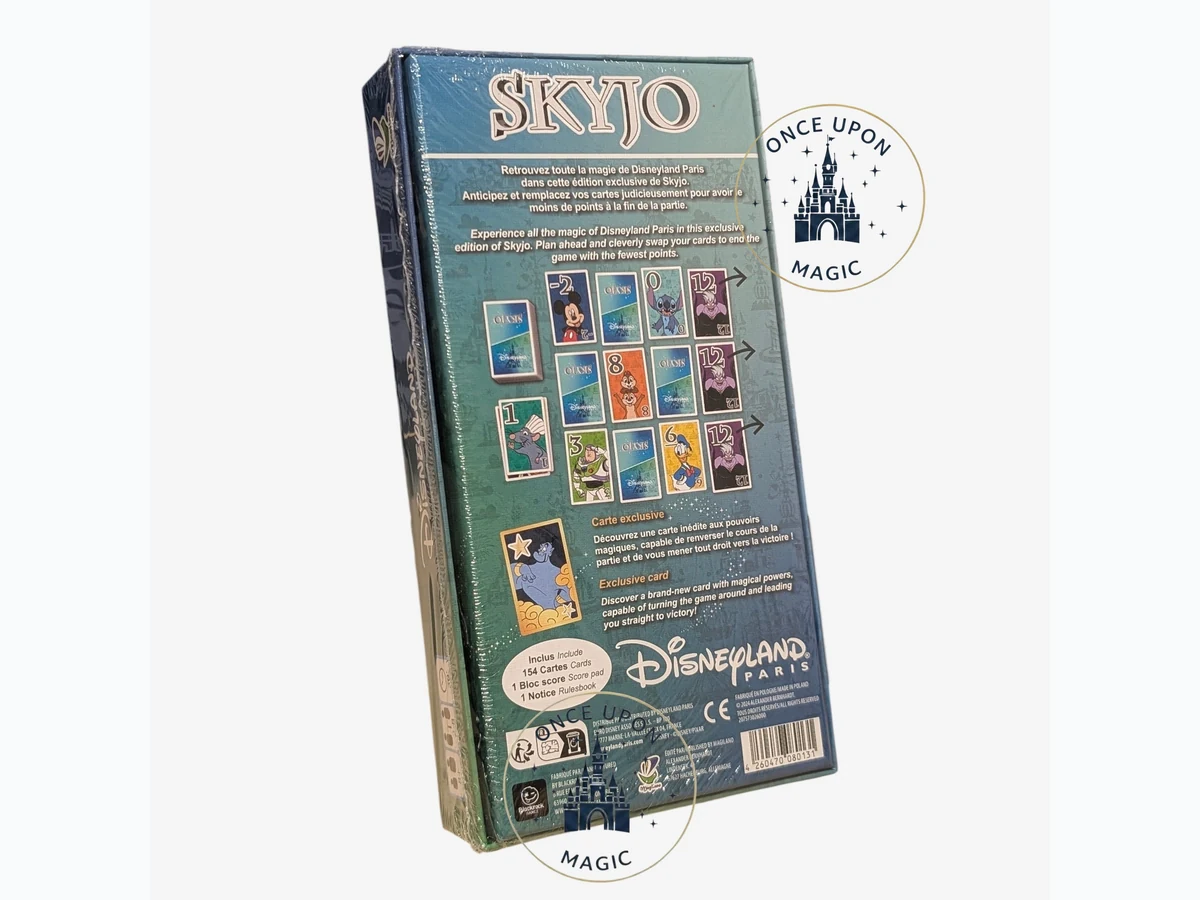
The photographed back lists 154 Cards, plus a score pad and a rulebook. It separately promotes an exclusive card with a magical, game-changing effect. A Genie-like character and star are visible on its example artwork. Yet the outside of the package does not explain how to play that card: it gives no trigger, timing window, scoring value, or duration. The effect belongs to the enclosed rules, so an Action rule borrowed from another SKYJO title would be an unsafe guess.
| Question | What the box supports | What still needs checking |
|---|---|---|
| Players and time | 2–8 players; about 30 minutes on the front | Actual session length for your group |
| Contents | “154 Cards,” score pad, rulebook | Whether the exclusive card is included in that printed count |
| Special rule | An exclusive card is advertised | Its exact effect in the enclosed rulebook |
Why the count caveat? The same retailer's text describes “154 illustrated cards” plus an exclusive card, which sounds like 155. The physical box instead prints “154 Cards” as its contents figure. With only an exterior photograph, there is no sound basis to declare which interpretation matches the cards inside. If you want a complete set, or you are comparing offers, ask for an insert or card-spread photo and describe the discrepancy to the seller. Do not assume the product is missing a card simply because two pieces of marketing copy use different arithmetic.
How much of Classic SKYJO carries over
The decorated cards still invite the obvious question: can you sit down with your usual SKYJO knowledge and play? The safest answer is to use Magilano's Classic SKYJO rulebook as a teaching baseline, then read the Disneyland Paris insert for any edition-specific instruction. The photographed Disney box identifies a SKYJO game for two to eight players and includes a rulebook. It does not print a complete turn sequence on the outside, so the Classic rulebook is a useful reference rather than proof that every detail is unchanged.
The turn structure you can rely on
In Classic SKYJO, each player lays out twelve face-down cards in a three-by-four grid, turns two face-up, and tries to finish with the lowest total. The highest sum of those two exposed cards starts the round. On your turn, you may take the top discard and use it to replace one card in your grid. Or you may draw a hidden card: replace a grid card with it, or discard the new card and reveal one of your own face-down cards. A replaced face-down card is revealed as it goes to the discard pile. This simple choice between a known card and a riskier draw is the heart of the game.
For example, imagine your exposed cards include an 11 and a 2, while the top discard is a 1. In Classic, taking that visible 1 to replace the 11 is an easy low-score move. Drawing instead could find an even better card, but it could also force you to reveal another unknown value. That trade-off makes the rules approachable even when the character illustrations are new to the table. For a complete explanation of round endings, scoring and the three-of-a-kind column, see our Classic SKYJO rules guide; apply the Disney insert if it changes any of those points.
Classic also lets you remove a vertical column when all three of its face-up cards show the same value. A round enters its final turns once one player has revealed all their cards. These mechanisms explain why a printed number matters more than the illustration during ordinary decisions. Yet there is a limit to the inference: the Disney box photos do not display every card, so they cannot independently prove that the Disney deck has the same frequency of each number, identical discard wording, or no extra exception. Open the supplied rulebook before announcing those details as facts about this edition.
Where the special card needs its own rule
The back of the Disneyland Paris box advertises an exclusive card and pictures a Genie-like character with a star. It does not say what event activates the card, whether it replaces a numbered card, how long an effect lasts, or how it scores. Those are exactly the questions that decide whether a table can play it correctly. If someone tells you “the star works like it does in SKYJO Action,” ask for the Disneyland Paris rulebook wording. SKYJO Action has a separate publisher rulebook and its own components. A similar symbol on a different edition is not enough to transfer a rule.
| Use now as a guide | Confirm from the Disney insert |
|---|---|
| Classic's twelve-card grid and low-score goal | Any setup or scoring changes for this printing |
| Classic's discard-or-draw turn choices | When and how the exclusive card is played |
| Classic's matching-column and round-end explanations | How the special card interacts with either rule |
For a first game, teach the familiar draw-and-replace rhythm, identify the exclusive card when it appears, and read the exact instruction in the enclosed booklet before resolving it. If you are buying an opened copy without a booklet, request a photograph of that page or ask the publisher for help. You could agree on a temporary house rule with your group, but label it as your own choice. This keeps the Disney box fun without turning a plausible visual guess into a false “official” rule.
How to check a copy before you buy
Buying a park-exclusive edition is more like finding a souvenir than ordering a standard mass-market deck. The product exists, but the official launch post's availability caveat and the mix of independent listings make it worth checking the specific copy and transaction. This short sequence keeps the decision tied to what you can verify today.
Park shops and resellers
If you will be at Disneyland Paris, start with the resort's own current merchandise channels or ask staff which shops have the game that day. The original announcement said many stores carried it, subject to availability; it did not promise a fixed shop, a permanent supply, or online checkout through Disneyland Paris. A fan's sighting at one store can be a lead, but only a fresh confirmation can help you plan a visit around it.
If you are shopping remotely, independent sellers such as Once Upon Magic, Magical Park Shop, and Dreams Shop DLP have listed the edition. They are third-party purchase routes; the presence of a product page does not mean an official park store currently has stock. One seller explicitly describes sourcing as dependent on park availability. Before paying, check whether the seller actually holds the item or will seek it after you order, then read the expected dispatch time, cancellation and return terms.
Compare the whole amount you would pay, including delivery, currency conversion and any destination-specific charges shown at checkout. A reseller's current price and stock can change, so an old screenshot is less useful than the live final checkout. If the item is a gift for a date, the difference between “in stock” and “we will try to obtain it” matters more than a small price difference.
Front, back, language and condition
Ask for photos of the actual copy whenever the listing uses only promotional images. Compare the front with the photographed Disneyland Paris branding, character-number cards, SKYJO name, and Magilano and Blackrock marks. Compare the back with its “154 Cards” contents line, score pad, rulebook, and exclusive-card panel. This is a practical way to catch a mismatched Classic, Action or Voyage listing, but a matching photograph alone cannot authenticate every copy.
Next, confirm condition. A sealed box may suit a collector, while an opened box can be perfectly good for play if the seller shows the cards, score pad and complete rulebook. Ask about crushed corners, torn shrink-wrap, writing on components and missing pieces rather than relying only on “new” or “good” labels. If the edition's language matters, the French and UK flags on the pictured front are a clue; ask to see the actual enclosed instructions. That also lets you verify the special card's rule, which the outside of the box does not explain.
Finally, raise the card-count wording if it affects your choice. The box prints 154 cards, while some sales text describes 154 illustrated cards plus an exclusive card. Ask the seller to confirm what the physical copy contains rather than declaring it incomplete from a description alone. Keep a copy of the exact listing and the seller's answer so the product you receive can be compared with what was offered.
Who should choose it over Classic, Action, or Voyage
The Disneyland Paris box has a clear reason to exist even before anyone knows the exclusive card's full rule: it lets a group play with Disney character art and gives a park visitor a recognizable souvenir. That is a different kind of appeal from buying another deck solely to change the rules. The visible package shows a real special-card promise, but the outside does not establish whether that single card makes the game faster, deeper, easier, or more unpredictable. Let the verified differences guide the purchase.
| Your priority | Edition to consider | What to check |
|---|---|---|
| Disney art or a park souvenir | Disneyland Paris edition | Current stock, real box photos, and the exclusive-card insert |
| A familiar first SKYJO game | Classic | The standard rules and a suitable seller |
| Extra rule elements | Action | Its own publisher rulebook |
| A travel-oriented version | Voyage | Current package details and our Voyage comparison |
Classic is the clearest starting point if your main aim is to teach ordinary SKYJO from a publicly available publisher rulebook. There is no exclusive-card uncertainty to resolve before the first deal. Disneyland Paris can still be your first copy if the character art is what draws your group in; just make time to read the enclosed rules rather than assuming the photo tells the whole story. For a collector, the condition of the actual box and the presence of its insert may matter as much as how often it reaches the table.
Action is a more deliberate choice when your group wants additional mechanisms. Magilano provides a separate Action rulebook, which is reason enough to treat it as its own game rather than as an explanation of the Disney card. Voyage is worth comparing when the practical question is what to pack. Its travel focus does not mean that the Disney box is less fun at home; these products answer different needs. Check each current box rather than importing details from one edition to another.
If you are deciding today, ask yourself which feature would still please you after the novelty wears off: Disney art, the straightforward Classic baseline, Action's extra rules, or a travel-focused format. Then verify the exact listing, available stock and included instruction booklet. The Disney edition is easy to appreciate for what the box demonstrably offers, while the exclusive card deserves to be played according to its own printed rule rather than an online guess.

Loading comments...