Head-to-head SKYJO Action
SKYJO Action for 2 Players: Rules, Tactics, and Endgame Examples
Play the normal twelve-card game with one opponent, learn the three turn choices, and judge a finish by the reply it leaves behind. These worked examples cover the physical Action edition, including stars, action-card liabilities, and the final-turn restrictions.
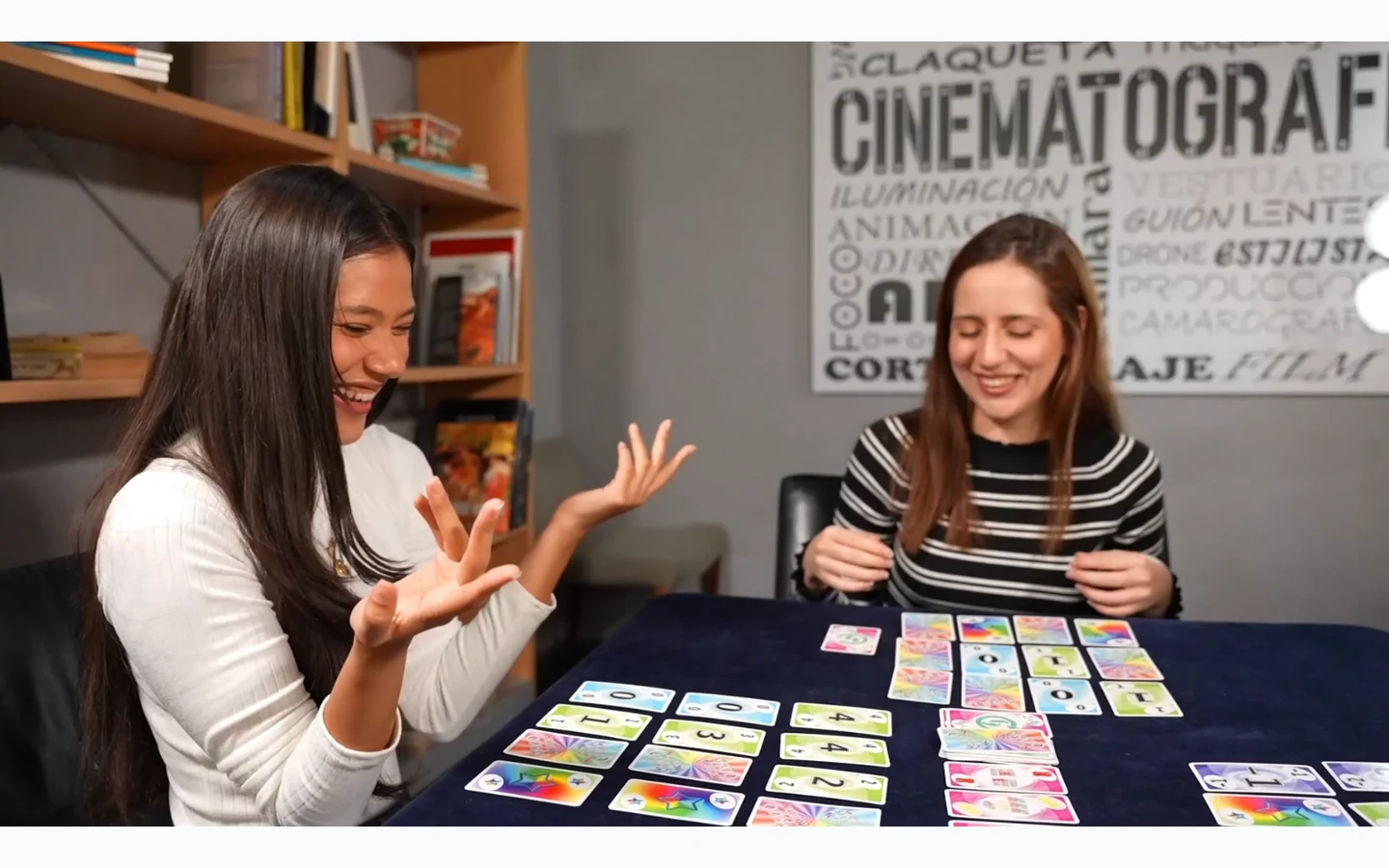
Magilano supports SKYJO Action at two players. The rules below keep that published game intact; the hypothetical positions explain the decisions it creates.
Set up a two-player game without changing the rules
Two people can play the normal physical SKYJO Action game. You do not need a smaller grid, a second box, or an invented two-player deck. Magilano lists the game for two to eight players. The important change at two is your attention: the same opponent receives your discards and answers your attacks throughout the round. Keep the published setup intact while learning what that direct relationship does to your decisions.
Deal 12 playing cards to each player, face-down, and arrange each display as four columns of three. Neither player looks at the hidden values. Each turns over any two cards. In the first round, the higher sum of those two exposed cards determines the starting player; in later rounds, the person who ended the previous round starts. Do not turn an equal opening sum into a scoring bonus: resolve an opening tie before play and move on.
Separate the playing cards from the action cards
Shuffle the number and star cards together as the playing deck. Put its remaining cards face-down in the center and turn one card face-up beside them to start the playing discard pile. Shuffle the action cards separately, reveal four in a row, and place the remaining action deck beside that row. Start a separate action discard pile as shown in the instructions. When someone takes a displayed action, refill its space immediately from the action deck.
Give the two decks different areas of the table. A player should be able to point to the playing draw pile, playing discard, four action choices, action draw pile, and action discard without hesitation. Acquired actions lie face-up beside their owner's display. They are public information, so placing them underneath the grid or holding them secretly changes the game. The box's stated 150 cards is an overall component count; it does not mean you should add another 30 actions to a 150-card numbered deck.
For your first round, arrange the displays so both people can see the other player's face-up numbers and acquired actions. Keep gaps created by later removals clear rather than casually sliding cards into a new pattern. You want to learn which existing horizontal or vertical lines can clear, not create accidental new matches by tidying the table.
If you know the original game, use our SKYJO edition comparison to orient yourself, then learn the Action turn below. Importing a familiar Classic rhythm without accounting for separate action turns is the fastest route to playing this edition incorrectly.
Learn the ordinary turn before adding action effects
Your turn normally consists of one of three alternatives: draw a playing card, acquire an action card, or play/discard an action you already own. Those are competing uses of the turn. You do not routinely improve your grid and then unload several actions for free. Specific effects can grant additional moves, but that permission comes from the card, not from a general extra-action phase.
Take the discard or draw unseen
Taking the top playing discard commits you to exchanging it for one card in your own display. The incoming card stays face-up; the outgoing one becomes the new discard. You may replace a visible number or a hidden card, but you cannot inspect that hidden card before deciding. Drawing from the face-down playing deck gives you a choice after you see the draw: exchange it into your display, or discard it and reveal one of your hidden cards instead.
Suppose you have an exposed 11 and draw a 2. Replacing the 11 removes nine known points and leaves the number of hidden cards unchanged. Replacing a hidden card opens that position and might reveal that you discarded something better than the 2. Neither option is universally correct. Against an opponent nearly ready to close, a guaranteed reduction may matter more; early in a round, exposing uncertainty can improve your later decisions. These are tactical choices within the same legal exchange.
Resolve stars and matching lines
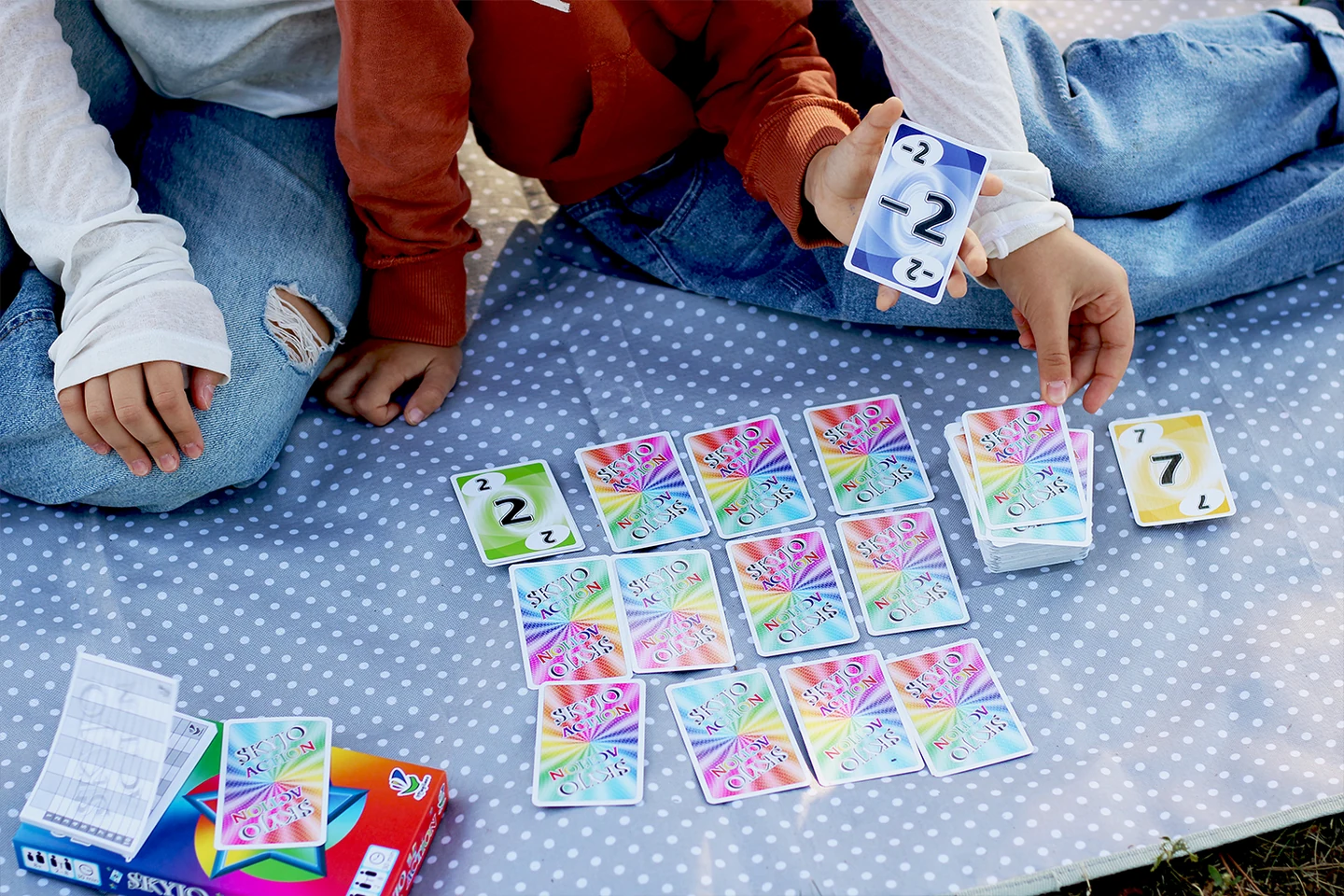
A newly revealed or newly placed star can grant a one-time action-card acquisition, including when you take a star from the playing discard. This entitlement also applies to stars among the two opening reveals. Choose a displayed action or the top face-down action, and keep it face-up beside your display. Normally, you must wait until a later turn to play it. The star's entitlement expires with that turn; swapping an already exposed star around does not repeatedly produce actions.
At the end of your turn, complete equal-number horizontal or vertical lines containing at least three cards must be discarded. This includes negative-number matches. A full starting horizontal row contains four cards: three 6s beside an unmatched fourth card do not qualify. Stars can temporarily match the needed number in their line, so an exposed vertical column of 8, star, 8 can clear. The star itself remains worth zero rather than becoming eight points.
When an exchange completes a removable line, discard the replaced card first and then the matching line; you may choose the order of cards within that removed line. This order matters because your opponent sees only the new top playing discard as an available pickup. Check the full position before passing the turn, especially when a star could complete more than one line. You cannot count the same physical card twice.
Read the discard pile as a conversation with one opponent
At a larger table, a useful discard may disappear before play reaches the person you were watching. With two players, your next opponent is always the same person. Before replacing a visible number, look across the table and ask what that number can finish. A high card is not automatically an unattractive gift: matching potential can make an 8 more valuable than a 1.
Imagine your opponent has a vertical column showing 8, 8, and one hidden card. Offering an 8 lets them replace the hidden card and clear that column at the end of the turn. The two exposed 8s already account for 16 points; the hidden card's value is unknown, so do not announce a precise total gain. Nevertheless, you have identified a concrete threat. If your alternative is replacing your own 9 with a 2, that saves seven known points. Compare those benefits instead of applying a blanket rule to take every low card.
Sometimes your own improvement is still worth the offer. You may be far behind, need to eliminate a much larger number, or have no safe way to leave a worse top discard. Sometimes an action turn keeps the dangerous number out of the playing discard while helping another part of your position. That alternative costs your opportunity to draw a playing card this turn. Refusing a useful exchange repeatedly can leave your own grid expensive while you wait for a perfect defensive move.
Line removal adds another choice. If you clear a vertical 8, star, 8, the removed cards sit above the card you originally replaced. Choosing an 8 as the final top card offers an ordinary matching value; choosing the star offers a wild card and a qualifying action acquisition when taken. Look at the other display before deciding the order. In most positions, feeding an easy star is a generous offer, but the exact competing number can also complete a valuable line.
Do not assume your opponent must take the bait. They can draw blind, acquire an action, or use an action instead. An action turn may leave the playing discard untouched until your next turn, which can change your own plan. Track what remains available rather than treating each pass as proof that a number is useless. For a broader treatment of action timing and line-building, continue with our SKYJO Action strategy guide; the head-to-head habit here is simply to evaluate both sides of every offer.
Spend action cards with the score and the next turn in mind
Acquiring an action is not the same as using it. If you spend your turn taking a displayed action, your opponent normally gets a turn before you can play it. Both players can see the card you selected. At two players that makes planning unusually readable: a visible swap threatens specific numbers, while an inspection effect suggests that hidden information will soon matter. Buy the opportunity only when the likely benefit justifies delaying your grid improvement.
Attack the position that matters
A swap attack can improve your score and worsen your opponent's at the same time. If an unprotected opponent has an exposed 1 and you have an 11, exchanging those cards face-up reduces your grid by ten and increases theirs by ten. The immediate score difference shifts by twenty, assuming neither change triggers a line removal. That is a useful way to evaluate a specific attack, not a claim that every swap is worth twenty.
Before acting, examine the destination. Giving away an 11 could finish the opponent's line of 11s and erase the card you intended as a burden. Taking their low number could break a line they were preparing, which may matter more than the small number itself. An attack that reveals somebody's last hidden card can also close the round. That makes the attacker's identity important for the finisher penalty discussed below.
Defense has a price even when it succeeds
Defense protects automatically against one attack while it lies in your action area; the protective card then goes to the action discard. It is not a secret reaction you can save for whichever attack feels most damaging. On an eligible turn, you can instead actively play it to discard it and receive an additional turn. Its protection ends immediately, so do not plan that next move as though the shield still exists.
This creates a real choice when your opponent is close to finishing. Keeping protection may preserve a valuable star arrangement against an attack. Spending it may remove a ten-point liability and let you use the additional turn productively. The best choice depends on the attacks actually visible, the risk of ending, and your current score. A shield that blocks nothing before scoring is still an unused action card.
Clear the action-hand liability before the round closes
Each action left beside your display adds ten points at scoring. A grid totaling four with two unused actions is therefore twenty-four before any finisher adjustment. Because ordinary disposal consumes a turn, you cannot assume you will empty a large action collection just before the other player closes. Start reducing that liability while ordinary action play is still available.
Respect the printed exceptions rather than inventing combos. Reactivation explicitly lets its selected discarded action resolve immediately. Action Card Thief grants an additional turn, but the stolen card must wait until after another player has taken a turn. You cannot steal a powerful effect and automatically use it in the same uninterrupted sequence. At two players, mark that waiting point clearly: your opponent must receive the intervening turn.
Finish the round only after pricing the reply
The finisher is the player whose move reveals the last hidden card in somebody's display. That can be your own display, but an action affecting your opponent can also do it. The scoring responsibility follows the person who caused the finish, not automatically the person whose cards are now exposed. At two players there is one other person to answer, which makes the reply easier to inspect but does not make it harmless.
The final turn is different
After the trigger, the other player receives one more move. Action cards cannot be played or discarded during this final lap. A saved swap or an unwanted shield is therefore not a reliable last-turn escape. The final move is not permission to empty the action area. This restriction is a reason to spend or dispose of actions before either display reaches the closing point.
Consider a hypothetical finish in which you end on eight points with no actions remaining. Your opponent has five points in exposed numbers, one hidden card, and no action cards. You leave a 0 on top of the playing discard. If taking it produces no matching removal, the opponent can replace the last hidden card with that known 0 and finish on five. You record sixteen, because your positive eight was not strictly lower. The hidden card's original value never needed to be known: your discard supplied a guaranteed reply.
Before deliberately closing, inspect that exact next move. Can the opponent take the visible discard to replace a large number or complete a line? Are your own acquired actions included in the number you are comparing? Could a star arrangement change the count? You cannot calculate away every unseen card, but you can avoid losing to a reply already lying face-up in the middle of the table.
Count every part of the score
Once the final move is resolved, reveal remaining hidden cards and apply valid line removals before recording the result. The matching rule still applies during this scoring reveal, and star conversions can help complete eligible lines. Individual stars count zero. A complete retained three-star line earns minus ten; a complete retained four-star horizontal line earns minus fifteen. All-star lines may be kept instead of discarded, and each physical star can contribute to only one counted line.
Add ten for every unused action card, then compare the complete round totals. A finisher with a positive total must be strictly below the opponent: equality also fails. Zero and negative finisher totals are exempt from doubling, even when the opponent scores better. These are edition rules in Magilano's SKYJO Action rulebook, not an optional two-person handicap.
| Finisher's complete round total | Opponent | Finisher records |
|---|---|---|
| 10 | 9 | 20 |
| 10 | 10 | 20: a tie fails |
| −3 | −7 | −3: negative exception |
| 6 in the display + one unused action = 16 | 12 | 32 |
Add each recorded round score to the running match total. The game ends when a completed round puts a player at 100 or more cumulative points; the lower cumulative total wins. An attractive individual round does not erase the match score. If you are already trailing, judge whether a cautious finish protects a recoverable position or merely locks in the lead your opponent already owns.
Teach your first head-to-head round with a short routine
Magilano recommends removing Action Card Thief and Meteor Shower when teaching beginners. Set aside those card types before shuffling the action deck, rather than discovering the change halfway through a round. This is a published teaching recommendation, not a special mandatory two-player rule. Leave the normal display size, ordinary turn choices, scoring, and ending restrictions in place.
For the first round, say your chosen alternative aloud before touching a deck. “I am taking a playing card” is enough; the point is to separate that move from acquiring or playing an action. If a star creates an action entitlement, explain why that acquisition is attached to the star instead of treating it as evidence that every turn includes a free action. Once that distinction is comfortable, most other timing questions become easier to answer.
| Moment | Say or check |
|---|---|
| Before the move | Which of the three alternatives am I taking? |
| Before an exchange | What am I giving the other player, and can it finish a line? |
| At the end of the turn | Is there a complete matching line or an expiring star entitlement? |
| Near the finish | How many ten-point action liabilities are still beside each display? |
| When someone closes | Who caused it, who has the final move, and are actions now barred? |
After scoring, identify one decision each person would change. A useful answer is specific: “I handed you the 8 that cleared your column,” or “I kept two actions when you had only one hidden card.” Avoid turning a lucky low draw into proof of a superior strategy. The teachable part is what information was available when the move was chosen.
Restore the full action selection when both players can explain the ordinary turn and final lap without prompting. If direct attacks make the duel less enjoyable for your pair, discuss the action selection before the next deal rather than silently changing effects. Two-player SKYJO Action works best when both people share a clear rules baseline and can then concentrate on the interesting question: which legal move leaves the better position after the other person replies?

Loading comments...