Voyage rules · Beginner guide
How to Play SKYJO Voyage: Complete Rules & Scoring Examples
Learn the compact edition from the first deal to the final total: both turn choices, matching columns, last turns, and the scoring penalty that catches new players.
2–4 players · 2025 Voyage booklet · Worked turn and score examples
Know Your Voyage Edition and the Winning Goal
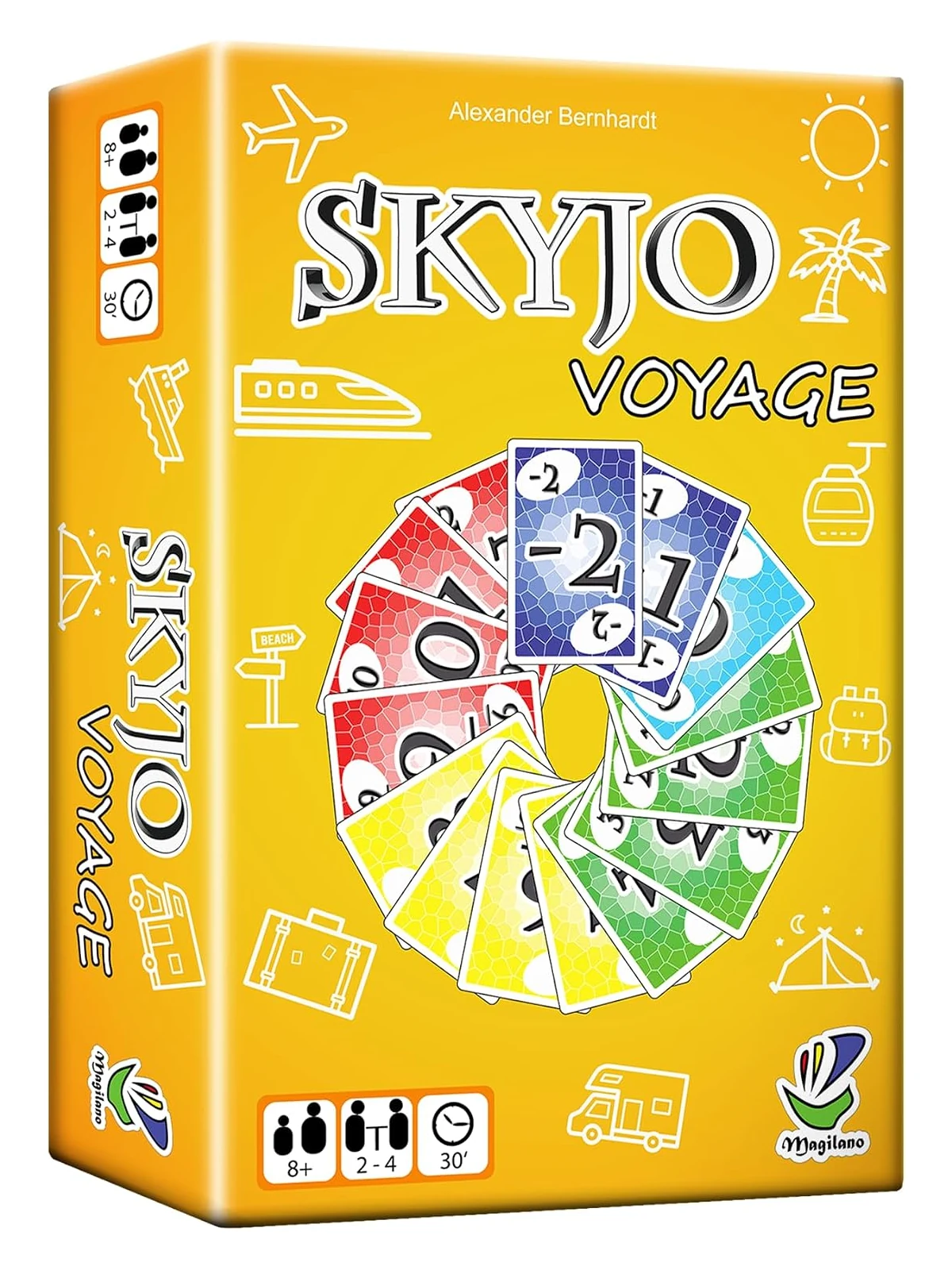
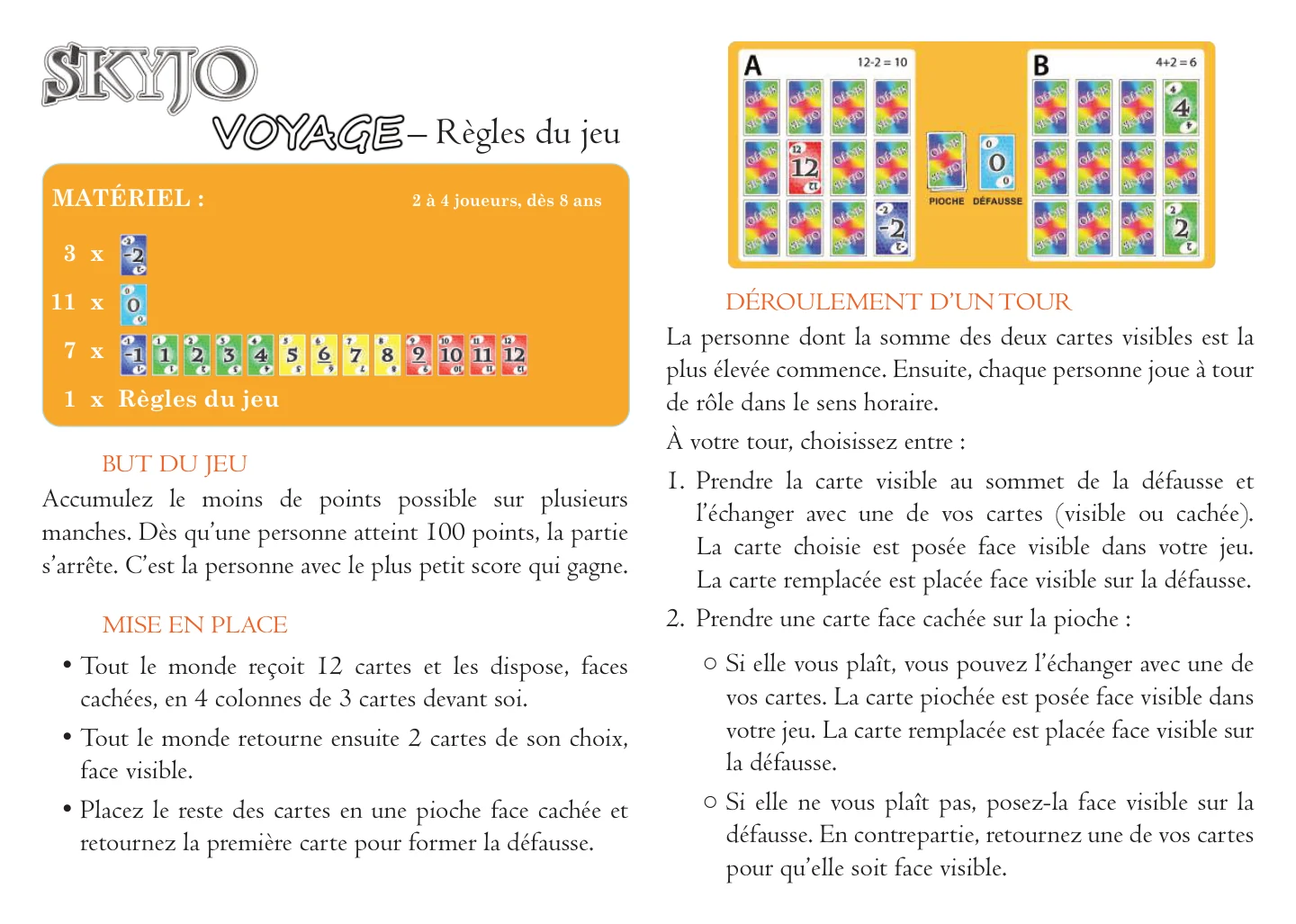
SKYJO Voyage is the compact number-card edition for two to four players, ages eight and up. This guide follows the 2025 French Voyage booklet credited to Alexander Bernhardt and published by Magilano. Its component illustration totals 105 cards: three −2 cards, eleven zeroes, and seven copies each of −1 and 1 through 12. Some product listings show a different count; use the booklet supplied with your exact box when identifying a printing.
For learning the game, the important distinction is between a round and the whole game. A round is one deal of cards, followed by turns and a score calculation. The game consists of several rounds, with each new score added to your running total. Your goal is the lowest cumulative score. Reaching 100 is the condition that ends the game; it is usually bad news for the player whose total reaches it.
Think of each remaining card as an entry on your eventual bill. A 12 is expensive, a zero adds nothing, and a negative card reduces the bill. You can replace individual cards and remove certain matching columns, but revealing cards also brings the round closer to its ending. A player who finishes first may therefore lose that round on points. Keep those two ideas separate when teaching children: getting your cards face up is a timing decision, while keeping your score low is the objective.
Voyage uses number cards rather than the powers and star-card system of SKYJO Action. If you are choosing between boxes or want the physical differences from Classic, read our SKYJO Voyage versus SKYJO comparison. For the first round here, you need the Voyage deck, a stable playing surface, and a way to record each player's total.
Set Up the Twelve-Card Grid
Shuffle the deck thoroughly before dealing. Each player's personal layout needs twelve cards arranged in four columns of three. Leave enough space between neighboring columns to make their boundaries obvious. A compact deck can fit a smaller table, but every player still needs twelve separate positions and room to move a card without disturbing the layout.
Deal the Cards and Prepare the Shared Piles
Deal the twelve cards face down to everyone. Arrange them without looking at their faces: four across and three down. The remaining cards form the face-down draw pile. Turn its top card face up beside it to begin the discard pile. Put both piles where every player can reach them; a player should not have to slide somebody else's grid aside to take the visible card.
A useful inventory check follows directly from the 105-card deck. Two players use 24 cards in their grids, plus one opening discard, leaving 80 in the draw pile. Four players use 48 in their grids, plus one discard, leaving 56. Revealing a card already in a grid does not reduce the draw pile. These counts are simply setup arithmetic, useful if an incomplete or mixed deck makes the table look wrong.
Reveal Two Cards and Choose the Starting Player
Each player turns over any two cards in their own grid. Add those two values, including negative signs. The person with the highest opening sum takes the first turn, and play proceeds clockwise. For example, Mia reveals 12 and −2 for 10; Ben reveals 4 and 2 for 6; Ava reveals 8 and 1 for 9. Mia starts because her combined value is highest, even though one of her cards is negative.
The two revealed cards stay where they were placed. Do not rearrange the grid to manufacture a promising column. The booklet does not specify an opening-total tie-break, so if two people share the highest sum, agree a simple starter between them before play. A coin toss is a convenient table agreement rather than an extra printed rule. At later deals, follow the setup and starting instructions in your Voyage booklet; avoid automatically importing a remembered Classic convention.
Take a Turn: Two Routes, One Required Decision
Start each turn by choosing a pile. The visible discard offers certainty about the card you receive; the hidden draw pile offers an unknown card and a decision after you see it. You choose one route. Drawing blind does not reserve the old discard for a second choice, and taking the visible discard does not also give you a hidden draw.
Take the Face-Up Discard and Exchange It
Take the top face-up discard and exchange it with one card in your own grid. That outgoing card may be visible or hidden. Put the incoming card face up in the same position, then put the outgoing card face up on the discard pile. Taking the visible discard commits you to an exchange. You cannot pick it up, change your mind, and treat the turn as a free reveal.
Suppose your grid contains a visible 11 and the discard shows 1. Replacing the 11 with the 1 cuts the value of that position by ten points. If you instead replace a hidden card, the improvement is uncertain: the outgoing card might be a 12, but it might be −2. Choose the position before turning that old card over. Once it is replaced, the old card goes to the discard rather than back into your grid because its value surprised you.
An exchange with an already visible card leaves the number of hidden cards unchanged. You do not also reveal another card. That matters when you want to improve a score without immediately accelerating the ending. Look at the next player's layout as well: your discarded 11 might be exactly the number they need for a matching column. This is a consequence to notice, not a reason to refuse every helpful exchange.
Draw Blind, Then Keep or Discard the Card
Draw the top face-down card and look at it. If you keep it, exchange it into your grid using the same procedure: incoming card face up, outgoing card face up on the discard. If you reject it, put the drawn card face up on the discard and reveal one hidden card in your own grid. Rejecting the draw still changes your layout by giving everyone information and reducing your hidden-card count.
For example, you draw a 2 while showing a 10. Keeping the 2 and replacing the 10 saves eight points at that position; you make no additional reveal. On another turn, you draw a 12 and reject it, then flip a hidden grid card that turns out to be 9. The 9 remains in place. You do not get to exchange it with the rejected 12 or take another draw simply because the reveal was disappointing.
The trade-off is concrete. Replacing a visible high card produces a known score change. Replacing a hidden position changes its value without first learning what you are surrendering. Rejecting a draw preserves your current cards but reveals one of them and moves the round closer to its finish. New players learn faster when they say their completed route aloud: “I keep this and replace that,” or “I discard this and reveal that.”
Remove Three Matching Cards in a Vertical Column
The special removal rule applies when three cards of the same value are face up in one vertical column. Discard those three immediately. A horizontal row does not qualify, a diagonal does not qualify, and two matching cards plus one hidden card do not qualify. The hidden card must actually be revealed or replaced to establish the third visible match.
A removed column contributes nothing to your eventual score. Leave its positions empty rather than dealing three replacement cards, and continue with the remaining columns. You may move a whole remaining column slightly for space, but do not sort individual cards into new combinations. Keeping the original column relationships clear is especially helpful on a crowded table where a small accidental shift can make a legal match appear ambiguous.
A Worked Column-Clearing Example
Imagine a column with two visible 8s and a hidden bottom card. You take an 8 from the discard and exchange it into that bottom position. The outgoing card goes onto the discard, and your column now shows 8, 8, 8. Remove all three. Their combined value of 24 no longer appears in your grid's score. A column showing 8, 8, 9 instead remains and would total 25; proximity alone creates no bonus.
This explains why keeping a fairly high number can sometimes make sense: an 8 can complete a valuable removal even though it would be an unattractive isolated card. The condition is an existing pair in the same column and a legal exchange into its third position. Without that pair, keeping an 8 merely because “matches are good” may leave you carrying points for a plan that never completes.
Removal is immediate, even when its arithmetic is unhelpful. Three −1 cards contribute −3 before removal; once discarded, those positions contribute zero. Losing that negative total raises the value of your remaining layout by three relative to keeping the column. Three zeroes also disappear, but the numerical score does not change. The useful lesson is that “fewer cards” and “fewer points” are related only when the removed cards were positive.
Finish the Round in the Correct Order
A player triggers the ending when their remaining grid has no face-down cards. They need not display all twelve original cards: cleared columns are already gone. Announce the ending clearly, because each other player gets one final turn. The person who triggered it does not receive another turn after everyone else has played.
- Complete the ending player's turn and any matching-column removal.
- Give each other player one normal final turn in clockwise order.
- Reveal every card still face down in the remaining grids.
- Remove any matching vertical columns established by that final reveal.
- Add the remaining cards, then apply the ending player's scoring condition.
Suppose the clockwise order is Mia, Ben, Ava, Dan, and Mia reveals her last hidden card. Ben, Ava, and Dan each play once; Mia does not play again. Ben might use that chance to replace a visible 12 with a zero. Even if he still has several hidden cards afterward, he gets no extra turns to uncover them individually. They are all revealed during the collective scoring preparation, and he must live with the values left there.
The collective reveal can improve a score as well as damage it. Ava may have two visible 6s with a hidden third card below them. If that hidden card is also 6, the column disappears before she counts points, removing an 18-point total. This is why Mia cannot decide whether she avoided the ending penalty by looking only at the opponents' visible sums when she finishes. Their final turns and final hidden cards still matter.
Another possible interruption is an empty draw pile. The two-page 2025 Voyage booklet does not specify a recycling procedure, so agree how your table will handle that case before starting a long session. Do not treat an empty pile as an additional printed round-ending condition. The site's Classic SKYJO rules hub offers broader background, but keep your Voyage booklet's wording as the reference for this edition.
Score the Round and Apply the Ending Penalty
Calculate everyone's raw grid total first, after all final turns, reveals, and column removals. Then decide whether the player who ended the round must double their score. Finally, record the resulting round scores and update the running totals. Keeping those three operations separate prevents arguments about whether a tie was measured before or after the penalty.
Add Remaining Cards, Including Negative Values
Suppose you have removed one column and your nine remaining cards form these three columns: −2, 0, 4; then 1, −1, 3; then 2, 0, 1. Their subtotals are 2, 3, and 3, giving a raw score of 8. The negative signs matter: the −2 cancels two points of the 4, while −1 reduces the next column's sum. The removed column adds nothing.
Do not award a separate removal bonus or subtract the discarded column a second time. Its benefit is already represented by leaving those cards out of the sum. Reading each column aloud is a useful beginner check, especially if several cards were revealed at the end and the layout now looks very different from its last visible total.
Double a Positive Ending Score That Is Not Strictly Lowest
The ending player must have a raw score strictly below every opponent's to avoid doubling a positive result. A tie for lowest is insufficient. If Mia triggers the ending with 8 and Ben also finishes with 8, Mia records 16 while Ben records 8. Being first to reveal everything does not give Mia a tie-break advantage.
| Ender's raw score | Opponents' raw scores | Ender's recorded score | Reason |
|---|---|---|---|
| 8 | 10 and 13 | 8 | Strictly lowest |
| 8 | 7 and 13 | 16 | An opponent is lower |
| 8 | 8 and 13 | 16 | Tied for lowest |
The adjustment belongs to the ender's round score, not their whole accumulated score and not every player involved in the tie. If Mia had 40 from earlier rounds, her penalized 16 makes the running total 56; it does not turn 48 into 96. This distinction is especially important late in the game, when a small round penalty can push a player across the ending threshold.
Handle Zero, Negative Scores, and the 100-Point Finish
The Voyage booklet exempts a negative ending score from doubling. If Mia ends on −1 and Ben has −3, Mia still records −1. She is not the lowest, but her negative result is not turned into −2. A zero remains zero as well: even if a rival scores −2, doubling zero cannot create positive points. Do not invent a fixed penalty because zero seems too forgiving.
Add each recorded round score to that player's cumulative total. The following example uses scores after any ending penalty. Notice that Ava's −2 in the second round lowers her running score instead of being treated as zero.
| Player | Round 1 | Round 2 | Round 3 | Cumulative total |
|---|---|---|---|---|
| Mia | 12 | 8 | 14 | 34 — winner |
| Ben | 35 | 38 | 30 | 103 — game ends |
| Ava | 18 | −2 | 20 | 36 |
Ben's 103 ends the game, but Mia's 34 wins it. Exactly 100 would also end the game. Finish recording everyone's score for that round before identifying the lowest cumulative total. The booklet does not supply a special tie-break for equal lowest game totals; agree whether to share the win or play a deciding round before the situation arises, and treat that choice as your table's addition.
Teach a First Round and Keep the Rules PDF Handy
A first round works best when you demonstrate the consequences of one turn before discussing clever plans. Start with the lowest-score objective and the twelve-card layout. Explain the ending penalty before someone is close to finishing, so a newcomer does not learn about doubling only after revealing their last card. You can keep the tactical discussion brief until everyone has completed both turn routes.
- Show an exchange. Point to a visible high card, such as 12, and demonstrate replacing it with an available zero. Keep the incoming zero face up and move the old 12 to the discard.
- Show the blind-draw decision. Explain that an unwanted draw, such as 11, can be rejected only with a hidden-card reveal. Do not physically give the learner a bonus demonstration turn during the real round.
- Check the grid after the turn. Look for a completed vertical match, then count remaining hidden cards. Those two checks identify both removal and the possibility of triggering the ending.
Ask the learner to describe the next action before moving a card. “I will take the discard and replace my 10” is clear; “I will see what this hidden card is first” exposes a misunderstanding before it disrupts play. Avoid coaching every choice toward a perfect score. A legal but imperfect exchange teaches the difference between the rules and a decision, while letting the player keep ownership of their turn.
Use the Voyage Booklet Rather Than a Classic PDF
Save the 2025 French SKYJO Voyage rules PDF to your phone before a trip. It is the two-page publisher booklet used for this guide, with the Voyage title and two-to-four-player marking. The article you are reading explains it in English; that download is in French. An English Classic PDF can be helpful background, but it should not be labeled as an English Voyage booklet.
Before each new deal, collect the removed and discarded cards, shuffle the complete deck, and prepare another fresh layout. Keep a score sheet with both the current round and running total visible. If a disagreement appears, stop before moving more cards and resolve the specific step: pile choice, exchange or reveal, matching column, final turn, then scoring. That order usually identifies the mistake more quickly than restarting the whole explanation.
Once the first game is comfortable, the SKYJO strategy hub can help you think about replacement choices and ending timing. Keep Voyage's smaller deck distribution in mind when reading any Classic probability figures. For now, choose a stable surface, deal twelve, reveal two, and follow one complete legal turn at a time. The first scoring calculation will make the low-score objective concrete.

Loading comments...