Family rules guide
How to Play SKYJO Junior: Complete Rules, 2-Player Setup & PDF
SKYJO Junior keeps the hidden-grid tension of the family favorite, then rebuilds the objective for younger players: match three identical fruit cards in a vertical column and collect the highest total. This guide takes you from unopened deck to a correctly scored winner, including the easy-to-miss setup difference that causes many mixed-up games.
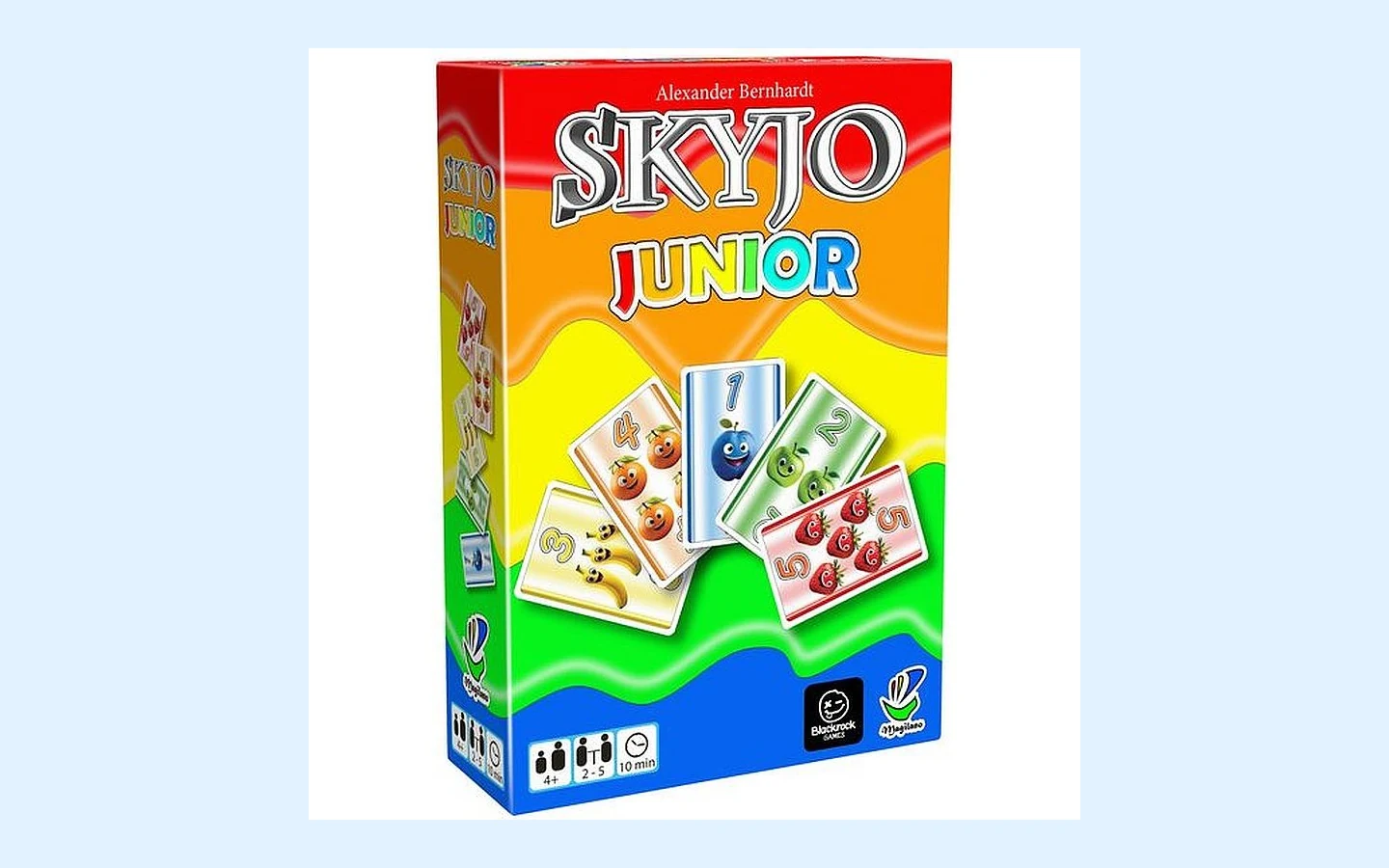
You can teach the core turn in a minute, but a good first game depends on three details: keep the starting grid face down, treat a visible discard as a commitment, and score only complete vertical triples. The sections below explain why each detail matters, then give parents a practical two-player script, conditional strategy, common corrections and a direct route to the Junior rules PDF.
SKYJO Junior in 60 Seconds: The Rule That Changes Everything
The goal of SKYJO Junior is to score as many points as possible by completing vertical columns of three identical cards. That single sentence prevents the most common teaching error. In Classic SKYJO, low numbers are desirable and the overall winner has the lowest total. Junior turns that instinct around: matching valuable fruit cards into complete triples is the whole game.
Every player works with 12 hidden cards arranged as four vertical columns and three horizontal rows. You draw, swap, and reveal until somebody has exposed their entire grid. At scoring time, incomplete columns are worth nothing; each completed vertical triple scores the number printed on those matching cards. A column of three 7s therefore scores seven points, not 21. Think of the number as the value of the completed set, not the price of each individual card.
That structure gives a young player a clean but real decision. A visible 7 looks exciting, yet it is useful only if the grid can turn it into a three-card column. A lower card that completes a pair immediately may be the stronger move. Junior is accessible because children can match pictures before they can calculate complicated totals, but the choice between a certain match and an ambitious high-value target still produces genuine tension.
| Edition | Winning idea | Do not import |
|---|---|---|
| SKYJO Junior | Build identical vertical triples and finish with the highest score. | Classic's “lowest number is best” mindset. |
| Classic SKYJO | Reduce the points left in your grid; see the site's Classic SKYJO rules. | Junior's fruit-triple scoring. |
| SKYJO Action | Uses extra action and star-card systems explained in the Action edition guide. | Action cards or star cards in a Junior game. |
Before dealing, check the front of the box for the word Junior. If the deck contains the familiar negative and double-digit number cards, you have Classic; if it contains special actions, you have Action. This guide follows the multilingual SKYJO Junior rulebook and keeps optional teaching advice clearly separate from its official turn sequence.
Set Up a SKYJO Junior Game Correctly
Give every player enough space for a rectangle roughly four cards wide and three cards deep. The orientation is not cosmetic. Junior scores matching cards in a vertical column of three, so a table laid out as four clear stacks makes the objective visible even to a child who is not reading the numbers yet.
- 1
Shuffle the Junior deck. Keep every card face down while dealing; nobody secretly checks a fruit or value.
- 2
Deal 12 cards to each player. Arrange them as four vertical columns with three cards in each column. In other words, the grid is four cards across and three cards high.
- 3
Build the draw pile. Put all undealt cards face down within everyone's reach.
- 4
Start the discard pile. Turn one card face up beside the draw pile. This visible card is a live option for the first player, not a decoration.
- 5
Let the youngest player begin. Play then continues clockwise.
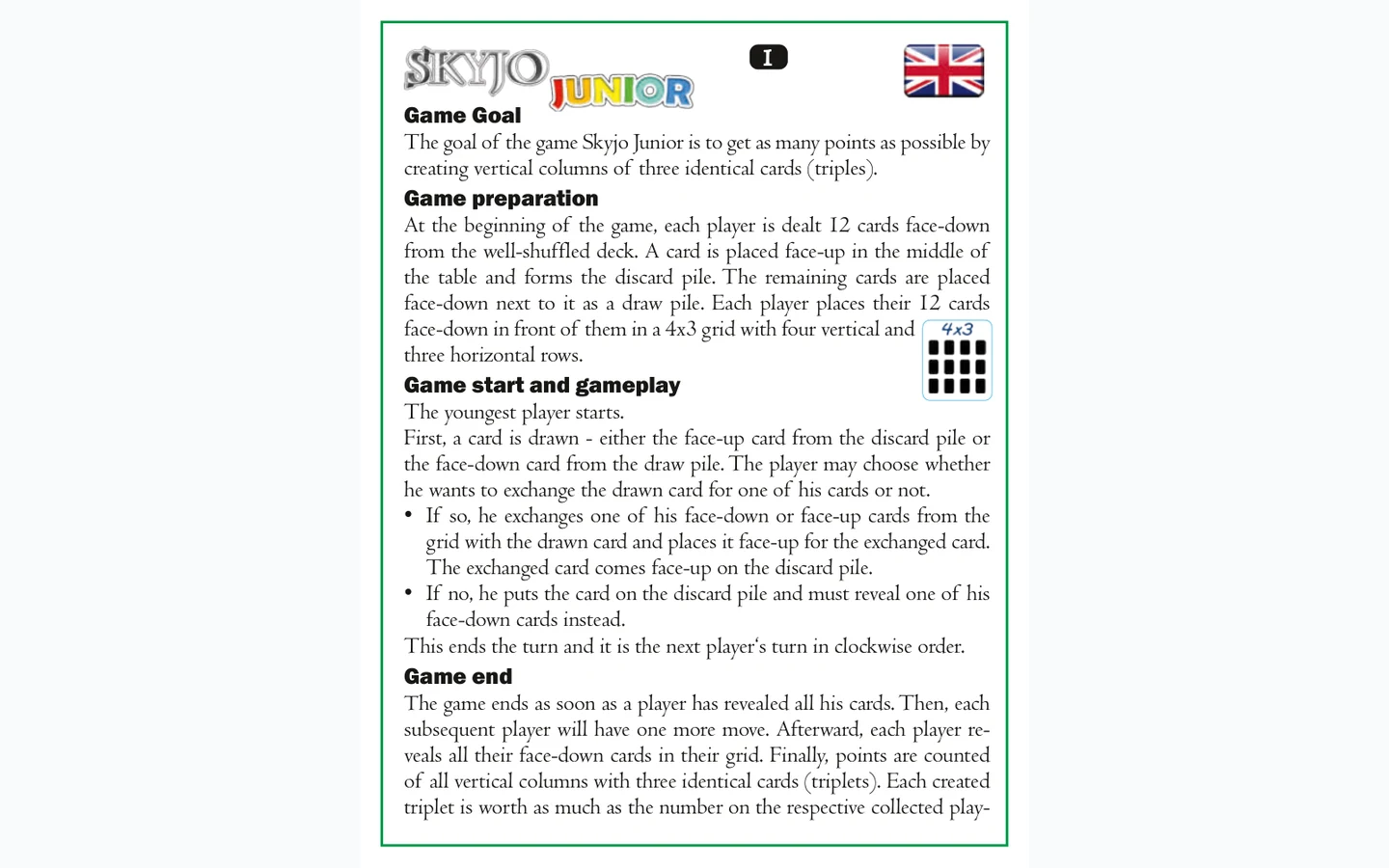
Do not flip two grid cards at setup. That familiar step belongs to Classic SKYJO. The multilingual Junior rules begin with all 12 grid cards face down and name the youngest player as the starter. Some secondary instruction pages blend the editions, which is exactly how a family can end up teaching the wrong opening.
For a first game, align each column neatly and leave a finger-width gap between it and the next. Put the draw and discard piles above the grids rather than in the middle of a child's cards. That small bit of table craft prevents accidental reveals and makes the two possible sources—mystery card or visible card—easy to point at. Once everyone can answer “Which pile did you choose?”, you are ready to play.
How a Turn Works, Step by Step
A Junior turn always begins with the same choice: take the visible top discard or draw a mystery card from the face-down pile. The piles are not equivalent. The discard gives certainty but commits you to a swap. The blind draw gives you a look before you decide, plus a fallback that reveals your own grid. That is the small engine driving the whole game.
Option A: Take the visible discard
- 1. Pick up the face-up top card.
- 2. Replace any one card in your grid, whether it is face up or face down.
- 3. Put the chosen card face up in that grid position.
- 4. Turn the removed grid card face up on the discard pile.
You cannot take the visible card, change your mind, and throw it straight back. Choosing certainty means using it.
Option B: Draw a mystery card
- 1. Take the top face-down card and look at it.
- 2a. Keep it by swapping it for any face-up or face-down grid card; the new card remains face up.
- 2b. Or reject it by placing it face up on the discard pile.
- 3. If you reject it, reveal one face-down card in your grid.
The reveal is mandatory. It ensures that even an unwanted draw moves somebody's grid closer to completion.
Worked turn: finish a pair without overthinking it
Imagine your left column shows a 6 at the top, a 6 in the middle, and one hidden card at the bottom. The discard pile also shows a 6. Take that visible 6 and place it over the hidden bottom card. You now have a complete vertical triple of 6s. Turn the displaced hidden card face up as it moves to the discard pile; you never inspect it first and then decide whether the trade was convenient.
Now change one fact: the discard shows a 2 and you have no pair of 2s. A blind draw is more flexible. If it reveals the fruit needed by one of your pairs, keep it. If it reveals an unhelpful card, discard it and expose a hidden grid card. The cost is uncertainty; the benefit is that either branch creates new information. A child can understand that trade without hearing the word “probability.”
The teaching sentence that works
Say: “The open pile is a promise; the closed pile gives you a choice.” Then ask which column the card could help. That prompt keeps the decision with the child while quietly reinforcing the rules.
After the swap or reveal is complete, the turn ends and the next player acts clockwise. There is no hand to maintain, no second draw, and no Action-edition power to resolve. Keep the cadence brisk: choose a pile, resolve one card, update the discard, pass. When children can narrate those four beats themselves, they know the game.
Make Triples, End the Game, and Score the Winner
A scoring set is exactly three identical cards occupying one vertical column. Horizontal lines, diagonals, pairs and three matching cards scattered across different columns do not count. Just as important, you do not total the three card faces. The number printed on the matching cards is the value of the complete triple, awarded once.
| Vertical column | Points | Why |
|---|---|---|
| 4 / 4 / 4 | 4 | All three match vertically; score the value once. |
| 7 / 7 / 6 | 0 | A promising pair is still incomplete. |
| 3 / 3 / 3 + 6 / 6 / 6 | 9 | Two triples score 3 + 6. |
When does SKYJO Junior end?
The end is triggered as soon as one player has revealed every card in their grid. That player is finished. Each player who follows them in turn order receives one last normal move. After those final moves, everybody turns over every card still face down. Only then do you make the complete scoring check.
The final reveal is not housekeeping; it can decide the winner. The rulebook's example has Laura apparently leading with 11 points. Paul stands at 9 and Maria at 8. When the remaining hidden cards are exposed, Maria completes another triple worth five, lifts her total to 13, and wins. That example is a useful warning against announcing a winner while hidden cards remain.
A foolproof scoring routine
- 1. Reveal every remaining hidden card for every player.
- 2. Start at the left edge of one grid and examine one vertical column at a time.
- 3. Ask, “Are all three identical?” If no, write zero; if yes, record the common value once.
- 4. Add the values of completed triples only.
- 5. The highest total wins. Equal highest totals share the victory.
Should completed triples disappear immediately?
Not under the Junior rules used for this guide. Leave a completed fruit column visible in the grid and count it at the end. The “remove three identical cards and put them on the discard pile” habit comes from Classic SKYJO, where a removed column reduces a low-score total. Importing that action would change both Junior's discard pile and its visible progress.
This difference changes end-game judgment. Revealing your last hidden card accelerates the finish and limits rivals to one further move each, but it does not guarantee the lead. A rival may already hold two completed columns, may complete a higher one on the final move, or may reveal a lucky triple during scoring. Ending is therefore a tempo choice, not a victory declaration.
How to Play SKYJO Junior With 2 Players
SKYJO Junior supports two players with the normal rules. Give both players 12 face-down cards in a four-by-three grid, create the same draw and discard piles, let the younger player begin, and use the same turn, final-move and triple-scoring procedures. Do not shorten each grid to nine or six cards; four potential scoring columns are part of the game's intended shape.
What changes is not the rulebook but the information rhythm. In a larger game, two or three people may alter the discard pile before your next turn. Head to head, the card you expose becomes your opponent's visible option immediately. If a child takes a 5 to build a pair and sends a 3 to the discard, the adult can use that 3 on the very next move. That direct feedback helps a young player see that every swap has two effects: it improves one grid position and changes what the other player may take.
Setup
12 cards each, four columns of three, all face down; one draw pile and one visible discard.
Turns
Alternate clockwise—which simply means back and forth—using the standard draw-or-discard choice.
Finish
When one grid is fully revealed, the other player gets one last move; reveal, count triples, highest score wins.
Make the first duel a teaching game
For the opening few turns, narrate your own decision: “I can see a 4, but it does not help a pair, so I will try the mystery pile.” Do not narrate the child's best move unless asked. The point is to demonstrate a question they can reuse, not to operate both grids. If the child is overwhelmed by hidden information, you can play one practice game with cards revealed—but call it an optional learning exercise, because it is not the standard rule.
Resist overusing the direct discard connection to block every developing pair. That may be competitive, but it makes a first family game feel like an adult is removing every interesting choice. A better progression is to coach matching and turn legality in game one, mention that the discard helps both players in game two, and let deliberate denial emerge later.
If your box contains number cards from -2 to 12 and asks you to minimize a running total, you have the original edition. Use the separate Classic SKYJO two-player guide; its opening reveal and scoring rules do not apply here.
Smart Junior Strategy and Common Rule Mistakes
Junior strategy is less about calculation than about valuing completion. A pair of 4s with a visible 4 on the discard pile is four certain points. A lone 8 looks more glamorous, but it still needs two matching cards before it scores anything. In an ordinary position, finishing the reliable 4 is stronger than opening a speculative 8—especially if another player is close to revealing their grid.
Ask three questions before every swap
- Does this card complete or create a pair in one vertical column? A completed triple is the only score-producing result.
- What card will I expose to the next player? Replacing a visible card gives opponents known information; replacing a hidden card may reveal a useful fruit on the discard.
- How close is the game to ending? When several grids are almost open, certainty usually gains value because there may be only one more turn.
Build pairs, but keep an exit
A pair creates direction: you know exactly what third card would score. It also creates tunnel vision. If the matching fruit does not appear, repeatedly drawing blind while ignoring another completable column can leave the pair worth zero. Treat a pair as a strong invitation, not a promise. When the discard offers a different sure completion, take the points that exist rather than the perfect triple you have imagined.
Be deliberate about which card you replace. Trading out a known mismatch keeps the hidden parts of your grid available for later reveals. Trading out the hidden third card beneath a visible pair is a clean gamble when the incoming card completes that pair, because the result is guaranteed. The bad version of that move is peeking at the hidden card first; a face-down position must remain unknown until it is legally replaced or revealed.
Five mistakes that change the game
Mistake: trying to collect the lowest numbers.
Correction: Junior wants the highest total from completed triples. Low cards are not automatically bad, but they are less valuable than higher triples when completion likelihood is equal.
Mistake: flipping two cards before the first turn.
Correction: keep all 12 grid cards face down and let the youngest player start. The two-card reveal is a Classic setup habit.
Mistake: scoring a horizontal row or a pair.
Correction: trace each column from top to bottom. Only three identical cards in that vertical line earn their shared value.
Mistake: removing a triple as soon as it appears.
Correction: leave Junior triples in the grid and count them at the end. Immediate column removal belongs to Classic and would alter the visible discard.
Mistake: adding every card or multiplying a triple by three.
Correction: an incomplete column scores zero, while three matching 6s score six—not 18.
The best coaching stays descriptive. Ask what the child is building, which card would finish it, and whether the visible discard helps now. Avoid saying “always take the higher number” or “never break a pair.” Those shortcuts ignore the cost of completion and the number of turns remaining. Junior has luck, but its meaningful skill is learning when a certain modest set beats an ambitious unfinished one.
SKYJO Junior Rules PDF and Table-Ready Checklist
For a rule check during play, use a document whose heading explicitly says SKYJO JUNIOR. A multilingual Junior rules PDF is available as a direct document, and Magilano's download hub is the sensible place to check for a newer file or another language. The booklet from your box remains useful because packaging and regional print runs can change over time.
Open the SKYJO Junior manual
Use the multilingual document for the complete rule text and worked scoring diagrams.
One-minute SKYJO Junior checklist
- 1. Deal: 12 face-down cards each.
- 2. Arrange: four columns, three cards high.
- 3. Center: one face-down draw pile and one face-up discard.
- 4. Start: youngest player, then clockwise.
- 5. Choose: visible discard or blind draw.
- 6. Resolve: swap; or reject a blind draw, discard it, and reveal one grid card.
- 7. Finish: full grid triggers one last move for each following player.
- 8. Score: reveal all; count exact vertical triples once; highest total wins.
Can children play SKYJO Junior with two people?
Yes. Product listings position Junior for 2–5 players and ages four and up. Use the full 12-card grid for both players. Age guidance is not a promise that every four-year-old will play independently; matching may come quickly while waiting, choosing a hidden replacement and accepting an unlucky reveal may still need calm adult support.
Is there an official solo rule?
The Junior rulebook used here does not provide a solo mode. A parent can invent a matching exercise, but it should be described as practice rather than an official one-player game. Without an opponent changing the discard pile or racing the reveal, a solo puzzle does not reproduce the same decisions.
Can you combine Junior with Classic or Action cards?
Not while preserving the published rules. Junior awards high-value completed sets; Classic minimizes the points remaining; Action adds powers and star cards. Mixing the decks creates unresolved questions about values, removal and winning. Play each edition with its own components before designing a clearly labeled house variant.
What if I downloaded the wrong SKYJO PDF?
Check the title and first objective. If it says to get the lowest total, reaches a 100-point threshold, or begins by flipping two cards, it is describing Classic. Use the site's Classic SKYJO rules PDF guide for that edition. Junior's identifying sentence is the high-score goal through vertical triples.

Loading comments...