SKYJO Rules PDF: Free Download & Print
Download the complete SKYJO rules PDF, learn setup, scoring, and strategy. Get printable quick reference cards, card distribution charts, and turn sequence flowcharts — everything you need to master this addictive card game.
SKYJO Rules PDF: Quick Facts at a Glance
| Feature | Details |
|---|---|
| Game Name | SKYJO (by Magilano) |
| Players | 2-8 players (best with 3-5) |
| Recommended Age | 8 years and older |
| Play Time | 20-30 minutes per game |
| Total Cards | 150 cards (numbered -2 to 12) |
| Card Distribution | 5 copies of -2 to 12 (15 values × 10 cards each) |
| Grid Layout | 4 columns × 3 rows per player (12 cards) |
| Objective | Score the fewest points across multiple rounds |
| Game End Trigger | Any player reaches 100+ cumulative points |
| PDF Availability | Official rules included in box; printable guides available online |
Table of Contents
What Is SKYJO?
SKYJO is a fast-paced, easy-to-learn card game published by Magilano in 2015. It quickly became one of the most popular family card games in Europe and has since gained worldwide recognition for its perfect balance of luck, strategy, and player interaction. The game supports 2-8 players (though it plays best with 3-5) and takes about 20-30 minutes per game.
The core mechanic is simple: each player has a 4×3 grid of 12 face-down cards. On your turn, you draw a card and decide whether to swap it with one of your face-down cards or discard it. The goal is to have the lowest total score when the round ends. Cards range from -2 (good) to 12 (bad), and if you collect three identical cards in a column, that entire column is removed from play — a satisfying moment that can dramatically lower your score.
What makes SKYJO special is its accessibility. The rules fit on a single page, setup takes less than a minute, and new players can learn while playing their first round. Yet beneath this simplicity lies genuine strategic depth: when to flip cards, which cards to swap, when to trigger the round end, and how to manipulate your grid for column removal all require careful decision-making.
Whether you’ve lost your original rulebook, want a quick reference for game night, or need a printable PDF to teach new players, this guide covers everything. Below you’ll find the complete SKYJO rules, setup instructions, scoring details, strategy tips, and downloadable reference cards — all formatted for easy printing.
Good to Know
SKYJO has spawned several variants including SKYJO Action (adds action cards and star cards) and SKYJO Junior (simplified for younger players). This guide covers the original SKYJO rules. The game box includes 150 cards, a scorepad, and the official rulebook in multiple languages.
Where to Download the SKYJO Rules PDF
Finding a reliable SKYJO rules PDF is easier than you might think. Here are the best sources for accurate, printable SKYJO rules:
Official Box Rulebook
The most reliable source. Every SKYJO box from Magilano includes a multi-language rulebook (English, German, French, Spanish, Italian) covering setup, gameplay, scoring, and game end conditions.
Best for accuracyMagilano Official Website
Visit magilano.com for official product details, FAQ, and downloadable resources. The publisher occasionally hosts PDF rulesheets and quick reference guides for their games.
Official publisherBoardGameGeek Files Section
The SKYJO page on BoardGameGeek has a “Files” section where users upload rules summaries, quick reference cards, and translated rulebooks. Search for “SKYJO” on BGG and check the Files tab.
Community resourcesThis Page (Save as PDF)
You can save this complete guide as a PDF directly from your browser. Press Ctrl+P (or Cmd+P on Mac) and select “Save as PDF” for a printable version with all rules, setup diagrams, and scoring examples.
Print this pageQuick Tip: How to Save This Page as a PDF
On any device, use your browser’s print function (Ctrl+P on Windows, Cmd+P on Mac) and change the destination to “Save as PDF.” This gives you a printable SKYJO rules reference you can bring to game night or share with friends!
What’s in the Box: Complete Card Breakdown
SKYJO comes with 150 cards total, all numbered from -2 to 12. Unlike many card games, SKYJO has a perfectly balanced distribution: there are exactly 10 copies of each number. This means you’ll see five -2 cards, ten 0 cards, ten 5 cards, and so on.
Understanding the card distribution is crucial for strategic play. Knowing that there are only ten -2 cards in the entire deck helps you assess risk when deciding whether to keep or discard a card. Similarly, knowing that 12s are just as common as 0s changes how you evaluate mid-range cards.
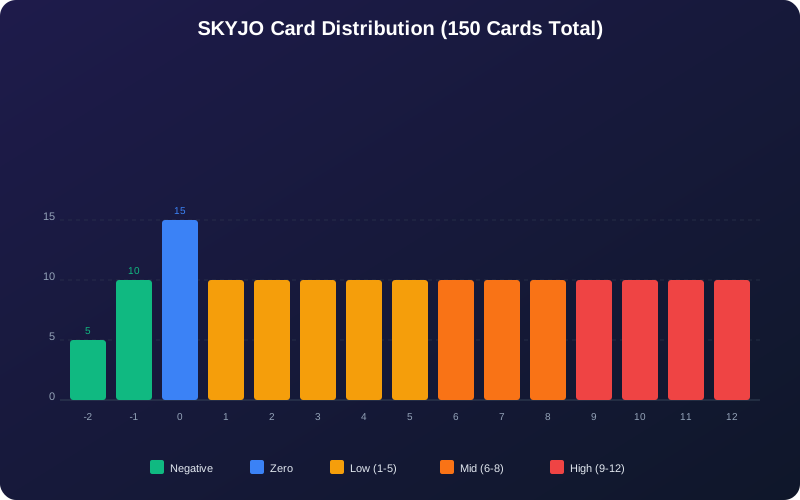
| Card Value | Quantity | Strategic Value |
|---|---|---|
| -2 | 10 cards | Best card in the game — always keep |
| -1 | 10 cards | Excellent — keep unless you have better |
| 0 | 10 cards | Very good — neutral points, good for columns |
| 1, 2, 3 | 10 each (30 total) | Good — low points, worth keeping |
| 4, 5, 6 | 10 each (30 total) | Neutral — situational, depends on your grid |
| 7, 8, 9 | 10 each (30 total) | Bad — high points, swap out when possible |
| 10, 11, 12 | 10 each (30 total) | Worst cards — swap immediately or use for columns |
| TOTAL | 150 cards | 15 different values × 10 copies each |
Pro Tip: Memorize the Distribution
Since there are exactly 10 copies of each number, you can track which cards have been played. If you’ve seen eight 12s already, you know there are only two left in the deck — making it safer to flip unknown cards. Advanced players use this card counting to make better decisions.
Complete Setup Guide (Step-by-Step)
Setting up SKYJO takes less than a minute. Follow these steps to get your game started:
Shuffle the Deck
Shuffle all 150 cards thoroughly. Make sure the cards are well-mixed, especially if you’re playing multiple rounds in a row.
Deal 12 Cards to Each Player
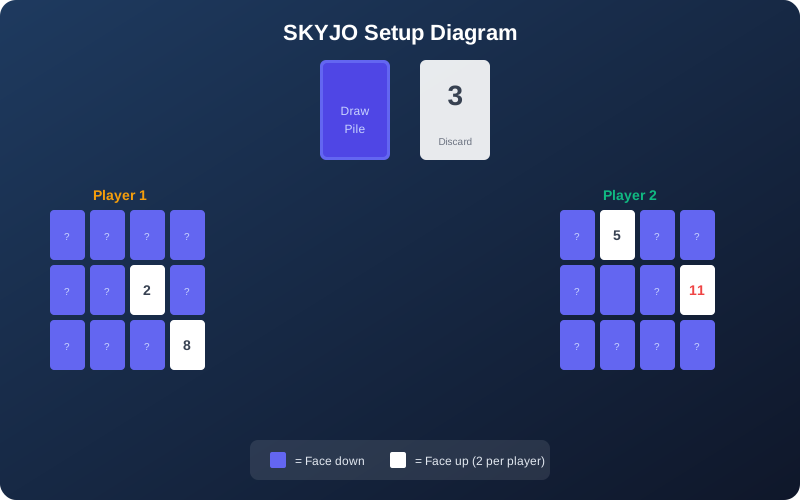
Each player receives exactly 12 cards, dealt face-down. Players should not look at their cards yet.
Players arrange their 12 cards in a 4×3 grid (4 columns, 3 rows) in front of them, all face-down. Leave some space between cards so you can easily swap them later.
Create the Draw Pile
Place the remaining cards face-down in the center of the table. This is the draw pile.
Start the Discard Pile
Flip the top card from the draw pile face-up next to it. This becomes the discard pile. Players can see this card and may choose to take it on their turn.
Flip Two Cards
Each player chooses any two cards from their 4×3 grid and flips them face-up. This gives everyone a starting point and some information about their grid. The other 10 cards remain face-down.
Determine the Starting Player
The player with the highest total from their two face-up cards goes first. If there’s a tie, the tied players flip one more card each until the tie is broken. The player with the highest total starts.
Setup Tip
When choosing which two cards to flip at the start, pick cards from different columns if possible. This gives you more information about your grid and helps you plan for potential column removal later.
How to Play SKYJO: Turn Sequence
SKYJO gameplay is straightforward. On your turn, you have two options: draw from the draw pile or take the top card from the discard pile. Your choice determines what happens next.
Option A: Draw from the Draw Pile
Draw the top card from the draw pile and look at it (don’t show other players).
You now have two choices:
Choice 1: Swap with a Card in Your Grid
Replace any card in your grid (face-up or face-down) with the drawn card. Place the drawn card face-up in that position. The replaced card goes face-up on the discard pile.
Choice 2: Discard and Flip
If you don’t want the drawn card, place it face-up on the discard pile. Then flip one of your face-down cards face-up (you must flip a face-down card — you cannot flip an already face-up card).
Option B: Take from the Discard Pile
Take the top card from the discard pile (everyone can see this card).
You must swap it with a card in your grid:
Mandatory Swap
Replace any card in your grid (face-up or face-down) with the card from the discard pile. Place the discard card face-up in that position. The replaced card goes face-up on the discard pile.
Important: You cannot discard the card you just took — you must use it to replace a card in your grid.
Critical Rule
If you draw from the draw pile and choose to discard it, you must flip one of your face-down cards. You cannot skip this step. This rule prevents players from stalling and forces the game to progress.
Column Removal Rule Explained
One of the most satisfying moments in SKYJO is removing an entire column from your grid. This powerful mechanic can dramatically lower your score and is key to winning the game.
The Rule: If you have three identical cards in the same column (all three rows), that entire column is immediately removed from play and placed in the discard pile. The column removal happens automatically as soon as the third matching card is revealed or placed.
When Column Removal Happens
When you flip a card that completes a column of three identical cards
When you swap a card into a column that already has two matching cards
At the end of the round when all cards are revealed (if you have three matching cards in a column)
Example: Successful Column Removal
All three cards in this column are 5s. The entire column is removed and placed in the discard pile. You now have only 9 cards left in your grid (3 columns instead of 4).
Example: No Column Removal
This column has two 3s and one 4. Since all three cards are not identical, the column stays in play. You need all three cards to match exactly.
Strategic Tip
Column removal is most valuable with high-value cards. Removing a column of three 12s eliminates 36 points from your score! Even removing a column of 0s is beneficial because it reduces your total card count, making it easier to end the round with fewer cards than opponents.
Ending a Round & Final Turn
A round of SKYJO ends when one player has all their cards face-up. This can happen naturally as players flip and swap cards, or strategically when a player decides to trigger the end game.
Important: When a player flips their last face-down card (making all their cards visible), the round does not end immediately. Instead, all other players get one final turn. This gives everyone a chance to improve their score before the round ends.
Player Reveals Last Card
When any player has all their cards face-up (either through flipping, swapping, or column removal), they announce that the round is ending.
Other Players Get One Final Turn
All other players (in turn order) get one more turn to draw, swap, or flip cards. They can try to lower their score or complete column removals.
Reveal All Remaining Cards
After everyone has taken their final turn, all players flip any remaining face-down cards face-up. Now everyone can see all cards in all grids.
Check for Final Column Removals
If revealing the last cards creates any columns with three identical cards, remove those columns before scoring.
Calculate Scores
Each player adds up the values of all their remaining cards. The player with the lowest score wins the round (see scoring section below for special rules).
Timing Strategy
Deciding when to end the round is crucial. If you end it too early with a mediocre score, other players might beat you on their final turn. If you wait too long, someone else might end it first. Generally, end the round when you have a strong score (below 20 points) and suspect others have higher scores.
Scoring Rules & Examples
Scoring in SKYJO is straightforward: add up all the card values remaining in your grid. However, there is one critical special rule that can dramatically affect the outcome.
Basic Scoring
Add up the values of all cards remaining in your grid
Negative cards (-2, -1) reduce your score
Removed columns do not count toward your score
Record each player’s score for the round on the scorepad
⚠️ Special Rule: Double Points Penalty
If the player who ended the round (by revealing their last card) does not have the lowest score, they receive a double points penalty.
How it works:
- Player A ends the round with a score of 25 points
- Player B has 22 points (lower than Player A)
- Player A’s score is doubled to 50 points as a penalty
- Player B keeps their 22 points and wins the round
Why this rule exists: It prevents players from ending the round prematurely with a mediocre score. You must be confident you have the lowest score before ending the round, or you will be severely penalized.
Scoring Examples
Example 1: Simple Scoring
Calculation:
-2 + (-1) + 0 + 1 + 2 + 3 + 3 + 4 + 5 + 7 + 8 + 10 = 40 points
Example 2: With Column Removal
(One column of 12s was removed)
Calculation:
-2 + (-1) + 0 + 0 + 1 + 2 + 2 + 3 + 4 = 9 points
Removing the column of 12s saved 36 points!
Example 3: Double Points Penalty
Scenario:
- Player A ends the round with 28 points
- Player B has 24 points
- Player C has 31 points
Result:
- Player A: 28 × 2 = 56 points (penalty)
- Player B: 24 points (wins the round)
- Player C: 31 points
Example 4: Successful Round End
Scenario:
- Player A ends the round with 15 points
- Player B has 22 points
- Player C has 28 points
Result:
- Player A: 15 points (wins the round, no penalty)
- Player B: 22 points
- Player C: 28 points
Winning the Game
SKYJO is played over multiple rounds. After each round, players record their scores on the scorepad. Scores are cumulative — each round’s score is added to your total from previous rounds.
The game ends when any player reaches 100 or more cumulative points. At that point, the player with the lowest total score wins the game. It does not matter who triggered the 100-point threshold — the winner is always the player with the fewest total points across all rounds played.
A typical game of SKYJO lasts 4-6 rounds, depending on how aggressively players end rounds and whether the double points penalty is triggered. Games with more players tend to last slightly longer because scores accumulate more slowly when the deck is spread across more grids.
Top 10 Winning Strategy Tips
While SKYJO involves luck, skilled players consistently outperform beginners. These strategies will help you lower your average score and win more games.
Prioritize Column Removal
Always look for opportunities to create columns of three matching cards. Even removing a column of 3s (9 points) is better than keeping those cards. Focus on building matching columns from the start of each round.
Flip Cards Strategically
When you must flip a face-down card (after discarding a drawn card), choose cards in columns where you already have matching face-up cards. This maximizes your chance of completing a column removal.
Take Low Cards from the Discard Pile
If the discard pile shows a -2, -1, or 0, almost always take it. These cards are guaranteed improvements over most face-down cards (the average card value is 5).
Replace Face-Down Cards First
When swapping a card into your grid, prefer replacing face-down cards over face-up ones (unless the face-up card is very high). This gives you information while improving your grid.
Track the Discard Pile
Pay attention to which cards have been discarded. If many low cards are gone, the remaining deck is higher on average. This affects whether you should draw from the deck or take from the discard pile.
Be Cautious About Ending the Round
The double points penalty is devastating. Only end the round when you are confident you have the lowest score. If in doubt, keep playing and try to improve further.
Watch Your Opponents
Keep an eye on other players’ grids. If someone has many face-up low cards, they might end the round soon. Prepare by swapping out your highest visible cards first.
Accept Mid-Range Cards for Columns
A column of three 6s (18 points removed) is better than three scattered low cards. Sometimes it is worth keeping a mid-range card if it helps complete a column removal.
Use the Average Card Value
The average value of all 150 cards is exactly 5. Any face-down card is statistically worth about 5 points. Use this to decide whether to swap: if a drawn card is below 5, it is likely an improvement over a face-down card.
Play Consistently Across Rounds
Since the game ends at 100 cumulative points, consistency matters more than occasional brilliance. Aim for 15-25 points per round rather than taking big risks that might result in 40+ point rounds.
Printable Quick Reference Card
Print this quick reference card to keep at your game table. It summarizes all the essential SKYJO rules on a single page.
SKYJO Quick Reference
Print this page (Ctrl+P) for easy reference
Setup
- Deal 12 cards to each player (4×3 grid, face-down)
- Create draw pile and flip one card for discard pile
- Each player flips any 2 cards face-up
- Highest total from 2 cards goes first
Turn Options
Option A: Draw from deck
Then: swap with grid card OR discard and flip a face-down card
Option B: Take from discard
Must swap with a card in your grid
Column Removal
- 3 identical cards in same column = remove entire column
- Happens immediately when 3rd card is revealed/placed
- Removed cards go to discard pile
Ending a Round
- Round ends when one player has all cards face-up
- Other players get one final turn
- Reveal all remaining cards
- Check for final column removals
Scoring
- Add up all card values in your grid
- Negative cards reduce your score
- Removed columns do not count
- Double Points Penalty: If you end the round but do not have the lowest score, your score is doubled
Winning
- Game ends when any player reaches 100+ cumulative points
- Player with lowest total score wins
Card Distribution
150 cards total: 10 copies each of -2 to 12
Average card value: 5 points
Quick Strategy Tips
Print This Reference
Press Ctrl+P (Windows) or Cmd+P (Mac), then select “Save as PDF” or print directly. This quick reference card fits on a single page and covers all essential rules.
Frequently Asked Questions
Where can I download the official SKYJO rules PDF? ▼
The official SKYJO rulebook comes inside the game box from Magilano and is available in multiple languages. For a free printable version, you can save this complete guide as a PDF using your browser’s print function (Ctrl+P → Save as PDF). BoardGameGeek also has user-uploaded rules summaries in the Files section of the SKYJO game page.
Can I swap a card with a face-up card in my grid? ▼
Yes! When you swap a card into your grid (either from the draw pile or discard pile), you can replace any card — face-up or face-down. The replaced card goes face-up on the discard pile. This is useful when you want to replace a high-value face-up card with a lower card.
What happens if I draw a card and do not want it? ▼
If you draw from the draw pile and decide not to use the card, you must discard it face-up and then flip one of your face-down cards face-up. You cannot skip the flip step. This rule ensures the game progresses and prevents stalling.
How does the double points penalty work? ▼
If you end the round (by revealing your last card) but another player has a lower score than you, your score for that round is doubled. For example, if you end with 30 points but someone else has 28 points, your score becomes 60 points. This penalty discourages players from ending rounds prematurely.
Can I remove a row instead of a column? ▼
No. In the original SKYJO, only columns can be removed (three identical cards vertically). Rows cannot be removed. Note: SKYJO Action (the sequel) does allow row removal, but that is a different game with different rules.
How many cards are in SKYJO? ▼
SKYJO contains 150 cards total. There are 15 different card values (from -2 to 12), with exactly 10 copies of each value. This balanced distribution means every number appears equally often in the deck.
What is the best number of players for SKYJO? ▼
SKYJO officially supports 2-8 players, but it plays best with 3-5 players. With 2 players, there is less interaction and the game feels more like parallel solitaire. With 6+ players, turns can feel slow and there is more downtime between your turns. The sweet spot is 3-5 players for optimal pacing and interaction.
Can I look at my face-down cards during the game? ▼
No. Once cards are placed face-down in your grid at the start of the round, you cannot look at them until they are flipped or swapped. Part of the strategy is remembering which positions might have high or low cards based on what you have seen.
What is the difference between SKYJO and SKYJO Action? ▼
SKYJO Action is the expanded sequel that adds action cards (30 cards across 9 types) and star cards (wild cards worth 0 points). It also allows row removal in addition to column removal. The original SKYJO is simpler with only numbered cards (-2 to 12) and column removal. Both are standalone games — you do not need one to play the other.
Is there a SKYJO app or online version? ▼
Yes! You can play SKYJO online for free at SKYJO.info. The website offers both single-player (against AI) and multiplayer modes. There are also unofficial SKYJO apps available on iOS and Android, though the official Magilano app is the most polished version.
Watch: How to Play SKYJO
Prefer learning visually? This video tutorial walks you through the complete SKYJO rules, covering setup, turn structure, column removal, and scoring. It is the perfect complement to the printable PDF guide above.
Video: SKYJO gameplay tutorial. If the video does not load, search “How to Play SKYJO” on YouTube.
Ready to Play SKYJO?
Now that you know all the rules, try playing SKYJO online for free or grab a physical copy for your next game night.

Loading comments...