Card-game comparison
SKYJO vs Skip-Bo: Which Card Game Fits Your Group?
Compare the decisions behind two familiar number-card games, from the first draw to the winning finish.
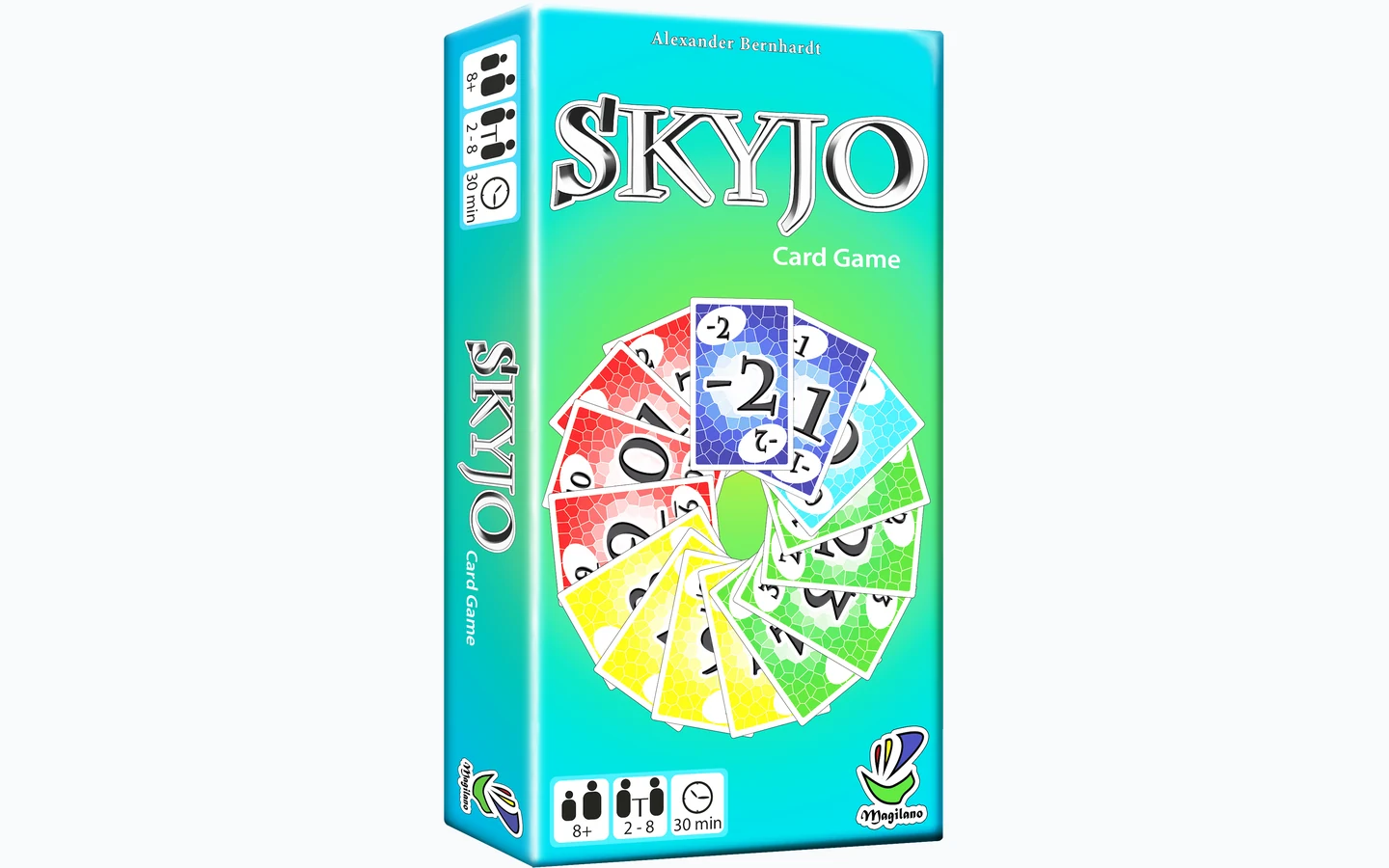
Choose by the kind of problem you enjoy solving
Choose SKYJO for managing risk in your own card layout. Choose Skip-Bo for constructing sequences and racing through a personal stock pile. Both use easy-to-read numbers, but the question you ask on a turn is different. SKYJO asks whether a card improves a position whose final value is not fully known. Skip-Bo asks which available cards will let you reach and remove the next card in your stock.
That difference matters more than calling either game “a simple family card game.” Someone who enjoys turning over an unknown card and gradually improving a small puzzle may prefer SKYJO. Someone who likes discovering a chain of legal plays, then watching several obstacles disappear in one turn, may prefer Skip-Bo. Neither preference requires being an experienced hobby gamer.
| Decision | Classic SKYJO | Standard Skip-Bo |
|---|---|---|
| What are you trying to reduce? | Your cumulative points | Cards remaining in your stock pile |
| Where is the central puzzle? | Your twelve-card layout and the shared discard | Your stock, hand, and personal discards feeding shared builds |
| Publisher player guidance | Two to eight players | Two to six players |
| Publisher age guidance | Eight and up | Seven and up |
The table is a starting point, not a difficulty ranking. A player may count comfortably but find planning several possible sequences frustrating. Another may understand Skip-Bo immediately yet dislike not knowing the value of most of a SKYJO layout. Think about the decisions your group likes discussing, and how much attention it enjoys giving another person's turn.
This comparison concerns the physical Classic games. SKYJO Action, Skip-Bo Junior, and app-specific modes can change the experience. If you already own SKYJO and need a rules refresher rather than a different game, start with the Classic SKYJO rules. If your group wants a distinct second game, the different finish lines below are the best reason to consider Skip-Bo.
Low scores and an empty stock pile are different finish lines
SKYJO makes finishing a scoring decision
In Classic SKYJO, a round ends when a player has exposed every remaining card in their layout. The other players each receive one final turn, then the remaining hidden cards are revealed and the layouts are scored. Each round's result is added to the running total. When someone reaches at least one hundred points, the game ends and the lowest cumulative total wins.
Finishing a round is therefore a decision about the quality of your position, not simply a race to reveal everything. Suppose you end with twelve points and another player finishes the round with ten. Your positive ending score becomes twenty-four because you did not finish strictly below everyone else. A positive tie also triggers that penalty; the doubling rule does not apply to zero or negative ending scores.
The consequences carry across rounds. You can lose the immediate race to expose cards and still be doing well overall. Conversely, ending quickly with a fragile score can turn an apparently successful turn into the most expensive result at the table. The guide to SKYJO ties and ending scores explains that distinction in more detail. For a first lesson, make sure everyone understands it before a player is about to close the round.
Skip-Bo makes the stock pile the priority
Skip-Bo's ordinary win condition is more direct: be the first to play every card from your personal stock pile onto the shared building piles. Your hand and personal discard piles are resources that help you accomplish that task. They are not extra piles that must also be emptied before you can win.
Imagine that you still hold two cards but can legally play the final card from your stock. That stock play wins the game. In the reverse situation, playing every card from your hand while stock remains does not win; it allows you to draw another five and continue your turn. This makes a long sequence exciting because it can uncover several successive stock cards, rather than merely make your hand look tidy.
Mattel also provides optional scoring for a series of games: the winner receives twenty-five points plus five for each stock card left among opponents, with five hundred as the match target. That option rewards winning rather than imitating SKYJO's lowest-total contest. Decide whether you want one stock-pile race or a scored series before starting. The two boxes can both fill an evening, but they create different reasons to celebrate a finish.
One SKYJO choice versus a chain of Skip-Bo plays
A normal SKYJO turn starts with a choice between the visible discard and the unknown top card of the draw pile. Taking the visible discard commits you to exchanging it with a card in your layout. Drawing blind gives you another decision: keep the drawn card and exchange it, or discard it and reveal one of your hidden cards. You cannot inspect hidden cards first and then decide which one to replace.
Suppose you draw a three while a visible ten remains in your layout. Exchanging them removes seven known points. Replacing an unknown card instead might remove more, or it might give away something valuable. That is a compact decision involving a certain improvement, uncertain information, and the situation in the rest of your layout. Once the turn is resolved, play passes on; you do not receive a long sequence of extra plays simply because the replacement was helpful.
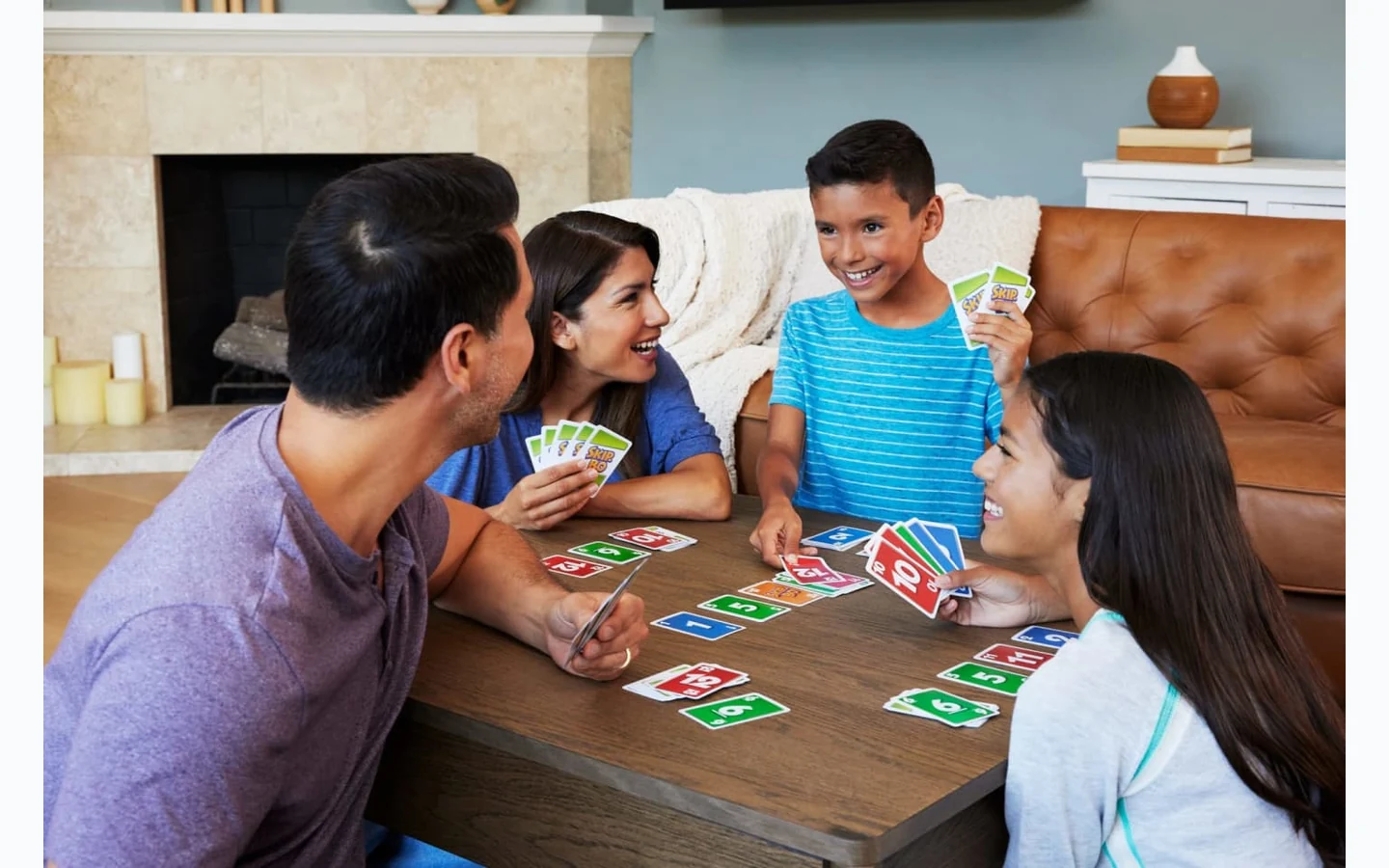
Skip-Bo begins differently. Draw until your hand contains five cards, then look for legal additions to the shared building piles. A pile starts with a one or a wild Skip-Bo card, advances in order, and is cleared when it reaches twelve. There can be up to four building piles. You may contribute cards from your hand, the top of your stock, and the tops of your own discard piles.
Consider a building pile topped by three, a four in your hand, and a five on your stock. Playing the four creates a route for the stock five. Turning over the next stock card then gives you fresh information, and you may continue if another play is available. You can also play all five hand cards, immediately draw five more, and keep going. Ending your turn by discarding your last hand card does not earn that refill.
This produces a different attention pattern. SKYJO often asks you to evaluate one improvement against a partly hidden position. Skip-Bo asks you to trace a route through several available sources while remembering that only each personal discard pile's top card is playable. A buried useful card may exist, yet be inaccessible now. You end the turn by putting one hand card onto a personal discard pile; that placement is part of your next-turn planning, not just housekeeping.
Strategy rewards patience in different ways
Random draws matter in both games, but “there is luck” does not mean your decisions are interchangeable. A useful way to compare strategy is to ask what you are sacrificing while waiting for a more attractive opportunity. The following positions are examples of reasoning from the rules, not promises that one habit will always win.
A promising SKYJO column can become a liability
In Classic SKYJO, three identical exposed cards in a vertical column are removed. Suppose you have two exposed nines above an unknown card. A visible nine in the discard pile can replace the hidden card, complete the matching column, and remove those cards from your scoring layout. A number that looks terrible by itself can therefore be exactly what you need.
Until that third nine arrives, however, the two exposed nines still contribute eighteen points. If another player is close to ending the round, waiting for a perfect match may leave you with an expensive unfinished project. Replacing one nine with a low card gives up the potential column, but buys a certain improvement. The worthwhile choice depends on time remaining, the rest of your layout, and what your opponents can do.
You should also look beyond your own grid before discarding. A nine that no longer suits you may complete the next player's visible pair. That does not mean you can never discard it: taking a big improvement yourself can be worth helping someone else. It means the visible discard has a recipient, not just a point value. See the column-matching explanation if your table is still confusing vertical triples with horizontal rows.
A Skip-Bo wildcard should open a useful route
A Skip-Bo card can supply a missing number on a building pile. Imagine a pile topped by six, an eight on your stock, and no playable seven in your hand or personal discard tops. Using a wild as seven lets you play the stock eight immediately. The value is not just one wild leaving your hand: you have removed a stock card and exposed a new chance to continue.
Compare that with spending a wild merely because it is legal. You might advance a shared pile to a number that helps the next player while leaving your own stock blocked. Sometimes clearing your hand to obtain a refill is worth that cost. Sometimes preserving the wild for a stock route is better. Trace the whole proposed sequence before spending the most flexible card in it.
Your personal discards deserve the same attention. Putting a convenient card on top of a useful lower card can hide the very number you need next turn. An orderly-looking pile is not automatically an accessible one. This is why Skip-Bo can satisfy players who enjoy planning chains, while SKYJO rewards comparing immediate savings with unfinished risks. The SKYJO strategy guide develops the latter decisions; it is not a substitute ruleset for Skip-Bo.
Two players, larger groups, and teaching younger players
Both standard games support two players. Choose between them by the relationship you want with the other person's position. In a two-player SKYJO game, every shared discard goes directly to your only opponent's next opportunity. You can concentrate on one rival's visible cards and learn to notice when a seemingly harmless discard completes a column. The two-player SKYJO guide is useful if that direct exchange appeals to you.
Two-player Skip-Bo instead makes the shared sequence a recurring negotiation. You may improve a building pile during your turn, knowing exactly which rival gets the next chance to use it. You still cannot control the hidden stock order, and a run of helpful reveals can change the race quickly. Enjoying that public contest matters more than believing that either box eliminates luck when only two people play.
More players change what you can plan
Classic SKYJO's stated range extends to eight players; standard Skip-Bo's extends to six. That is a straightforward selection rule if seven or eight people must play together. Within those limits, the practical difference is attention. More SKYJO layouts mean more visible scores and unfinished columns to consider before closing. More intervening Skip-Bo turns can change several building piles before you play again, making a plan based on the old table obsolete.
Skip-Bo's ability to continue a productive turn can be rewarding for the active player and demanding for someone who dislikes watching extended chains. SKYJO's ordinary turn has fewer actions, but a large table still means waiting through several decisions. Neither observation supplies an exact session time. Slow teaching, discussion, and how carefully people calculate their positions can outweigh a duration printed on a box.
For younger players, compare the actual learning tasks. SKYJO involves low and negative values, uncertainty, and understanding why the quickest finish can be penalized. Skip-Bo involves numerical order, wild cards, and keeping stock, discard, draw, and building piles distinct. Publisher guidance puts SKYJO at eight-plus and Skip-Bo at seven-plus, but those labels do not determine which particular child will grasp the game first. Demonstrate one open turn, then ask the learner to explain what they are trying to achieve. That answer is more useful than simply watching them recognize the numbers.
Check the edition before comparing value
Look at the full product name before treating two prices as comparable. Classic SKYJO is the number-card layout game described here. SKYJO Action adds action and star cards, while Junior is a separate product rather than a label for the same instructions. Likewise, a Skip-Bo Junior box or a digital version should not be assumed to teach the standard physical game in this comparison. The Classic versus Action comparison helps if the SKYJO names are the confusing part.
Even standard Skip-Bo packaging deserves a closer look. Mattel's 42050 listing describes a deck of one hundred sixty-two cards, while its newer JMM20 listing and matching instructions state one hundred sixty-eight. A different printed card total is therefore not, by itself, proof that a seller is offering a fake or that the whole game has changed. Match the exact product code and included instructions instead of resolving an edition question from one old review.
For either game, check that the set is complete and that its condition matches your expectations. This matters especially with used copies: a bag of familiar-looking cards is not necessarily a complete playable set. Also consider whether a readable booklet and suitable storage are included. A low sticker price loses some appeal if you must first establish what is missing or whether the rules belong to that box.
Compare the delivered cost in your region, including shipping, rather than a search-result price detached from its seller and date. There is no useful universal claim that one game is always the cheaper purchase. For SKYJO, use the existing buying guide as a starting point, then verify the actual listing. The better value is the complete edition your group will want to bring back to the table, not simply the box with the lower number beside it.
Pick the first game your group can explain back to you
If your group likes improving a personal puzzle, weighing a safe replacement against an unknown card, and deciding when to close, start with SKYJO. The decisions are small enough to explain one at a time, yet the final score gives them consequences. It is also the straightforward choice between these standard boxes when seven or eight people need seats in the same game.
If your group enjoys connecting moves, working through shared numerical sequences, and making visible progress toward an empty stock pile, start with Skip-Bo. A satisfying turn can consist of several linked decisions rather than a single exchange. Players who enjoy tracing that route may welcome its extended turns; players who want each person's action resolved quickly should consider whether that rhythm suits them.
Before making a purchase decision for children or new players, try a simple teaching conversation. For SKYJO, ask why replacing a visible high card is different from replacing a hidden card, and what could go wrong when the last hidden card is revealed. For Skip-Bo, ask which pile must disappear to win, then demonstrate how a hand card can open a route for a stock card. Someone who can explain the objective and one meaningful choice has a much firmer start than someone who only recognizes the numbers.
Once you have chosen, teach that game on its own terms for the first session. Do not explain SKYJO as “Skip-Bo with a grid,” or Skip-Bo as “SKYJO where you get rid of everything.” Those shortcuts hide the decisions that make each game interesting. Keeping the first explanation focused also makes later comparisons fair: a group can decide it prefers low-score tension or a stock-pile race after understanding what each actually rewards.
There is no need to buy both at once. If you already enjoy SKYJO, Skip-Bo offers a different central challenge rather than more of the same. If you already own Skip-Bo and want more uncertainty within a personal layout, SKYJO is a sensible next candidate. Choose the problem your table wants to solve together, then give the rules enough attention for that problem to emerge.

Loading comments...