Pronunciation · Brand history · Evidence guide
How Do You Pronounce SKYJO—and What Does the Name Mean?
In English, “sky-joe” is the practical everyday reading; a German-influenced “sky-yo” also makes sense. The harder question is the name's meaning. Magilano's official materials checked for this guide use SKYJO consistently but do not provide a located etymology, so plausible wordplay must remain labelled as speculation.
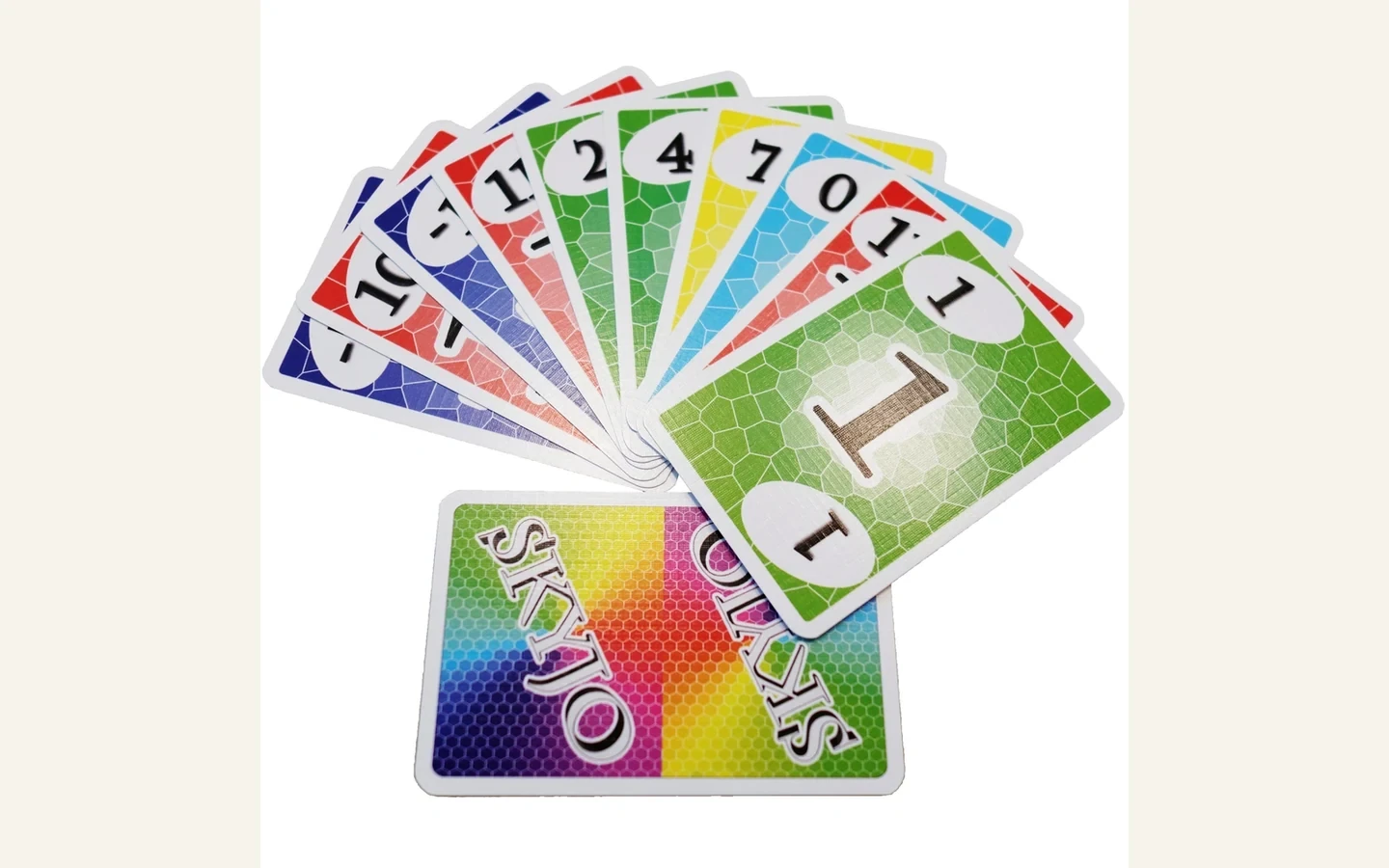
The practical answer: “sky-joe” works in English
Say it at an English-speaking table
SKY-joh (“sky-joe”)
That is the clearest everyday English reading. A German-influenced SKY-yoh (“sky-yo”) also appears in player usage. No accessible Magilano product page or rulebook located for this article imposes one mandatory pronunciation.
The evidence has three levels. First, English pronunciation pages and independent English-language game guidance converge on a `j` sound like the one in “Joe.” Second, a German-speaker recording and German spelling expectations support the `y`-like alternative. Third—and most important for any claim of correctness—the official materials checked display the name but do not supply phonetic spelling, audio guidance or a sentence telling buyers how Magilano requires it to be said. The first two levels describe usage; neither becomes an official decree merely through repetition.
That is why “sky-joe” is the useful answer rather than “the only correct answer.” If you are teaching in Britain, the United States, Canada or another English-speaking setting, it will be immediately readable and rarely needs explanation. If someone says “sky-yo,” you still know exactly which game they mean. Correcting them adds nothing to setup, turn order or scoring.
One final boundary matters: the pronunciation follows the brand stem across SKYJO Action, SKYJO Junior and SKYJO Voyage, but the shared name does not make those editions mechanically identical. Say the name naturally, then use the full edition title when rules or buying decisions depend on it.
Why English “sky-joe” and German-influenced “sky-yo” both appear
The disagreement sits almost entirely in one letter: j. English readers normally map it to the opening sound in “jump” or “Joe.” German readers normally map it to the consonant English writes with `y` in “yes.” Put either habit after “sky” and you get the two familiar forms without anyone misreading the first syllable.
| Reading habit | Plain-English cue | Technical cue | SKYJO result |
|---|---|---|---|
| English `j` | `j` in “Joe” | /dʒ/ | sky-joe |
| German `j` | `y` in “yes” | /j/ | sky-yo |
Cambridge's English pronunciation entry for the letter `j` uses /dʒ/, the sound in “jump.” Deutsche Welle's German learner material describes German `j` as the sound of English `y`, and the ordinary German word ja (“yes”) is transcribed /jaː/. Those references explain the mechanics of the split. They do not, by themselves, tell us which set of spelling habits the person who coined SKYJO wanted buyers worldwide to use.
That limitation matters because SKYJO is an invented brand, not an ordinary inherited German dictionary word. A German speaker can preserve local letter-to-sound expectations; an English speaker can adapt the unchanged spelling to English. Research on names and borrowed words describes exactly this kind of choice: speakers may preserve a source-like sound, follow the written form through their own language, or settle on a community convention. Brand names often travel without respelling, so local speech does the adapting.
Known
English and German commonly assign different consonant sounds to written `j`.
Observed
Both “sky-joe” and “sky-yo” appear in current player-facing pronunciation resources.
Not established
The inventor's intended consonant cannot be inferred solely from his nationality.
So “German game” is useful context, not a trump card. If Magilano publishes an explicit pronunciation, that direct evidence would outrank spelling predictions and community recordings. Until then, the intellectually honest position is modest: `sky-joe` is natural English adaptation; `sky-yo` is natural German-influenced adaptation; both point to the same box.
What does SKYJO mean? The honest answer is that the etymology is undocumented
No official Magilano etymology was located in the product pages, company page, downloads and rulebooks checked for this article. Those sources repeatedly use SKYJO as a product name and explain how the game works. They do not say what the word stands for, split it into source words, or recount how Alexander Bernhardt chose it. The defensible answer is therefore “meaning not officially documented in the sources checked”—not a confident fan-made translation.
Documented
SKYJO is the name used by Magilano for the game and the shared stem in its product family.
Not located
A publisher explanation of the word's origin, intended meaning, acronym expansion or mandatory pronunciation.
Not justified
Presenting “sky + Jo,” “sky + joy” or a high-card metaphor as something Magilano has confirmed.
This wording may sound cautious, but it is more informative than false certainty. Magilano's current English product page begins by identifying SKYJO as the name of its card game, then moves directly to the goal of collecting as few points as possible. The company collection does the same across Action, Junior and Voyage. The About page describes the publisher's focus on original card games. The rules title the game and teach it. None of those accessible texts completes the sentence “We called it SKYJO because…”
Absence has limits. A naming discussion could exist in an interview, an unavailable early press kit, a private design note or a page not indexed by search. That possibility is why this article does not claim that Magilano has never explained the name. It reports a reproducible research result: no explanation appeared in the official materials located and checked on the research date.
The game's German origin also does not turn SKYJO into a standard German word with a dictionary translation. It behaves as a coined brand: the spelling remains recognisable across language editions while surrounding instructions change. The existing SKYJO English rules guide is useful for terminology and play, but its brief name discussion should likewise be read as editorial interpretation unless it cites a direct naming statement.
Safe sentence to repeat
“SKYJO appears to be a coined game name; Magilano's official etymology was not found in the product pages and rulebooks checked.”
What trademark and publication records actually prove
Trademark records give the name a documented legal history, but legal history is not etymology. Records for SKYJO strongly connect the mark with Alexander Bernhardt and card games. They identify filing dates, classes and the literal word being protected. They do not contain a creator interview explaining the inspiration for `SKYJO`, and they do not turn a database's search fields into a definition.
| Record point | What it supports | What it does not support |
|---|---|---|
| 9 August 2016 filing, serial 79191934 | SKYJO filed as a standard-character card-game mark associated with Alexander Bernhardt | That the word was first conceived on the filing date |
| 21 March 2017 registration in the US record mirror | A registered legal mark history for card games | A pronunciation ruling or naming story |
| 20 November 2023 application, serial 98278593 | Literal element SKYJO and identified card, dice and table-top games | A new meaning for the same letters |
“Standard character mark” is particularly easy to misunderstand. It means the legal claim concerns the wording without limiting protection to one particular font, size or colour. It does not mean SKYJO is a standard dictionary word. Likewise, a record may show a pseudo-mark or search-normalisation field such as “SKY JO.” That helps databases find similar strings; it is not evidence that Bernhardt officially combined the English noun “sky” with the name “Jo.”
Dates need equally careful handling. A filing date proves that an application was filed on that date. It does not prove the designer invented the word that morning. The game was already in use before the 2016 filing, and later applications can broaden or refresh protection without re-coining the brand. For the game's creation and release context, use the dedicated SKYJO history and creator timeline rather than making a trademark database carry a historical claim it was not designed to answer.
Strong inference
SKYJO was intentionally used and protected as a brand for games, with Alexander Bernhardt named in the records.
Unsupported inference
The legal record reveals a secret acronym, confirms “sky + Jo,” or mandates “sky-joe.”
This distinction is not pedantry. It keeps the evidence useful. The records narrow the honest story: SKYJO is not an anonymous folk-game label that drifted into use; it is a deliberately owned game mark. They simply stop before answering the linguistic questions readers are most curious about.
Popular name-origin theories—and why they remain theories
Search long enough and SKYJO acquires several confident origin stories. One page proposes `sky + joy`; another reports `sky + jump`; name-meaning pages pull `Jo` toward Joe, Johannes or a friendly nickname; players connect “sky” with high cards that should be removed. The problem is not that these ideas are impossible. The problem is that the pages located do not trace them to Magilano or Alexander Bernhardt.
| Theory | Why it feels plausible | Evidence problem | Verdict |
|---|---|---|---|
| sky + joy | Positive, playful brand association; `jo` resembles the start of “joy” | The `y` is missing and no direct naming statement is cited | Possible wordplay, unverified |
| sky + jump | Both suggest upward motion | The abbreviation is unexplained and unrelated to documented play | Weak, unverified |
| sky + Jo/Johannes | The spelling can be visually split into two familiar pieces | No identified person or creator citation links `Jo` to the game | Unsupported |
| high cards / sky metaphor | Classic players remove high values and seek a low score | Gameplay fit can be invented after the name; `jo` remains unexplained | Neat association, not etymology |
The conflicting expansions are useful evidence in one sense: they show how easily a catchy coined word invites pattern-finding. If a verified source said “joy,” the `jump` story would need correction; if the creator named a person called Jo, the high-card story would become retrospective symbolism. Without that anchor, choosing the theory we like best simply rewards plausibility.
A three-question theory test
- Who said it? A named creator or publisher source is stronger than an unattributed blog sentence.
- Where is the original? A link to an interview, press kit or dated official page is stronger than pages repeating one another.
- Does the evidence predate the theory? A story recorded during launch carries more weight than wordplay invented after worldwide success.
Search results also mix different intents. A personal-name site may generate an origin for a hypothetical person named Skyjo, but that does not research Magilano's card-game trademark. An April Fools article or playful translation may deliberately turn the title into “Sky Joy”; humour is not a press release. Even a sincere player explanation can become circular when later pages cite the claim but none can reach an original source.
You can still enjoy the associations. “Sky” is memorable, “joy” fits a social game, and the contrast between high cards and low scores is a clever mnemonic. Just introduce them accurately: “one fan theory suggests…” or “I remember it by…” That wording preserves the fun without laundering a guess into history.
The editorial verdict is deliberately unresolved. No located theory cleared the source test. Until Magilano or Bernhardt supplies a traceable explanation, SKYJO's brand etymology remains unknown.
How to say and write SKYJO without derailing game night
Use the pronunciation that makes communication effortless, and use the spelling that keeps the product precise. In English conversation, “sky-joe” is a clear default. In a German-influenced group, “sky-yo” may be the settled local form. In writing, preserve SKYJO and add the complete edition suffix whenever rules, reviews or purchases depend on it.
Teaching an English-speaking group
Say “sky-joe” once and start setup. Do not interrupt a player who naturally says “sky-yo”; both labels identify the game and the rules do not use spoken calls.
Joining an established group
Mirror the group's form unless clarity suffers. Pronunciation conventions are social coordination, not a hidden scoring rule.
Recording a review or tutorial
A transparent line is enough: “I say sky-joe in English; you may also hear the German-influenced sky-yo.” Avoid calling either official without a publisher citation.
Writing a listing or article
Use the recognisable brand spelling and full product: SKYJO, SKYJO Action, SKYJO Junior or SKYJO Voyage. Do not turn a pronunciation cue such as “Skyjoe” into the product title.
Edition precision matters more than accent precision. Magilano's catalogue uses the SKYJO stem across a product family, but the suffixes identify materially different experiences. Action adds special systems; Junior changes presentation and scoring for younger players; Voyage packages Classic-style play for a smaller travel use case. Saying “sky-joe” perfectly while applying Classic rules to Junior is the real communication failure. The site's edition comparison handles that distinction.
Capitalisation can be practical rather than theatrical. Use the official all-caps styling in a heading, product name or first reference. Ordinary editorial prose may use Skyjo if the site's style permits, but do not respell it as Sky Joe, Skyjoa or Sky-Jo as though those were official variants. Pronunciation respelling belongs in parentheses: SKYJO (“sky-joe”).
When should you correct someone?
Correct the conversation when the wrong edition or a different product is being discussed. Do not correct a harmless `j` sound when everyone understands the reference. If a child, learner or presenter asks, offer both common cues and be honest about the missing official ruling.
That approach respects language variation and preserves useful accuracy. The name gets everyone to the same table; the edition label gets everyone into the same game.

Loading comments...