SKYJO Card Game Review: Honest Verdict (2026)
An honest, comprehensive review of SKYJO by Magilano. We break down the gameplay, pros and cons, price comparison, and deliver our final verdict on whether this popular card game deserves a spot in your collection.
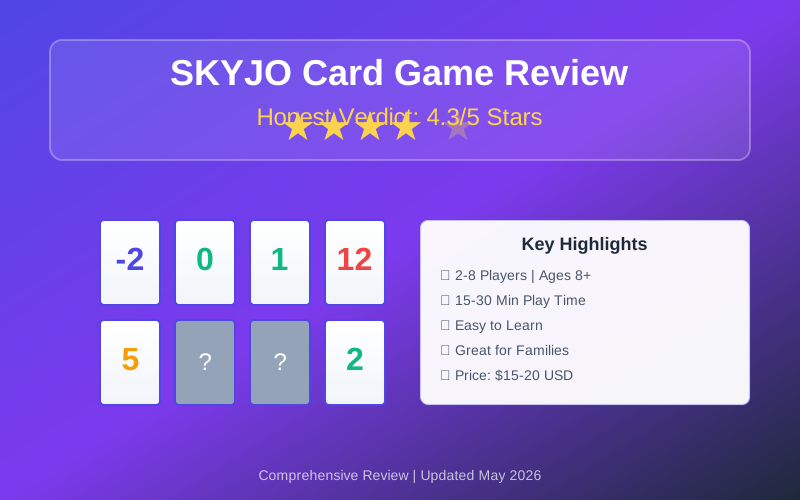
Quick Facts: SKYJO at a Glance
| Feature | Details |
|---|---|
| Publisher | Magilano |
| Designer | Alexander Bernhardt |
| Release Year | 2015 |
| Players | 2-8 players |
| Age | 8+ years |
| Play Time | 15-30 minutes |
| Contents | 150 playing cards, scorepad, rules |
| Card Range | -2 to +12 |
| Price Range | $15-20 USD |
| Our Rating | 4.3 / 5 |
| Complexity | 1.07 / 5 (Very Light) |
| Best For | Families, casual gamers, mixed age groups |
What Is SKYJO? Game Overview
SKYJO is a lightweight card game designed by Alexander Bernhardt and published by Magilano in 2015. Since its release, SKYJO has become a worldwide phenomenon, selling millions of copies and earning a reputation as one of the best family card games on the market.
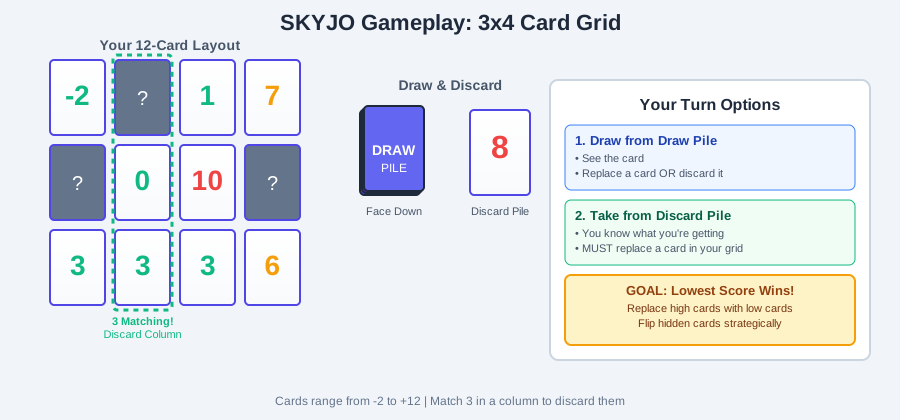
The game belongs to the "golf" family of card games, where the goal is to achieve the lowest score rather than the highest. Each player manages a grid of 12 face-down cards arranged in a 3x4 formation. Throughout the game, you draw and discard cards to replace higher-value cards with lower ones, all while managing hidden information and making risk-versus-reward decisions.
Cards range from -2 to +12, creating opportunities for both penalty-heavy draws and score-reducing plays. The game ends when any player reaches or exceeds 100 points across multiple rounds, and the player with the lowest cumulative score wins.
What makes SKYJO special is its perfect balance: simple enough for children and grandparents to learn in minutes, yet engaging enough to keep experienced gamers coming back for more.
How to Play SKYJO: Rules Summary
Setup
Each player receives 12 cards dealt face-down, which they arrange in a 3x4 grid (3 rows, 4 columns) in front of them. Players then flip any 2 cards of their choice face-up. The remaining deck becomes the draw pile, and one card is flipped to start the discard pile.
On Your Turn
You have two options:
- Draw from the draw pile: Look at the card. You can either replace one of your 12 cards with it (discarding the replaced card) or discard the drawn card and flip one of your face-down cards.
- Take from the discard pile: You know what you're getting, but you MUST replace one of your cards with it.
Special Rule: Column Elimination
If you have three cards in a vertical column that are all the same number, you may discard the entire column. This is a powerful way to eliminate high-value cards.
Ending a Round
A round ends when one player has all 12 of their cards face-up. Each remaining player takes one final turn, then all hidden cards are flipped. The player who triggered the round's end must have the lowest score, otherwise their total doubles as a penalty.
Winning the Game
The game ends when any player reaches or exceeds 100 points. The player with the lowest cumulative score wins.
What We Love About SKYJO (Pros)
Incredibly Easy to Learn
With a complexity rating of just 1.07 out of 5, SKYJO is one of the most accessible card games available. New players grasp the core concepts within a single round. The familiar draw-discard structure feels immediately comfortable to anyone who has played standard card games.
Perfect for Families
SKYJO fits perfectly into family game nights where mixed ages and experience levels gather around the table. The rules are intuitive enough for grandparents and simple enough for children who can handle basic addition. It also provides great math practice for kids.
Scales Beautifully (2-8 Players)
Being able to support up to eight players is a huge asset. It is challenging to find a game that supports such a high player count without being a party game. Four to five players hits the sweet spot balancing game length with table interaction.
Engaging Risk/Reward Decisions
SKYJO combines draw-and-discard mechanics with hidden information management. The core loop involves evaluating risk versus reward when deciding between a known discard pile card and an unknown deck draw. This creates genuine tension even in a lightweight game.
Portable and Affordable
SKYJO comes in a small box that is easily packable and portable. At $15-20, it is an inexpensive addition to any game collection. The box it comes in is also very portable, making the game an ideal option to take on a road trip or a picnic.
High Replayability
One of the best features of SKYJO is its replayability. The game has a simple concept but offers nearly endless possibilities for different strategies and outcomes. The column elimination rule adds an interesting risk versus reward mechanic that keeps games fresh.
What Could Be Better (Cons)
Heavily Luck-Dependent
Due to its simplicity, SKYJO relies on quite a bit of luck. The cards you are dealt and draw are going to determine how well you do in the game. The player who draws more low cards is going to have a distinct advantage. No strategy is going to overcome that fact.
Limited Strategic Depth
In general, SKYJO doesn't contain a lot of strategy. The strategic moves in the game are usually obvious as there isn't a reason to keep a higher card if you draw a lower card. If you generally play games filled with strategy, you likely will find the game to be too simple.
Requires More Table Space
Players need a larger play space because each player has a three by four grid of cards in front of them. So it doesn't make a good restaurant game or small space game. You'll need a decent-sized table for 4+ players.
Minimal Player Interaction
SKYJO is a game that does not require a lot of interaction between players. Players take turns playing their cards, but there is little opportunity for players to directly affect each other. Most of the game is spent managing your own tableau.
SKYJO vs Other Card Games (UNO, Phase 10, Golf)
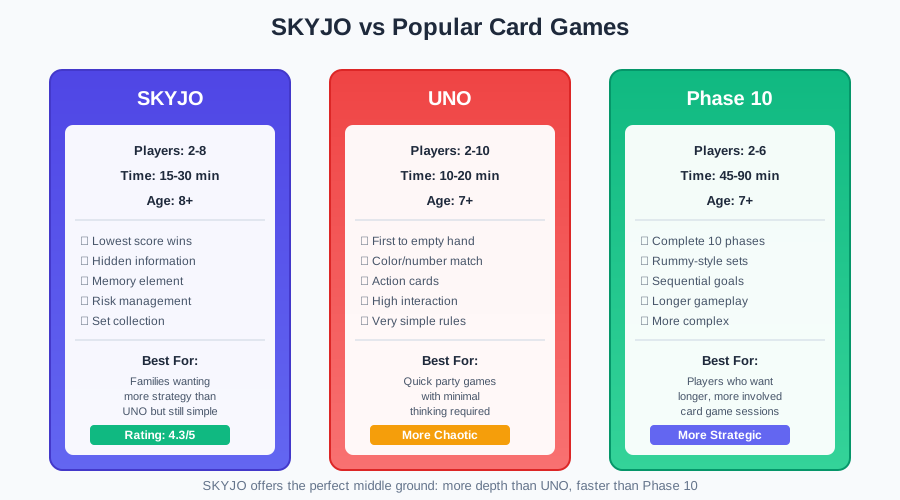
Players who enjoy UNO or Phase 10 but want something with slightly more decision-making will find SKYJO scratches that itch. It shares the accessible card-play feel while offering genuine choices each turn.
| Feature | SKYJO | UNO | Phase 10 |
|---|---|---|---|
| Players | 2-8 | 2-10 | 2-6 |
| Play Time | 15-30 min | 10-20 min | 45-90 min |
| Complexity | Light | Very Light | Light-Medium |
| Goal | Lowest score | Empty hand first | Complete 10 phases |
| Strategy Level | Medium | Low | Medium-High |
| Luck Factor | High | Very High | High |
| Player Interaction | Low | High | Medium |
| Price | $15-20 | $8-12 | $10-15 |
| Best For | Families wanting strategy | Quick party games | Longer sessions |
Bottom Line: SKYJO offers the perfect middle ground - more depth than UNO, faster than Phase 10.
Who Should Buy SKYJO?
✓ Perfect For:
- • Families with mixed ages - Simple enough for kids 8+, engaging for adults
- • Casual gamers - Easy to learn, quick to play, fun to repeat
- • Large groups - Scales well up to 8 players without lag
- • Travel and portability - Small box, easy to pack
- • Gateway gamers - Want more than UNO but not heavy strategy
- • Budget-conscious buyers - Great value at $15-20
✗ Skip If:
- • You prefer deep strategy games - SKYJO is light on tactics
- • You dislike luck-dependent games - Card draw matters a lot
- • You want high player interaction - Mostly solitaire-style play
- • You have limited table space - Needs room for card grids
- • You prefer cooperative games - SKYJO is competitive only
Price & Where to Buy
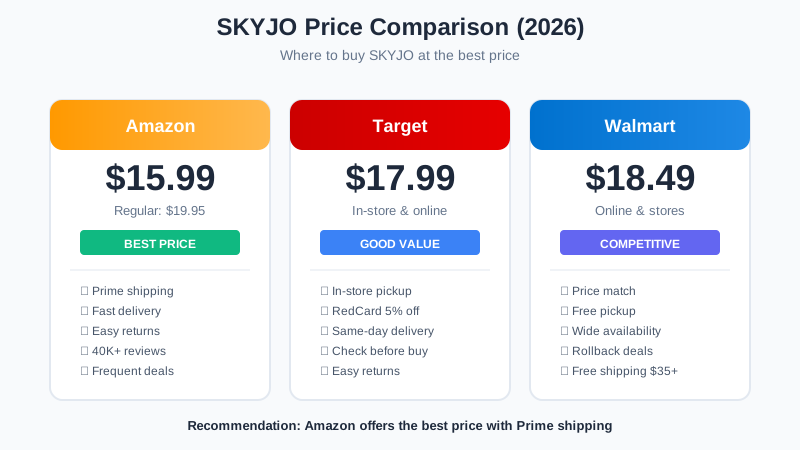
SKYJO typically retails for $15-20 USD, making it an affordable addition to any game collection.
Amazon
$15.99
Regular: $19.95
- ✓ Prime shipping
- ✓ 40,000+ reviews
- ✓ Frequent deals
Target
$17.99
In-store & online
- ✓ In-store pickup
- ✓ RedCard 5% off
- ✓ Same-day delivery
Walmart
$18.49
Online & stores
- ✓ Price match
- ✓ Free pickup
- ✓ Rollback deals
Our Recommendation: Amazon typically offers the best price with Prime shipping.
Our Final Verdict
SKYJO Card Game
By Magilano
Highly Recommended for Families and Casual Gamers
SKYJO is an excellent family card game that delivers exactly what it promises: simple, accessible fun that works across ages and skill levels. While it won't satisfy hardcore strategy gamers, it fills a valuable niche in the casual gaming market.
The game's greatest strength is its perfect balance of simplicity and engagement. New players can learn the rules in under 5 minutes, yet the hidden information and risk management create enough tension to keep games interesting. The column elimination rule adds a clever twist that rewards both luck and planning.
At $15-20, SKYJO offers outstanding value. The components are well-made, the box is portable, and the game scales beautifully from 2 to 8 players. It's become a staple at family gatherings worldwide for good reason.
The downsides are real but manageable. Yes, luck plays a major role. Yes, strategic depth is limited. Yes, player interaction is minimal. But these aren't flaws for the target audience - they're features. Families don't want cutthroat competition; they want relaxed fun where everyone has a chance to win.
Bottom line: If you're looking for a casual card game that's more engaging than UNO but faster than Phase 10, SKYJO is an easy recommendation. It's earned its reputation as one of the best family card games on the market.
Frequently Asked Questions
Is SKYJO worth buying in 2026?
Yes, SKYJO remains an excellent purchase in 2026. It's one of the best-selling family card games worldwide, with over 40,000 positive reviews on Amazon. At $15-20, it offers outstanding value for a game that works well with 2-8 players and appeals to all ages.
How long does a game of SKYJO take?
A typical game of SKYJO takes 15-30 minutes. The game consists of multiple rounds, and ends when any player reaches 100 points. With experienced players, games tend toward the shorter end; with new players or larger groups, expect closer to 30 minutes.
What age is SKYJO appropriate for?
SKYJO is rated for ages 8 and up, but younger children who can handle basic addition and subtraction (including negative numbers) can play with minimal help. The game is equally enjoyable for adults, making it perfect for multi-generational family game nights.
Is SKYJO better than UNO?
SKYJO and UNO serve different purposes. SKYJO offers more strategic depth and memory elements, while UNO is faster and more chaotic. If you want a game with meaningful decisions and less direct conflict, SKYJO is the better choice. If you want quick, high-energy party fun, stick with UNO.
Can you play SKYJO with 2 players?
Yes, SKYJO works with 2 players, though it's more competitive and direct at this count. The game shines brightest with 4-5 players, where there's enough variety in card flow without excessive downtime. Two-player games are still enjoyable but feel more like a duel.
What's the difference between SKYJO and SKYJO Action?
SKYJO Action is the sequel that adds action cards and star cards for more strategic depth and player interaction. Original SKYJO is simpler and faster, while SKYJO Action offers more complexity and longer playtime (30-40 minutes). Start with original SKYJO if you're new to the series.
Is SKYJO too luck-based?
SKYJO does have a significant luck element - the cards you draw matter. However, skilled players consistently outperform beginners through better memory, risk assessment, and timing decisions. It's roughly 60% luck, 40% skill, which is perfect for casual family gaming where everyone should have a chance to win.
Where can I buy SKYJO at the best price?
Amazon typically offers the best price at $15.99 with Prime shipping (regular price $19.95). Target sells it for $17.99 with in-store pickup and RedCard discounts. Walmart lists it at $18.49 with price matching available. Check for digital coupons and seasonal sales for even better deals.
Ready to Try SKYJO?
Join millions of families worldwide who have made SKYJO their go-to card game. Simple to learn, fun to play, perfect for all ages.

Loading comments...