SKYJO Action Review: Is It Worth It?
An honest, in-depth review of SKYJO Action by Magilano. We break down the gameplay, action cards, star cards, and whether this sequel lives up to the original. Find out if SKYJO Action deserves a spot on your game shelf.
Quick Facts: SKYJO Action at a Glance
| Feature | Details |
|---|---|
| Publisher | Magilano |
| Players | 2-8 players |
| Age | 8+ years |
| Play Time | 30-40 minutes |
| Contents | 150 playing cards, 30 action cards, scorepad, rules |
| Card Types | Number cards, Star cards, 9 Action card types |
| Price Range | $18-25 USD |
| Our Rating | 4.2 / 5 ★★★★☆ |
| Languages | English, German, French, Spanish, Italian, Japanese |
| Best For | Families who want more strategy than original SKYJO |
What Is SKYJO Action?
SKYJO Action is the sequel to the massively popular SKYJO card game, published by Magilano. While the original SKYJO became a worldwide hit thanks to its simple rules and addictive gameplay, SKYJO Action takes the core formula and adds new layers of strategy through action cards and star cards.
The fundamental goal remains the same: end each round with the lowest total point value across your 12-card layout (3 rows by 4 columns). But SKYJO Action introduces 9 different action card types that let you steal cards from opponents, peek at hidden cards, swap cards between players, and even trigger dramatic events like the Meteor Shower that reshuffles the board state.
Released after the original game had already sold millions of copies worldwide, SKYJO Action targets players who loved the base game but wanted more depth, more interaction, and more dramatic moments. The question is: does it deliver? Let's find out.
How SKYJO Action Differs from the Original
If you've played the original SKYJO, you already know the basics. But SKYJO Action introduces several meaningful changes that alter both the pace and strategic depth of the game.
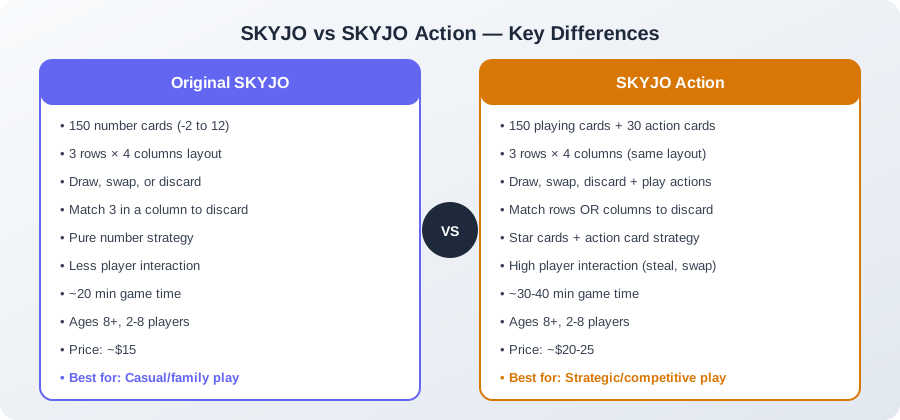
Key Differences at a Glance
| Feature | Original SKYJO | SKYJO Action |
|---|---|---|
| Card Types | Number cards only (-2 to 12) | Number + Star + Action cards |
| Total Cards | 150 cards | 180 cards (150 + 30 action) |
| Matching Rule | 3 matching in a column | 3-4 matching in rows OR columns |
| Player Interaction | Minimal (indirect) | High (steal, swap, block) |
| Game Length | ~20 minutes | ~30-40 minutes |
| Complexity | Very light | Light-medium |
| Luck vs Strategy | 60% luck / 40% strategy | 45% luck / 55% strategy |
The Expanded Matching System
One of the biggest gameplay changes in SKYJO Action is the expanded matching system. In the original, you could only discard columns of three matching cards. SKYJO Action allows you to match and discard both rows and columns, and since the layout includes 4-column rows, you can even match four cards in a row for an even bigger payoff.
This seemingly small rule change has massive implications for strategy. You're no longer thinking purely vertically; horizontal patterns become equally valid, opening up far more decision paths on every turn.
Star Cards: The Wildcard Mechanic
Star cards are a brand-new addition in SKYJO Action. They're worth 0 points on their own and act as wildcards that can temporarily represent any number in their row or column for matching purposes. This makes them incredibly versatile for completing sets.
But there's more: if you collect three star cards in a complete row or column, you receive a -10 point bonus. Collect four star cards in a row? That's a massive -15 point bonus. This creates an entire secondary strategy around collecting star cards rather than just low numbers.
Star Card Scoring Bonuses
- Single star card: 0 points (neutral)
- 3 star cards in a row/column: -10 points (huge bonus!)
- 4 star cards in a row: -15 points (game-changing!)
The 9 Action Cards: What They Do
The heart of SKYJO Action lies in its 30 action cards, spread across 9 unique types. You acquire action cards by activating star cards during gameplay, and each one can be played on your turn for powerful effects. If you don't play them by the end of the round, they count as 10 points each — a harsh penalty that encourages you to use them or find ways to get rid of them.
Swap Your Own
Swap two of your own cards within your layout. Great for rearranging to set up matches.
Double Move
Take two regular turns in a row. Doubles your progress and lets you set up combos.
Draw Three
Draw three cards from the draw pile and choose one to swap into your layout. More options = better decisions.
Enlightenment
Peek at any face-down cards in your own layout. Knowledge is power for planning your next moves.
Reactivation
Play this card immediately after another action card to use that same action card again.
Defense
Block any action card played against you. The ultimate protection to keep your layout safe.
Swap With Player
Take one card from any opponent's layout and swap it with one of yours. Target their low cards or dump your high ones.
Action Card Thief
Steal an action card from another player's hand. Take their best tools and use them yourself.
Meteor Shower
All players (including you) must discard a card from their layout and replace it with a drawn card. Pure chaos!
Beginner Tip
For your first few games, the official rules recommend removing the Action Card Thief and Meteor Shower cards. These are the most chaotic and complex action cards, and learning the game without them makes the experience smoother for newcomers.
Gameplay Experience: What It Feels Like to Play
Playing SKYJO Action feels distinctly different from the original, and that's both its greatest strength and its most polarizing feature. Where classic SKYJO is a calm, meditative experience of slowly revealing cards and making quiet calculations, SKYJO Action is a rollercoaster of dramatic swings, gleeful card theft, and last-second defensive plays.
A typical turn in SKYJO Action involves deciding whether to draw from the deck or discard pile (just like the original), but now you also need to consider whether to play any action cards in your hand. Should you use your Swap With Player to steal an opponent's visible 0 card, or save it for when you can see something even better? Should you play Enlightenment now to peek at your hidden cards, or hold it and hope you draw a Reactivation to double its effect?
These decisions create a much more engaging mental challenge. You're not just managing your own layout anymore — you're watching what your opponents are doing, tracking which action cards have been played, and timing your power plays for maximum impact.
Round Flow and Pacing
Each round of SKYJO Action typically takes 8-12 minutes, compared to 5-8 minutes for the original. The extra time comes from the added decisions around action cards, but it rarely feels slow because every player's turn has the potential for something exciting to happen.
The game maintains the same end condition: once a player has revealed all 12 of their cards, every other player gets one final turn. The added twist is that action cards in your hand count as 10 points each at round's end, creating a satisfying tension between hoarding powerful actions and the risk of getting stuck with them.
Player Interaction and Table Talk
One area where SKYJO Action vastly outperforms the original is player interaction. The original SKYJO is essentially a multiplayer solitaire game — you focus on your own layout and barely interact with other players. SKYJO Action changes this dramatically.
When someone plays a Swap With Player card, the table erupts. "Don't take my zero!" becomes a common refrain. The Meteor Shower card triggers groans and laughter in equal measure. And when someone plays Defense to block a devastating steal, it feels genuinely triumphant.
This heightened interaction makes SKYJO Action a significantly better party game and a more memorable experience. Games of SKYJO Action generate stories — "Remember when you stole my star card on the last turn?" — in a way that the original rarely does.
Component Quality and Presentation
SKYJO Action comes in a compact box that's slightly larger than the original to accommodate the additional 30 action cards. Inside, you'll find:
- 150 playing cards — including number cards (-2 to 12) and star cards
- 30 action cards — clearly distinguished by their different card backs and design
- Score pad — 100-page pad for tracking multi-round scores
- Rule booklet — available in 6 languages (EN, DE, FR, ES, IT, JP)
Card Quality
The cards are standard quality — comparable to most mass-market card games. They have a smooth, lightly coated finish that makes shuffling easy and holds up well to repeated play. The card stock is decent but not premium; heavy gamers who play multiple times per week may notice some wear after several months.
The action cards feature distinct, colorful artwork that clearly communicates each card's function. Even without reading the text, the iconography is intuitive enough that after a couple of games, most players can identify each action at a glance.
Design and Readability
Magilano maintained the clean, colorful design language from the original SKYJO. Number cards use a clear color-coding system: low-value cards (good) are green and blue, mid-range cards are yellow and orange, and high-value cards (bad) are red. This makes it easy to assess your layout at a glance.
Star cards are golden and immediately distinguishable. The action deck has its own card back design to prevent any confusion with the playing deck during setup. Overall, the visual design is functional and attractive, if not particularly artistic.
Who Should Buy SKYJO Action?
SKYJO Action isn't for everyone, and that's perfectly fine. Here's our honest assessment of who will love it and who might want to stick with the original.
✔ SKYJO Action Is Great For
- • Experienced SKYJO players who want a fresh challenge with more strategic depth
- • Families with older kids (8+) who can handle the extra complexity of action cards
- • Competitive players who enjoy direct interaction, card stealing, and blocking tactics
- • Game night groups looking for a light-medium card game that generates memorable moments
- • Players who found original SKYJO too simple and wanted more decision-making
✘ Might Not Be Ideal For
- • Very young children (under 8) who may struggle with the action card mechanics
- • Players who prefer calm, solitaire-style games where others can't mess with your plans
- • Hardcore strategy gamers looking for deep, brain-burning complexity
- • People who hate "take-that" mechanics like stealing and forced swaps
- • Brand-new card game players — start with original SKYJO instead
Our Detailed Ratings
Gameplay
Action cards add meaningful depth without overwhelming complexity
Components
Standard card quality with clear, colorful design. Functional, not premium.
Replayability
Action cards ensure no two games feel the same. Customizable difficulty.
Value for Money
At $18-25, it's a fair price for a game that delivers hours of entertainment.
Strategy Tips for New Players
If you've decided to pick up SKYJO Action, here are some proven strategies to help you win more often:
1 Prioritize Revealing Cards Early
Knowledge is your most valuable asset. The sooner you know what's in your layout, the better decisions you can make. Use Enlightenment cards early and focus on flipping face-down cards when possible. Hidden cards are a liability because you can't plan around them.
2 Don't Hoard Action Cards
Remember: each unplayed action card in your hand costs you 10 points at the end of the round. It's almost always better to play an action card for a mediocre benefit than to hold it hoping for the perfect moment. The exception is Defense — that one is worth holding if you're sitting on a strong layout.
3 Think in Rows AND Columns
New players often forget they can now match rows too. Always scan for both horizontal and vertical matching opportunities. Rows are actually more valuable because they can hold 4 cards instead of 3, meaning bigger discards.
4 Star Cards Are Your Best Friend
Star cards are worth 0 points, act as wildcards for matching, and grant massive bonuses when collected in sets. Whenever you have a chance to acquire a star card, strongly consider it. A column of three star cards (-10 points) is one of the most powerful plays in the game.
5 Watch Your Opponents' Layouts
Pay close attention to what cards your opponents have face-up. When using Swap With Player, target their lowest visible cards. When someone is close to completing a star card set, consider disrupting them with a Meteor Shower if you have one. Information about opponents is what separates good SKYJO Action players from great ones.
Pros and Cons: The Full Verdict
+ Pros
- ✓Significantly more strategic than the original, with meaningful choices every turn
- ✓High player interaction creates memorable moments and table talk
- ✓Excellent replayability — action cards ensure no two games are identical
- ✓Customizable difficulty — remove advanced action cards for simpler games
- ✓Star card bonuses add an exciting secondary scoring mechanic
- ✓Row AND column matching opens up more strategic pathways
- ✓Great for 3-5 players — the sweet spot for player count
- ✓Multi-language support in 6 languages right out of the box
- Cons
- ✗More complex to learn than the original, especially the 9 different action card types
- ✗Action cards can feel unfair — a well-timed Meteor Shower can destroy a winning position
- ✗Longer game time (30-40 min vs ~20 min) may not suit every occasion
- ✗Not a good entry point — newcomers should start with the original SKYJO
- ✗Some action cards are situational — drawing weak ones at the wrong time feels bad
- ✗"Take-that" mechanics can frustrate sensitive or competitive players
- ✗Card quality is average — not premium; may wear with very heavy play
- ✗Can feel chaotic with 7-8 players — best at 3-5 player counts
SKYJO Action Buying Guide: Where to Get the Best Deal
SKYJO Action is widely available online and in many retail stores. Here's a breakdown of where to find it and what to expect in terms of pricing:
| Retailer | Price Range | Notes |
|---|---|---|
| Amazon | $18-22 | Best overall value, often with free Prime shipping |
| Target / Walmart | $20-25 | Available in-store and online, good for same-day pickup |
| Board Game Shops | $20-28 | Support local game stores! Sometimes have demo copies |
| eBay | $15-32 | Prices vary widely; watch for international editions |
Watch Out for Language Editions
SKYJO Action comes in multiple language editions. Make sure you're buying the version with your preferred language. The card text on action cards is language-specific, so getting the wrong edition means you'll need to reference a separate rules sheet. The English edition is typically marked as "EN" on the box.
Should You Buy Both SKYJO and SKYJO Action?
This is one of the most common questions we receive. Our recommendation: start with the original SKYJO if you've never played either version. It's cheaper, simpler, and gives you a solid foundation for understanding the core mechanics.
Once your group has played the original 10-15 times and is looking for something more challenging, SKYJO Action is the perfect next step. You don't need the original to play SKYJO Action — it's a standalone game — but the learning curve is smoother if you already know the basics.
If you're an experienced card game player and enjoy medium-weight games with player interaction, you can jump straight to SKYJO Action. Just plan to play your first couple of games with the simplified setup (without Action Card Thief and Meteor Shower cards).
Watch: SKYJO Action in Action
Want to see how SKYJO Action plays before you buy? Watch this overview to get a feel for the gameplay, action cards, and table dynamics:
SKYJO vs SKYJO Action: Which One Should You Choose?
Choosing between SKYJO and SKYJO Action depends entirely on what you're looking for in a card game. Here's a detailed side-by-side analysis to help you decide:
| Criteria | Original SKYJO | SKYJO Action | Winner |
|---|---|---|---|
| Ease of Learning | 5 minutes to learn | 10-15 minutes to learn | Original |
| Strategic Depth | Light — mostly card draw luck | Medium — action cards add real decisions | Action |
| Player Interaction | Low — independent play | High — steal, swap, block | Action |
| Family Friendliness | All ages (6+) | Ages 8+ recommended | Original |
| Game Length | ~20 minutes | ~30-40 minutes | Tie |
| Replayability | Good but repetitive | Excellent — action cards keep it fresh | Action |
| Price | ~$13-17 | ~$18-25 | Original |
| Chaos Level | Low — predictable | Medium-High — action cards surprise | Depends |
The Bottom Line
Choose Original SKYJO if you want a quick, relaxing game for all ages. Choose SKYJO Action if you want more strategy, excitement, and player interaction. Buy both if you play frequently — they complement each other perfectly, and you can choose which version suits the mood of each game night.
Common Mistakes to Avoid in SKYJO Action
After playing dozens of rounds and watching new players learn, here are the most common mistakes we see and how to avoid them:
Mistake #1: Mixing Up the Two Decks
SKYJO Action has two separate decks — the playing deck (number + star cards) and the action deck. New players sometimes shuffle them together during setup. Always keep them separate; they have different card backs for a reason.
Mistake #2: Forgetting Action Cards Cost 10 Points
The single most costly mistake is hoarding action cards. Each one in your hand at round's end adds 10 points. Play them as soon as they're useful, even if the benefit seems small — avoiding 10 penalty points is a benefit in itself.
Mistake #3: Ignoring Row Matching
Players transitioning from the original SKYJO often focus only on column matching out of habit. Remember: in SKYJO Action, you can match rows too. A full row of four matching cards is an incredibly powerful discard.
Mistake #4: Undervaluing Star Cards
Star cards are arguably the most powerful cards in the game. They're worth 0 points, work as wildcards for matching, grant access to action cards, and provide massive bonuses when collected in sets. Never pass up a star card opportunity.
Mistake #5: Not Watching Opponents
Unlike original SKYJO where you can play in your own bubble, SKYJO Action rewards paying attention to other players. Track their face-up cards, notice when they're building toward star card sets, and use your action cards to disrupt the leading player.
How to Set Up SKYJO Action: Quick Start Guide
Setting up SKYJO Action takes just 2-3 minutes. Here's a step-by-step guide for your first game:
Separate the Decks
Sort all cards into two piles: the playing deck (number cards + star cards) and the action deck (30 action cards). They have different card backs.
Shuffle Both Decks
Shuffle each deck separately and thoroughly. For beginners: remove the Action Card Thief (2 cards) and Meteor Shower (2 cards) from the action deck before shuffling.
Deal 12 Cards to Each Player
From the playing deck, deal 12 cards face-down to each player. Each player arranges them in a 3-row by 4-column grid without looking at them.
Set Up Draw and Discard Piles
Place the remaining playing cards face-down as the draw pile. Flip the top card face-up next to it to start the discard pile. Place the action deck nearby with 4 face-up action cards displayed.
Reveal Starting Cards
Each player flips 2 of their 12 cards face-up. The player with the highest total of their two revealed cards goes first. You're ready to play!
Replayability and Long-Term Value
One of the strongest arguments for SKYJO Action is its excellent replayability. The original SKYJO, while fun, can start to feel samey after 20-30 plays because the decisions are relatively straightforward. SKYJO Action avoids this problem through several clever design choices.
First, the action card distribution is randomized each game. You might get an early Defense card in one game and a Double Move in the next, forcing you to adapt your strategy on the fly. No two games follow the same tactical arc.
Second, the customizable card set means you can adjust the game's complexity to match your group. Playing with all 9 action card types is the full experience, but removing the advanced ones creates a different, lighter game. This gives you essentially multiple difficulty levels in one box.
Third, the player interaction ensures human unpredictability. Even if you've mastered the optimal strategies, you can't predict when an opponent will steal your star card or trigger a Meteor Shower. The human element keeps every game surprising.
How Many Plays Before It Gets Stale?
Based on our experience and community feedback, SKYJO Action maintains its appeal for 50-100+ plays before you might want a break. That's roughly 3-5x longer than the original SKYJO for most groups. At $20, that's potentially less than $0.25 per play — outstanding value for a card game.
Frequently Asked Questions
Is SKYJO Action a standalone game or an expansion? ▼
SKYJO Action is a standalone game. You do NOT need the original SKYJO to play it. The box contains everything you need: 150 playing cards, 30 action cards, a score pad, and rules in 6 languages.
Can I play SKYJO Action with just 2 players? ▼
Yes, SKYJO Action officially supports 2-8 players. However, the game truly shines with 3-5 players. With 2 players, some action cards (like Swap With Player) lose their dynamic feel since you only have one target. With 6-8 players, the game can become chaotic and slow. For 2 players, the original SKYJO may actually be the better choice.
Is SKYJO Action worth it if I already own original SKYJO? ▼
Yes, absolutely. SKYJO Action is different enough to justify owning both. Think of it this way: Original SKYJO is your relaxing weeknight game, while SKYJO Action is your competitive weekend game night choice. The action cards, star cards, and expanded matching rules create a fundamentally different experience. Many families keep both and choose based on mood and who's playing.
What age is appropriate for SKYJO Action? ▼
The official recommendation is ages 8+, and we agree. Children under 8 may struggle with remembering what each of the 9 action card types does and when to play them. That said, mature 7-year-olds who are experienced with the original SKYJO can often handle it with some guidance. For younger children (5-7), stick with the original SKYJO.
How long does a game of SKYJO Action take? ▼
A full game (played until someone reaches 100 points) takes 30-40 minutes on average. Individual rounds take 8-12 minutes each. The game is slightly longer than original SKYJO (~20 minutes) due to the extra decision-making around action cards. With beginners or large groups (6-8 players), expect games to run closer to 45-50 minutes.
Can I combine SKYJO and SKYJO Action cards together? ▼
While there's no official "combined" mode, some players do create house rules that mix elements from both games. However, the games are designed as separate experiences. SKYJO Action already includes all the number cards you need plus the new star and action cards. We recommend playing each game as intended for the best experience.
What do star cards do in SKYJO Action? ▼
Star cards are worth 0 points and act as wildcards that can temporarily match any number in their row or column. When activated, they also let you draw from the action deck. Collecting 3 star cards in a complete row or column earns a -10 point bonus, and 4 star cards in a row earns -15 points. They're among the most versatile and powerful cards in the game.
Is SKYJO Action more luck-based or strategy-based? ▼
SKYJO Action strikes a good balance, leaning slightly toward strategy. We'd estimate it's about 45% luck and 55% strategy. The card draw is random (luck), but deciding when to play action cards, which cards to swap, and when to end the round are all meaningful strategic decisions. Experienced players will consistently outperform beginners over multiple rounds, which is a good sign that skill matters.
What happens if I can't use an action card before the round ends? ▼
Any action cards remaining in your hand at the end of a round count as 10 points each. This is a significant penalty and a key strategic consideration. The game encourages you to play action cards proactively rather than hoarding them. The only card worth holding defensively is the Defense card, and even that carries risk.
Final Verdict: Is SKYJO Action Worth It?
Out of 5 — Highly Recommended
SKYJO Action is a worthy sequel that successfully builds on the original's foundation without losing what made it special. The addition of action cards transforms a pleasant but passive card game into an engaging, interactive experience full of dramatic moments and meaningful decisions.
It's not a replacement for the original — both games serve different purposes. Original SKYJO is the relaxing appetizer; SKYJO Action is the main course. If your family or game group has played the original SKYJO to death and is hungry for something more, SKYJO Action delivers exactly what you need.
At around $20, SKYJO Action offers exceptional value. It's the kind of game that stays on the table for weeks, generates great stories, and scales well from intimate 3-player sessions to lively 5-6 player game nights. The customizable difficulty (by removing advanced action cards) means it grows with your group's experience level.
Our recommendation: If you enjoy card games with a mix of strategy and luck, and you want more player interaction than the original SKYJO provides, SKYJO Action is absolutely worth your money.
Ready to Try SKYJO Action?
Experience the next level of SKYJO with action cards, star cards, and more strategic depth. Perfect for family game night!

Loading comments...