SKYJO Action Cards: All 9 Action Cards Explained
The complete guide to every action card in SKYJO Action. Learn what each card does, when to play it, how many copies exist in the deck, and the best strategies for using them to dominate your opponents.
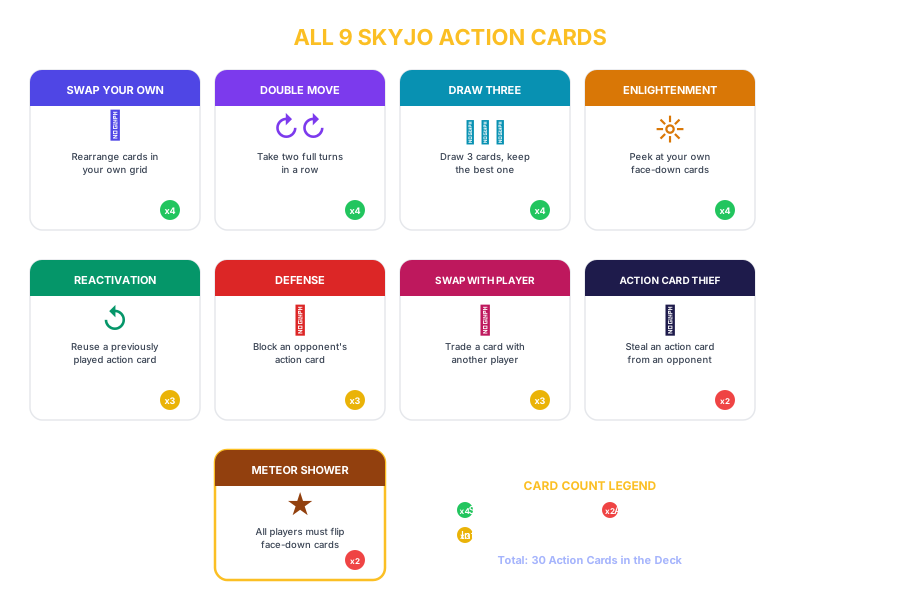
Quick Facts: SKYJO Action Cards at a Glance
| Feature | Details |
|---|---|
| Total Action Cards | 30 cards in the action deck |
| Unique Types | 9 different action card types |
| Point Value | 10 points each (if unplayed at round end) |
| How to Get Them | Activate a Star Card to draw from the action deck |
| Face-Up Display | 4 action cards visible at all times |
| Beginner Tip | Remove Action Card Thief & Meteor Shower for first games |
| When to Play | On your turn, before or after your main action |
| Can Be Blocked? | Yes — with the Defense action card |
What Are Action Cards in SKYJO Action?
Action cards are the defining feature that separates SKYJO Action from the original SKYJO card game. While classic SKYJO is purely about drawing, swapping, and revealing number cards to achieve the lowest score, SKYJO Action introduces 30 action cards spread across 9 unique types that add tactical depth, player interaction, and unpredictable twists to every round.
These action cards form their own separate deck, shuffled independently from the playing cards. During setup, four action cards are placed face-up in the center of the table, creating a visible "market" that all players can choose from. The remaining action cards stay in a face-down pile.
Action cards are worth 10 points each if they remain in your hand at the end of a round. Since the goal is to have the lowest score, you want to play your action cards before the round ends — or avoid collecting too many.
Players earn action cards by activating Star Cards (the joker/wild cards mixed into the playing deck). When a star card is revealed or activated, the player gets to choose one of the four face-up action cards or draw blindly from the top of the action deck. This creates a strategic decision: do you want a known card with a specific power, or gamble on something potentially better?
How Do You Get Action Cards?
Unlike number cards that you draw every turn, action cards require a specific trigger. Here is the step-by-step process for obtaining action cards in SKYJO Action:
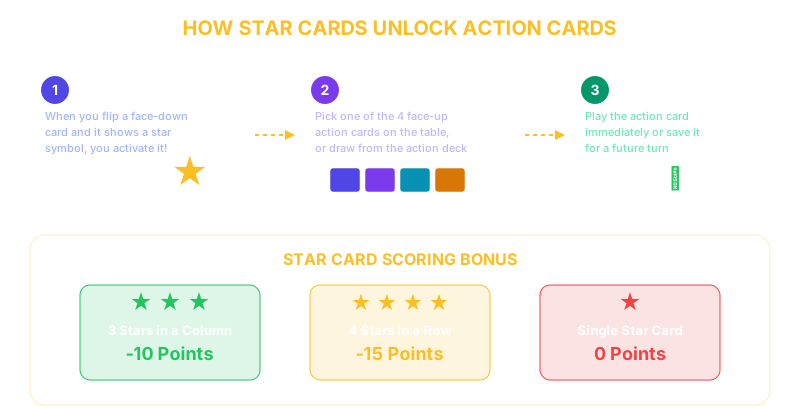
Reveal a Star Card
When you flip a face-down card in your grid and it shows a star symbol, or when you swap a card and reveal a star, the star card activates.
Choose Your Action Card
Pick one of the 4 face-up action cards displayed in the center, or draw the top card from the face-down action deck for a surprise.
Play or Save It
You can play the action card immediately for its effect, or hold it in your hand to use on a future turn. But remember: unplayed cards cost 10 points!
All 9 SKYJO Action Cards Explained
Below is the complete breakdown of every action card in SKYJO Action, including how many copies exist, exactly what each card does, and strategic tips for when to play them.
1. Swap Your Own Cards
4 copies in deckWhat It Does
Allows you to swap the positions of two cards within your own 4x3 grid. You can swap any two cards — face-up, face-down, or one of each. The cards do not change their face-up/face-down status; they simply switch positions.
When to Play It
- When you need to align matching numbers into the same column for elimination
- When you have two matching face-up cards in different columns and want to create a triplet
- Early game when rearranging can set up future column matches
Strategy Tip
This card is most powerful when you already have two matching numbers visible and need to move one into position to complete a column of three. Completing a column removes all three cards and their points from your score.
2. Double Move
4 copies in deckWhat It Does
Grants you two complete turns in a row. After playing this card, you take your normal turn and then immediately take a second full turn before play passes to the next player. Each turn follows the standard rules — draw, swap or discard, and optionally flip a card.
When to Play It
- When you are close to ending the round and want to flip your last cards quickly
- When the discard pile has a card you need and you want to grab it plus take another action
- Late game when every turn counts toward finishing first
Strategy Tip
Double Move is one of the most powerful cards in the game. Save it for the endgame when you want to close out the round before opponents can improve their scores. Two consecutive turns can be the difference between winning and losing a round.
3. Draw Three Cards
4 copies in deckWhat It Does
Draw three cards from the top of the playing card deck. Look at all three privately, then choose one to swap into your grid (replacing any card in your layout). The other two cards are placed on the discard pile. If none of the three cards are useful, you may discard all three instead.
When to Play It
- When you need a specific low number to complete a column match
- When the discard pile has nothing useful and you want better odds from the draw pile
- Mid-game when you still have high-value cards to replace
Strategy Tip
Drawing three cards triples your chances of finding a low-value card or a matching number. This is especially valuable when you need a specific number (like a 2 or 3) to complete a column elimination. The math works in your favor — three chances instead of one.
4. Enlightenment
4 copies in deckWhat It Does
Allows you to secretly peek at one or more of your own face-down cards without revealing them to other players. You look at the cards, memorize their values, and place them back face-down in the same positions. Other players do not see what you looked at.
When to Play It
- Early game when most of your cards are still face-down
- Before deciding whether to swap a drawn card — knowing what is hidden helps you decide
- When you suspect a face-down card might be low and want to confirm before the round ends
Strategy Tip
Information is power in SKYJO Action. Knowing your hidden cards lets you make smarter swap decisions for the rest of the round. Use Enlightenment early to plan your entire strategy — if you discover a hidden -2, you know to protect that position.
5. Reactivation
3 copies in deckWhat It Does
Lets you reuse any previously played action card from the discard pile. Choose one action card that has already been played (by you or any other player) and activate its effect again. The reactivated card goes back to the action discard pile after use.
When to Play It
- When a powerful card like Double Move has already been played and you want its effect again
- When the action discard pile contains the perfect card for your current situation
- Late game when you need one more specific action to close out the round
Strategy Tip
Reactivation is essentially a wildcard — it can become any action card that has been played before. Its value increases as the game progresses and more powerful cards accumulate in the discard pile. Save it for when you can copy a high-impact card like Double Move or Draw Three.
6. Defense
3 copies in deckWhat It Does
Allows you to block any action card played against you by another player. When an opponent plays a card that targets you (such as Swap With Player, Action Card Thief, or Meteor Shower), you can immediately play Defense to cancel its effect entirely. The blocked card is discarded without taking effect.
When to Play It
- When an opponent tries to swap one of your low-value cards with their high-value card
- When someone plays Meteor Shower and you have many face-down cards you want to protect
- When Action Card Thief targets your best held action card
Strategy Tip
Defense is a reactive card — you cannot play it on your own turn proactively. Hold it as insurance against devastating plays. Its mere presence in your hand (if opponents know you have it) can deter them from targeting you, creating a psychological advantage.
7. Swap Cards With Another Player
3 copies in deckWhat It Does
Lets you swap one card from your grid with one card from another player's grid. You can choose any card in your layout (face-up or face-down) and exchange it with any card in an opponent's layout. Both cards retain their face-up or face-down status after the swap.
When to Play It
- When you have a high-value face-up card (like 11 or 12) and an opponent has a visible low card
- When you want to disrupt an opponent who is close to completing a column match
- When you can trade a known bad card for an opponent's known good card
Strategy Tip
This is both offensive and defensive. Offensively, dump your worst card onto an opponent. Defensively, steal their best visible card. The best play is swapping your face-up 12 for their face-up 0 or -2. Be aware that opponents with Defense cards can block this.
8. Action Card Thief
What It Does
Allows you to steal one action card from another player's hand. Choose any opponent who is holding action cards and take one of their cards for yourself. If the targeted player has multiple action cards, they choose which one to give up (unless house rules specify otherwise).
When to Play It
- When you know an opponent is holding a powerful card like Double Move or Defense
- When an opponent has accumulated multiple action cards (reducing their options and adding to yours)
- Late game when stealing a Defense card leaves an opponent vulnerable
Strategy Tip
Action Card Thief is a high-risk, high-reward card. It is recommended for experienced players only. The best time to use it is when you can identify what an opponent is holding based on what they picked from the face-up display. Stealing a Defense card right before you play Swap With Player is a devastating combo.
Beginner Note: The official rules recommend removing this card for your first few games until all players are comfortable with the base mechanics.
9. Meteor Shower
What It Does
All players (including you) must immediately flip one or more of their face-down cards face-up. This is a global effect that impacts every player at the table simultaneously. The revealed cards cannot be swapped or hidden again — they stay face-up for the rest of the round.
When to Play It
- When you have few face-down cards remaining (minimizing your own risk)
- When opponents have many hidden cards and you want to expose their high-value cards
- When you already know your face-down cards (via Enlightenment) and they are low values
Strategy Tip
Meteor Shower is the most chaotic card in the game. The ideal time to play it is when you have already revealed most of your cards (so you are barely affected) while opponents still have many unknowns. Combining Enlightenment + Meteor Shower is a powerful sequence: peek at your cards first, confirm they are low, then force everyone to reveal.
Beginner Note: Like Action Card Thief, this card is recommended to be removed for introductory games. Add it once players understand the base game flow.
Action Card Comparison Table
Here is a side-by-side comparison of all 9 action cards, showing their key attributes at a glance:
| Card Name | Copies | Target | Timing | Difficulty | Impact |
|---|---|---|---|---|---|
| Swap Your Own | 4 | Self | Your turn | Easy | Medium |
| Double Move | 4 | Self | Your turn | Easy | High |
| Draw Three | 4 | Self | Your turn | Easy | High |
| Enlightenment | 4 | Self | Your turn | Easy | Medium |
| Reactivation | 3 | Self | Your turn | Medium | High |
| Defense | 3 | Self (reactive) | Any time | Easy | High |
| Swap With Player | 3 | Opponent | Your turn | Medium | High |
| Action Card Thief | 2 | Opponent | Your turn | Hard | High |
| Meteor Shower | 2 | All players | Your turn | Hard | Very High |
Action Card Strategy Tier List
Not all action cards are created equal. Here is our tier ranking based on competitive play impact and versatility:
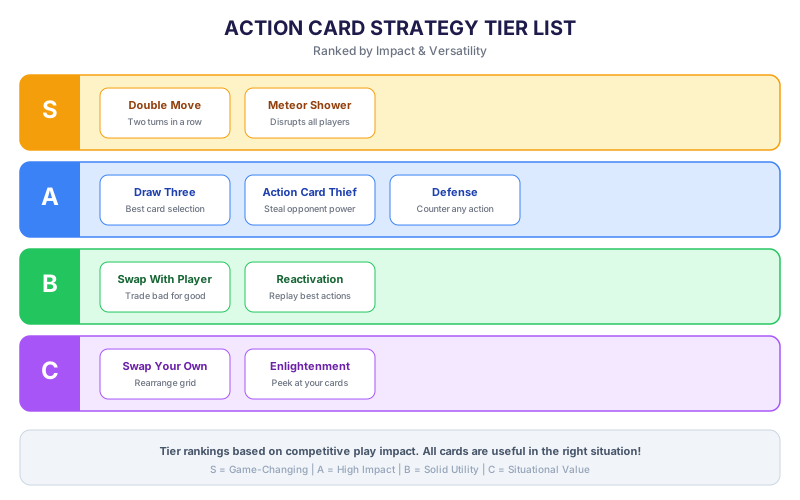
S-Tier: Game Changers
- Double Move — Two turns in a row gives you unmatched tempo advantage. Can close out rounds before opponents react.
- Meteor Shower — Forces all players to reveal cards simultaneously. Devastating when you have few face-down cards left.
A-Tier: High Impact
- Draw Three — Triple your odds of finding the perfect card. Consistent value every time you play it.
- Action Card Thief — Steals opponent resources while gaining them yourself. Two-for-one advantage.
- Defense — The only reactive card. Prevents devastating plays and creates psychological pressure.
B-Tier: Solid Utility
- Swap With Player — Direct card exchange with opponents. High ceiling but can be blocked by Defense.
- Reactivation — Flexible wildcard that copies any previously played action. Value scales with game length.
C-Tier: Situational Value
- Swap Your Own — Useful for column alignment but does not directly improve your card values.
- Enlightenment — Information is valuable but does not change the board state. Best in early game.
Top 7 Strategy Tips for Using Action Cards
Mastering action cards is what separates casual SKYJO Action players from consistent winners. Here are the most important strategic principles:
Play Action Cards Before the Round Ends
Every unplayed action card in your hand costs you 10 points at round end. Even if the timing is not perfect, playing a card for partial value is almost always better than eating a 10-point penalty. The only exception is Defense — holding it as insurance can save you more than 10 points.
Combine Enlightenment with Swap Decisions
Play Enlightenment early to peek at your face-down cards. This information lets you make better swap decisions for the rest of the round. If you discover a hidden -2 or 0, you know to protect that position. If you find a hidden 12, you know exactly which card to replace next.
Save Double Move for the Endgame
Double Move is most powerful when the round is about to end. Taking two consecutive turns lets you flip your last cards and end the round before opponents can improve their positions. This is especially devastating if you have a low score and opponents still have high face-down cards.
Track What Action Cards Have Been Played
Pay attention to the action card discard pile. If you hold Reactivation, knowing which powerful cards are available to copy is crucial. Also, if all Defense cards have been played, you know opponents cannot block your Swap With Player or Meteor Shower.
Use Swap With Player Aggressively
Do not just use this card defensively. If an opponent has a visible -2 or 0, and you have a visible 10+, make the swap immediately. The point swing of 12+ points in a single play is enormous. Just be aware of Defense cards in opponents' hands.
Do Not Hoard Action Cards
Holding more than 2 action cards at once is risky. If the round ends suddenly (another player flips their last card), you are stuck with 10 points per unplayed card. One or two cards in hand is the sweet spot — enough options without excessive risk.
Combo Cards for Maximum Impact
The strongest plays combine multiple action cards in sequence. Enlightenment + Meteor Shower (peek first, then force reveals). Action Card Thief + Swap With Player (steal their Defense, then swap freely). Double Move + Draw Three (two turns of triple-draw power).
Pros & Cons of Action Cards in SKYJO Action
Action cards fundamentally change the SKYJO experience. Here is an honest assessment of what they add and what challenges they introduce:
✓ Pros
- ● More strategic depth — Action cards reward planning, timing, and reading opponents
- ● Increased player interaction — Cards like Swap With Player and Meteor Shower create memorable moments
- ● Higher replayability — Each game plays differently depending on which action cards appear
- ● Comeback potential — A well-timed action card can turn a losing position into a winning one
- ● Scalable complexity — Remove advanced cards for beginners, add them back for experienced groups
- ● Faster endgames — Double Move and Draw Three help close out rounds efficiently
✗ Cons
- ● Steeper learning curve — Nine different card types to memorize can overwhelm new players
- ● More randomness — Lucky action card draws can sometimes override skillful play
- ● Longer game time — Action cards add decisions and interactions that extend each round
- ● Targeting can feel unfair — Swap With Player and Action Card Thief can frustrate targeted players
- ● 10-point penalty risk — Collecting action cards you cannot play before round end hurts your score
- ● Analysis paralysis — More options per turn can slow down decision-making for some players
Beginner Setup vs. Full Game: Which Cards to Use
The official SKYJO Action rules recommend a graduated approach to introducing action cards. This is especially helpful when playing with mixed groups that include both experienced gamers and newcomers.
7 Action Cards (Remove 2)
For your first 2-3 games, remove the following cards from the action deck:
- ✗ Action Card Thief (2 cards removed)
- ✗ Meteor Shower (2 cards removed)
This leaves 26 action cards with 7 types — enough variety without overwhelming complexity.
All 9 Action Cards (30 total)
Once all players are comfortable with the base mechanics, add back:
- ✓ Action Card Thief (adds hand disruption)
- ✓ Meteor Shower (adds global chaos)
The full 30-card action deck provides maximum strategic depth and player interaction.
Some groups also remove Defense cards for the very first game to keep things simple. This means no blocking — every action card played takes effect. Add Defense back in game two once players understand the basic flow.
Frequently Asked Questions About SKYJO Action Cards
How many action cards are in SKYJO Action? ▼
There are 30 action cards in total, spread across 9 unique types. Four types have 4 copies each (Swap Your Own, Double Move, Draw Three, Enlightenment), three types have 3 copies each (Reactivation, Defense, Swap With Player), and two types have 2 copies each (Action Card Thief, Meteor Shower). These form a separate action deck that is shuffled independently from the playing cards.
How do you get action cards during the game? ▼
You get action cards by activating Star Cards. When a star card in your grid is revealed (either by flipping it face-up or through certain game actions), you earn the right to take one action card. You can choose from the 4 face-up action cards displayed in the center of the table, or draw blindly from the top of the action deck.
What happens if you do not play your action cards before the round ends? ▼
Each unplayed action card in your hand at the end of a round costs you 10 points. Since the goal of SKYJO Action is to have the lowest score, holding action cards is risky. You should try to play them before the round ends, even if the timing is not ideal. The 10-point penalty makes hoarding action cards a losing strategy.
Can you play multiple action cards on the same turn? ▼
Generally, you can play one action card per turn in addition to your normal turn action (drawing and swapping/discarding). However, the Defense card is special — it can be played reactively at any time when an opponent targets you, even if it is not your turn. This makes Defense the only card that can be played outside your normal turn sequence.
Can Defense block Meteor Shower? ▼
Yes! When a player plays Meteor Shower, any player who holds a Defense card can play it to protect themselves from the effect. The player who uses Defense does not have to flip any cards, while all other players (who do not play Defense) must still reveal their face-down cards. This makes Defense especially valuable when Meteor Shower is in the game.
What is the best action card in SKYJO Action? ▼
Double Move is widely considered the strongest action card because it gives you two full turns in a row. This tempo advantage is especially powerful in the endgame when you can close out the round before opponents improve their scores. However, the "best" card depends on the situation — Defense is invaluable when opponents are targeting you, and Draw Three provides consistent value throughout the game.
Should beginners use all 9 action cards? ▼
No. The official rules recommend that beginners remove Action Card Thief and Meteor Shower for their first few games. These two cards are the most complex and can create confusing situations for new players. Start with the 7 simpler action card types, then add the advanced cards once everyone is comfortable with the base mechanics.
How do Star Cards relate to Action Cards? ▼
Star Cards are the gateway to action cards. They are mixed into the playing deck (not the action deck) and serve two purposes: (1) When activated, they let you draw an action card, and (2) They act as wild/joker cards that can match any number in their column or row for elimination purposes. A column of 3 star cards scores -10 points, and a row of 4 star cards scores -15 points.
Can you use Reactivation to copy another player's action card? ▼
Yes! Reactivation lets you copy any action card in the discard pile, regardless of who originally played it. This means if an opponent played Double Move three turns ago, you can use Reactivation to get the same effect. The copied card does not leave the discard pile — Reactivation simply duplicates its effect for one use.
What is the difference between SKYJO and SKYJO Action cards? ▼
The original SKYJO has no action cards at all — it only contains 150 number cards ranging from -2 to 12. SKYJO Action adds 30 action cards (9 types) and 8 star cards to the mix, creating a more strategic and interactive experience. SKYJO Action is backwards compatible: you can remove the action and star cards to play it as classic SKYJO.
Watch: How SKYJO Action Cards Work
See the action cards in play with this helpful video tutorial that walks through each card type and demonstrates real gameplay scenarios:
Video: SKYJO Action gameplay tutorial showing action card mechanics in practice.
Complete Card Count Breakdown
Understanding how many copies of each action card exist in the deck helps you calculate probabilities and plan your strategy. Here is the full breakdown:
| Card Type | Copies | % of Deck | Category |
|---|---|---|---|
| Swap Your Own Cards | 4 | 13.3% | Self-Improvement |
| Double Move | 4 | 13.3% | Self-Improvement |
| Draw Three Cards | 4 | 13.3% | Self-Improvement |
| Enlightenment | 4 | 13.3% | Information |
| Reactivation | 3 | 10.0% | Utility |
| Defense | 3 | 10.0% | Protection |
| Swap With Player | 3 | 10.0% | Interaction |
| Action Card Thief | 2 | 6.7% | Disruption |
| Meteor Shower | 2 | 6.7% | Global Effect |
| TOTAL | 30 | 100% | — |
With 4 face-up action cards displayed at all times, you can see 13.3% of the action deck at any moment. This means roughly 1 in 7.5 cards in the deck is visible, giving you useful information for planning which star cards to activate and when.
Action Cards vs. Star Cards: Understanding the Difference
New players often confuse action cards with star cards. While they work together, they are fundamentally different card types with distinct roles:
| Feature | Action Cards | Star Cards |
|---|---|---|
| Location | Separate action deck | Mixed into playing deck |
| Total Count | 30 cards (9 types) | 8 cards |
| Point Value | 10 points (penalty if unplayed) | 0 points (or -10/-15 in sets) |
| Primary Function | Special abilities and effects | Wild cards + action card trigger |
| Placed In Grid? | No — held in hand | Yes — part of your 4x3 layout |
| Relationship | Earned via star cards | Triggers action card draws |
Ready to Master SKYJO Action Cards?
Now that you know all 9 action cards inside and out, it is time to put your knowledge to the test. Grab a copy of SKYJO Action and start playing with the full action deck!
SKYJO Action by Magilano | 2-8 Players | Ages 8+ | 30-45 Minutes

Loading comments...